
Autumn Budget 2026: 12 Examples of What It Means for You

On Wednesday 28 October 2026, Chancellor John Healey delivered the Autumn Budget — and within hours, the same question was everywhere: what does it actually mean for me? The headlines give you rates and billions. This guide gives you people. Below are 12 examples, one for each kind of household the Budget touches most, showing the measure, what it works out at in pounds, and the one move to make. If you want the full plan behind these examples, read our guide to adjusting your budget after the Autumn Budget 2026 — it turns the same announcements into a 7-step plan — and our pre-Budget preparation guide, which explains the tax code, ISA and debt checks these examples build on.
A note on the numbers, so nothing here misleads you. Every Budget measure below is an announced figure. Where an example works a figure out for a made-up person — say, a worker on 37.5 hours a week — it is labelled "Example", because your hours, tax code and bills will differ. Nothing here is personal financial advice: tax rules depend on your circumstances and can change, and for a big decision such as a pension or a house purchase, check the official sources at the end or speak to a qualified adviser.
How to read these examples
Every example follows the same shape: who it is about, what changed in the Budget, an Example that works the figure out, and what to do about it. Dates matter more than headlines here, so keep this timeline in mind: the £100 energy payment arrives from January 2027; most tax, pay and pension changes start on 6 April 2027; electricity VAT relief and the fuel duty cut run until July 2027; gas standing charges go by the end of 2027; and the first-home and pension changes stretch out to 2029 and beyond. If your example's date has not arrived yet, the move is to prepare now, not to act in a panic.
The 12 examples
Example 1: The household in council tax band B — the £100 energy payment
What changed: from January 2027, a £100 Household Energy Payment goes to up to 20 million households in council tax bands A to D in England, as part of a £2.6 billion support package. It is paid towards winter energy costs, and it is the Budget's most direct piece of help: cash for bills, on a fixed date, for a defined group.
Example: imagine a household in band B whose January electricity and gas bill comes to £150. The £100 payment covers two-thirds of that month's bill — not the whole winter, but the coldest month made noticeably cheaper. The payment is per household, not per person, so a shared house does not get £100 each.
What to do: check your council tax band on your council's website — it takes two minutes and it decides whether this payment applies to you. When it arrives, leave it against your energy account or set it aside for winter bills, rather than letting it dissolve into everyday spending. If a winter bill still worries you, our guide to winter energy bills and the price cap explains tariffs, support and the standing-charge change in plain terms.
Example 2: The saver with cash outside an ISA — savings tax rises
What changed: from 6 April 2027, tax on savings income rises to 24% for basic-rate taxpayers, 44% for higher-rate taxpayers and 49% for additional-rate taxpayers. Your personal savings allowance does not change: £1,000 of savings interest tax-free for basic-rate taxpayers, £500 for higher-rate taxpayers and £0 for additional-rate taxpayers. The allowance is the tax-free slice; anything above it is taxed at the new rates.
Example: take a basic-rate taxpayer with £1,800 of savings interest in a year. The first £1,000 sits inside the allowance and is not taxed. The remaining £800 is taxed at 24%, which is £192 of tax. If the same person's interest were £900, below the allowance, the new rates would not touch them at all — which is why this example starts with your own interest figure, not with the headline rate.
What to do: list every savings account you hold, note which are ISAs and which are taxable, and work out whether your yearly interest sits above your allowance. If it does, the months before April 2027 are the time to review where that money sits — and Example 6 explains why a Cash ISA is part of that review.
Example 3: The worker aged 21 or over on the minimum wage — £13.21 an hour
What changed: from April 2027, the National Living Wage rises by 3.9% to £13.21 an hour for workers aged 21 and over. It is the largest single pay change in the Budget for lower-paid workers, and it lands in the April pay packet, not in November.
Example: a worker aged 21 or over on £13.21 working 37.5 hours a week would earn £495.38 a week before tax and other deductions (37.5 × £13.21), or roughly £2,147 a month gross. That is a gross figure, not take-home pay — tax, National Insurance and pension contributions all come off first — but it shows why the move below matters: a rise that is never written into a budget tends to vanish into small daily spending.
What to do: check your April payslip against your age band and your hours, and decide now where any increase goes — debt, savings or bills — before it arrives. Our guide to budgeting on the National Living Wage shows how to build a monthly plan around the new rate, including how to check you are actually being paid it.
Example 4: The 18-year-old worker — £11.27 an hour
What changed: the same April 2027 rise lifts the National Minimum Wage for 18 to 20 year olds to £11.27 an hour, and the rate for under-18s and apprentices to £8.31 an hour. Young workers are often the least likely to check a payslip line by line, and the most likely to be paid the wrong rate by mistake.
Example: an 18-year-old working 30 hours a week at £11.27 would earn £338.10 a week before deductions (30 × £11.27). An apprentice on the same hours at £8.31 would earn £249.30 a week. The gap between those two figures is exactly why the age band on your payslip matters: same hours, same job title, different legal minimum.
What to do: confirm your age band, your hours and your rate on your next payslip, and keep a note of your hours each week. If the rate looks wrong, raise it with your employer first — most underpayments are payroll errors, not arguments — and keep your payslips as evidence.

Example 5: The first-time buyer with a Lifetime ISA — penalty cut to 20%
What changed: the Lifetime ISA withdrawal penalty falls from 25% to 20% for qualifying first-home purchases above the £450,000 price cap. The change applies from 29 October 2026, and it matters most in higher-priced areas, where buyers previously faced the full 25% penalty on withdrawing for a home over the old cap.
Example: on a £20,000 Lifetime ISA withdrawal for a qualifying purchase, the old 25% penalty would have been £5,000; the new 20% penalty is £4,000 — £1,000 less kept back. That is a real saving, but it is not a reason to buy a more expensive home: a lower penalty on a purchase you cannot afford is still a bad purchase.
What to do: do not close a Lifetime ISA on Budget-week excitement. A new First-Time Buyer ISA replaces it for new savers from April 2029, paying a 25% bonus on up to £4,000 a year — but that is for new savers, and your existing account has its own rules. Match the route to your buying date, and for a purchase this large, talk to a qualified mortgage adviser before moving deposit savings.
Example 6: The Cash ISA saver — the £20,000 allowance stays
What changed: the widely feared cut to the Cash ISA allowance did not happen. The plan to cap it at £12,000 for under-65s was scrapped, so the allowance stays at £20,000 a year. For ordinary savers, this is the Budget's best piece of good news, because interest inside an ISA is not taxed at all.
Example: imagine £15,000 sitting in an ordinary taxable savings account. Move it into a Cash ISA and the interest it earns sits inside the tax-free wrapper — outside the new 24%, 44% and 49% savings rates entirely. The allowance is per tax year, so money moved before 5 April 2027 uses this year's allowance; money moved after that date uses next year's.
What to do: check how much of your £20,000 allowance you have used this tax year, and compare Cash ISA accounts on access as well as rate — a top rate you cannot touch when you need the money is not a top rate for you. And do not confuse this with Example 2: the ISA shelters interest from tax, but it does not raise the rate your bank pays.
Example 7: The side hustler — trading allowance rises to £3,000
What changed: from April 2027, the trading allowance rises from £1,000 to £3,000. It covers small trading and miscellaneous income — selling things, casual freelance work, small services — and it means more side income can be earned without the extra tax admin that used to kick in above £1,000.
Example: £2,500 of side income in a year sits comfortably inside the new £3,000 allowance. Under the old £1,000 allowance, £1,500 of that same income would have needed more attention. The allowance removes a burden, not the need to know your own numbers — and it does not change the tax position of larger side incomes above £3,000.
What to do: start a simple log now — what you earned, when, and from whom — so that April 2027's higher allowance works for you from day one. If you are building side income from scratch, our guide to making extra money in the UK lists 15 real side hustles with the same record-keeping habit at the core.
Example 8: The pensioner on the full State Pension — protected from tax
What changed: two pension measures arrive together in April 2027. The full new State Pension rises by 3.9% to £250.70 a week, and a new Pension Tax Allowance means pensioners whose total income is no more than the full new State Pension pay no income tax on it. A Triple Lock adjustment is planned from April 2030, but that is a later change, not an April 2027 one.
Example: £250.70 a week is £13,036.40 a year (52 × £250.70). A pensioner whose only income is the full new State Pension therefore sits inside the new allowance and pays no income tax on it. A pensioner with a private pension on top needs to add the two together: it is total income, not each pension separately, that decides whether the allowance covers them.
What to do: add up every income source — State Pension, private pensions, savings interest — and compare the total with the full new State Pension figure. Keep pension details and beneficiaries up to date, and get qualified advice before changing any pension arrangement: the inheritance tax change for unused pension funds, also from April 2027, matters for larger pots and estate planning, not for day-to-day pensioner budgeting.

Example 9: The driver — fuel duty held and mileage rates improved
What changed: two driving measures help in different ways. The 5p fuel duty cut is kept until July 2027, and the mileage allowance improves: the 55p rate for the first 10,000 business miles is now permanent, and above 10,000 miles the rate rises from 25p to 35p from 6 April 2027.
Example: a driver doing 12,000 business miles in a year would claim 10,000 miles at 55p (£5,500) plus 2,000 miles at 35p (£700) — £6,200 in total. Under the old above-10,000 rate of 25p, those last 2,000 miles would have been worth £500, so the change is worth £200 on this example. The fuel duty cut is separate: it holds pump prices 5p a litre lower than they would otherwise be until July 2027.
What to do: log your miles from now — a phone note with the date, destination and miles is enough — so that when the new rate starts, your claim is already complete. And do not let cheaper driving quietly become more driving: the saving only helps your budget if it stays saved.
Example 10: The landlord — property income taxed at the new rates
What changed: from 6 April 2027, property income is taxed at the same new rates as savings income: 24% for basic-rate taxpayers, 44% for higher-rate taxpayers and 49% for additional-rate taxpayers. This covers rental income, including a single room or a small flat — not just professional landlords.
Example: a basic-rate landlord with £6,000 of rental income in a year would pay £1,440 at the new 24% rate, compared with £1,200 at the old 20% basic rate — £240 more. That is before any allowable expenses or reliefs, which depend on the property and the landlord's circumstances, so treat it as the shape of the change, not as your own tax bill.
What to do: review your rental records before April 2027: what you earned, what you spent on the property, and what reliefs apply to you. Clean records are the difference between a smooth April and a stressful one, and for anything beyond a single straightforward letting, a qualified tax adviser is worth the fee.
Example 11: The household watching energy bills — VAT held and standing charges going
What changed: electricity VAT stays at 0% until July 2027 (it has been 0% since 1 October 2026), and gas standing charges are to be removed by the end of 2027, or as soon as possible after that, with the cost recovered through unit rates. These are bill-structure changes, not payments: they change what each unit costs and what the daily charge looks like, rather than handing you cash.
Example: on every £105 of electricity that would carry 5% VAT, the tax would be £5; at 0% VAT, that £5 disappears — a £5 saving per £105 of electricity. The standing-charge removal works differently: the daily charge goes, but unit rates absorb some of the cost, so the saving is real but smaller than the standing charge alone suggests. Do not expect either change to halve a bill.
What to do: do not switch supplier or fix a tariff in a panic because of Budget headlines. Compare tariffs calmly when your current deal ends, and read the unit rate and the standing charge together — a tariff with no standing charge and a high unit rate can cost more than one with both, depending on how much you use.
Example 12: The middle earner — frozen thresholds quietly take more
What changed: headline income tax rates are unchanged — and that is precisely the catch. Income tax thresholds remain frozen until 2031, so a normal pay rise can quietly push more of your income into tax, even though no rate went up. This is the Budget change that affects the most people while appearing in the fewest headlines.
Example: with the personal allowance frozen at £12,570, every £1,000 of pay rise above that allowance adds £200 of tax at the basic rate. A £3,000 rise over three years therefore adds £600 of yearly tax at the basic rate, before National Insurance and pension contributions — not because any rate rose, but because the threshold did not move with your pay.
What to do: rebuild your budget around take-home pay, not headline pay, and check your tax code every year. If you have never built a monthly budget from scratch, our beginner's guide to budgeting money walks through the first-month setup — and if debt is eating the rise before you see it, our guide to paying off debt fast sets out the highest-interest-first order.
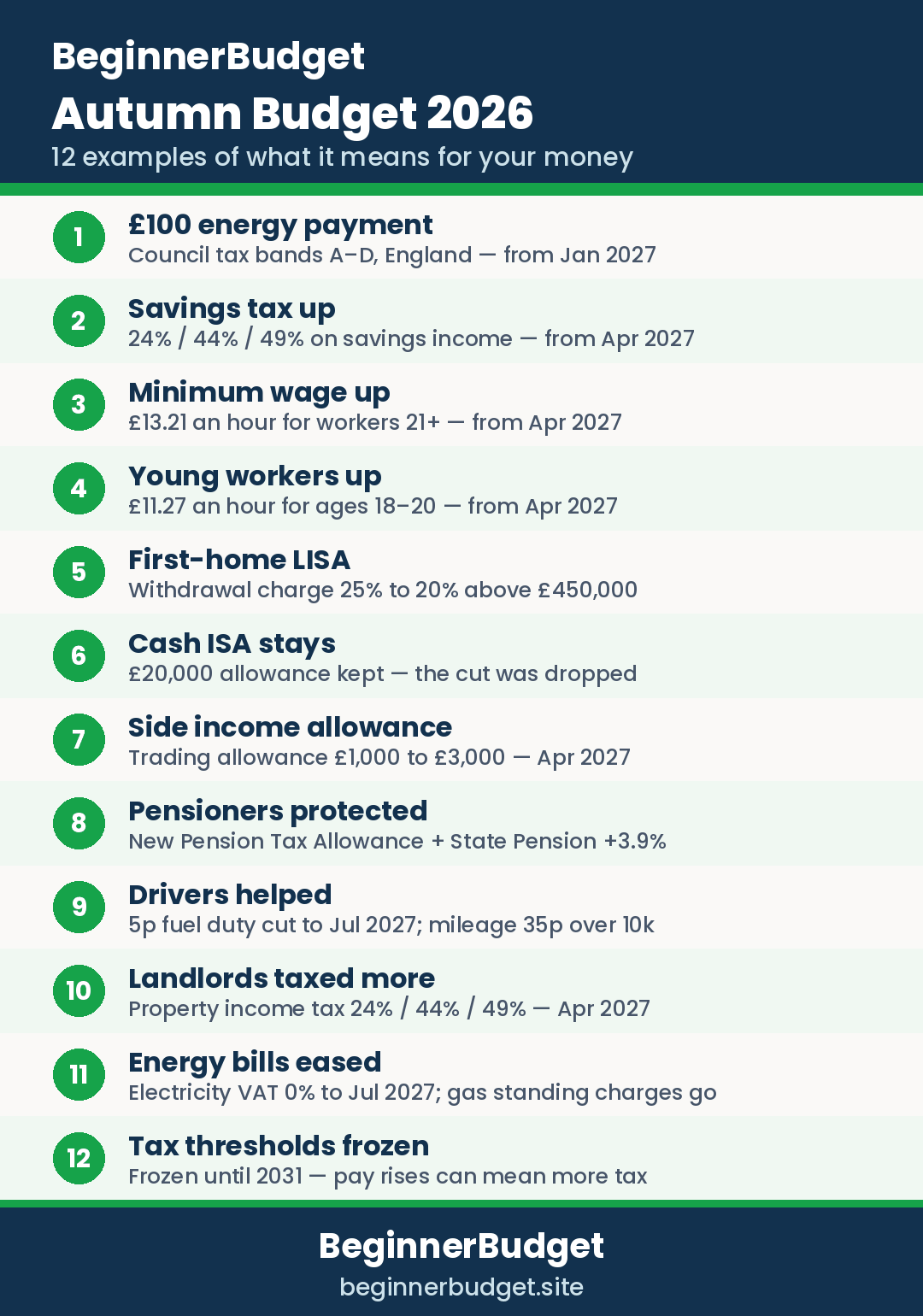
All 12 at a glance: the infographic
If you only remember one thing from this guide, make it this picture. Every example above, reduced to its figure and its date, in one place — save it, share it, or pin it where you plan your monthly budget.
What to check this week
Five checks, none of them longer than a few minutes, and all of them worth doing before the April 2027 changes arrive:
- Your council tax band — it decides whether the £100 winter payment applies to your household.
- Your April payslip — age band, hours and rate, especially if you are on or near the minimum wage.
- Your savings list — which accounts are ISAs, which are taxable, and whether your interest sits above your personal savings allowance.
- Your side-income log — what you earned, when, and from whom, ready for the £3,000 trading allowance.
- Your pension details — contribution rate, employer match, and beneficiaries, all up to date.
3 mistakes to avoid
Mistake 1: Moving savings before the new rates even start. The savings tax rates change on 6 April 2027, not in November 2026. Shuffling accounts in a panic now — especially into products you do not understand — can cost you access, bonuses or flexibility for no benefit. Compare calmly, and move money once, with the new rules in front of you.
Mistake 2: Spending the wage rise and the £100 before they arrive. A National Living Wage rise in April and a £100 energy payment in January only help if they are planned for. Assign both in advance — to debt, to savings, or to winter bills — and the Budget actually changes your year.
Mistake 3: Copying someone else's Budget response. A landlord's property-tax plan, a higher-rate taxpayer's ISA shuffle, or a first-time buyer's equity decision may be exactly right for them and completely wrong for you. Your tax band, your savings allowance, your debts and your buying date are yours alone. Run the 12 examples on your own numbers.
Frequently asked questions
When was the Autumn Budget 2026 delivered?
Wednesday 28 October 2026, by Chancellor John Healey. Most of its household measures start in April 2027, with the winter energy payment arriving earlier, from January 2027.
Will I get the £100 winter energy payment?
It goes to up to 20 million households in council tax bands A to D in England, from January 2027, as part of a £2.6 billion Household Energy Payment. Check your council tax band to confirm whether your household is included.
What are the new savings tax rates?
From 6 April 2027, savings income is taxed at 24% for basic-rate taxpayers, 44% for higher-rate taxpayers and 49% for additional-rate taxpayers. Your personal savings allowance is unchanged: £1,000 for basic-rate taxpayers, £500 for higher-rate taxpayers and £0 for additional-rate taxpayers.
What is the National Living Wage from April 2027?
£13.21 an hour for workers aged 21 and over, £11.27 an hour for 18 to 20 year olds, and £8.31 an hour for under-18s and apprentices — a rise of 3.9%.
Did the Cash ISA allowance fall to £12,000?
No. The planned cut to £12,000 for under-65s was scrapped, so the Cash ISA allowance stays at £20,000 a year.
Is this financial advice?
No. This article is general financial education, not personal financial advice. Tax rules depend on your circumstances and can change. For decisions about your own money, check the official sources below or speak to a qualified adviser.
Official sources to verify: MoneyHelper — free, impartial money guidance, Ofgem — the energy regulator, StepChange — free debt advice.
Your next step this week
Do three things before the weekend, and the Budget is handled: first, check your council tax band and your April payslip — the two documents that decide whether the £100 payment and the wage rise apply to you. Second, list your savings accounts and check whether your interest sits above your personal savings allowance. Third, assign any April 2027 increase — pay, payment or allowance — to debt or savings in advance, before it arrives. Everything else in this guide can wait for its date, and that is the point: a Budget is a calendar, not an emergency.