
Black Friday UK vs USA 2026: 7 Price Differences

Same date, different game. Black Friday started in the United States, and the UK borrowed the name — but not the rules. Taxes work differently, returns work differently, and the small print on a US website means something else entirely when the parcel has to cross an ocean. This guide compares the two countries side by side, so you can tell a genuine bargain from a price that only looks cheaper.
Same Day, Different Shape: Dates and Sale Calendars
Let's pin the dates down first, because everything else hangs off them. In 2026, Thanksgiving in the United States falls on Thursday, 26 November. Black Friday follows the next day: Friday, 27 November 2026. The UK uses the same date, even though there is no Thanksgiving here — British retailers simply adopted the American date.
What happens around that date is where the two countries split. In the USA, Black Friday is part of a public-holiday weekend. Many people have the Friday off work, shops open early (some very early), and queues outside stores are still a real thing for the biggest doorbuster deals — the limited-stock offers designed to pull crowds in. That said, the American event has moved heavily online too: most major US retailers now run deals for a full week or more around the weekend, and their weekly adverts and apps show the headline offers days in advance.
In the UK, Black Friday is a retail event, not a holiday. Nobody gets the day off for it, and the in-store crush is much smaller. The British pattern is calmer in shops and heavier online: most major UK retailers run their deals on their websites, often for a full week leading up to the Friday, and some start even earlier in November. For a UK shopper, that is actually an advantage — you can compare prices from your sofa instead of standing in a queue, and you have days, not hours, to check whether a "deal" is real.
Then comes Cyber Monday: Monday, 30 November 2026. It began in the USA as the online follow-up to the in-store weekend, and it is still a bigger deal there than here. UK retailers run Cyber Monday offers too, but treat it mostly as an extension of Black Friday week rather than a separate event. If you miss a Friday deal, Monday is your second chance on both sides of the Atlantic — but don't count on the same item still being in stock.
One practical point falls out of this: the UK sale season is longer and quieter, the US one is shorter and louder. If you like to research before you buy, the UK calendar suits you. If you like the thrill of a doorbuster, the US calendar is built for it.
Where People Actually Shop
The names below are the big stages where most Black Friday spending happens. They are not recommendations — and they are definitely not a list of live deals, which change by the hour. Treat this as a map of where to look, then judge each offer on its own merits.
In the UK, the heaviest Black Friday traffic goes to Amazon UK, Currys, Argos and John Lewis, with the big supermarkets (Tesco, Sainsbury's, Asda) and fashion retailers (Next, Marks & Spencer, ASOS) running their own sale weeks alongside. Electricals, TVs and small appliances dominate the UK conversation, and most of the action is online — even the high-street chains push their best prices through their websites first.
In the USA, the big four are Amazon, Walmart, Best Buy and Target, with Kohl's, Macy's and Costco also running major events. Electronics and TVs dominate here too, but the US adds two things the UK doesn't really have: genuine in-store doorbusters with limited stock, and a much bigger toy and home-goods push aimed at the holiday gift season that starts the same weekend.

Here's the habit that matters on both sides: check the price of the exact item you want before sale week starts. Retailers on both sides of the Atlantic have been caught — and in the UK, penalised — for inflating a "was" price shortly before a sale so the discount looks bigger. A screenshot of today's price is worth more than any percentage badge on the day.
The Price Truth: VAT Included vs Tax Added
This is the single biggest difference between the two countries, and the one that catches cross-border shoppers out most often. It comes down to one question: does the price you see include the tax, or not?
In the UK, the price you see is the price you pay. UK retailers must show prices that include VAT, and the standard VAT rate is 20% for most goods (see GOV.UK's VAT rates). When a UK site says £100, you pay £100 at checkout (plus delivery if the retailer charges it). There is no surprise at the payment step, and comparing two UK prices is a straight like-for-like comparison.
In the USA, the price you see is not the price you pay. The United States has no federal sales tax at all. Sales tax is set state by state — and often city by city on top of that. Forty-five states plus Washington DC charge a statewide sales tax, with base rates running roughly from 4% to 7.25% (California has the highest statewide base rate at 7.25%, per the Tax Foundation's state sales tax rates). Five states — Alaska, Delaware, Montana, New Hampshire and Oregon — charge no statewide sales tax at all, though some Alaskan towns add their own local tax. Local add-ons in other states can push the combined rate well above the state base rate. The result: the same $100 item can cost $104 in one state and $110 or more in another, and you only find out at checkout.
Let's make that concrete with an illustrative example — not a real deal, just the maths:
| Item | UK checkout | US checkout (illustrative 8% combined tax) |
|---|---|---|
| Headphones listed at £100 / $100 | £100 — VAT already inside the price | $108 — $100 plus $8 tax added at checkout |
| TV listed at £500 / $500 | £500 — VAT already inside the price | $540 — $500 plus $40 tax added at checkout |
The 8% in that table is an example rate to show the mechanism, not a claim about any particular state — your actual rate depends on the delivery address. The point is the mechanism: in the UK, tax is baked in; in the USA, it lands on top. Any US "deal" you compare with a UK price needs that checkout total, not the sticker price.
There is one more layer for UK buyers looking at US prices: currency. If you pay in dollars, your bank or card provider converts the payment to pounds, and most cards add a conversion fee on top of the exchange rate. A $100 item at a rough $1.27 to the pound is about £79 before any fees — but the exact figure moves with the rate on the day, and the fee varies by card. Never compare a dollar price with a pound price without converting it first, and check your card's conversion fee before sale week, not after you've clicked buy.
For the wider picture on what things actually cost on each side, our guides to the cost of living in the UK and the cost of living in the USA put these prices in their everyday context.
Changing Your Mind: Returns Rights Compared
You bought it, you don't want it. What happens next depends entirely on which country's law covers your purchase — and the gap here is wide.
In the UK, online buyers have a legal cooling-off right. Under the Consumer Contracts Regulations 2013, goods bought online (or by phone or mail order) from a UK trader can usually be cancelled within 14 days starting the day after delivery — no reason needed, no fault required. Once you've told the seller, you get a further 14 days to send the item back, and the seller must refund you within 14 days of getting it back, including the cost of standard delivery. There are exceptions: personalised or made-to-order items, perishable goods, and sealed items like hygiene products or software once you've opened them don't carry the right. And note the limit: this is a distance-selling right. If you buy in a physical UK shop and simply change your mind, there is no automatic legal right to a refund — whatever the shop offers is its own goodwill policy.
In the USA, there is no federal cooling-off right for ordinary shop or online purchases. Change-of-mind returns are governed by each retailer's own policy, and those policies vary a lot. Some big US chains give you 90 days; some give you 14; some charge a restocking fee (a percentage deducted from your refund) on certain categories like electronics; and sale items sometimes carry different return terms from full-price ones. The policy is usually printed on the receipt or the product page — but you have to go looking for it, because no single law guarantees it. The one exception worth knowing: US federal law does give a 3-day cooling-off right for certain door-to-door and high-pressure sales, but that doesn't cover a normal online or in-store Black Friday purchase.
What does this mean in practice? A UK shopper buying online has a legal safety net that doesn't depend on the retailer's mood. A US shopper's safety net is whatever the store promised — which is often generous at the big chains, but it is a promise, not a right, and it can exclude sale stock. Before you buy on either side, check two things: the return window in days, and whether sale items are treated differently. On a Black Friday purchase, that second question matters more than usual.
When It Arrives Faulty
Faulty goods are a different story from changed minds, and here the UK's protection is notably stronger and clearer.
In the UK, the Consumer Rights Act 2015 sets out a fixed ladder. Goods must be of satisfactory quality, fit for purpose, and as described. If they aren't, your rights run against the retailer who sold you the item — not the manufacturer. The ladder works like this: within the first 30 days from delivery, you have a short-term right to reject faulty goods for a full refund. After 30 days, the retailer gets a chance to repair or replace them, within a reasonable time and without significant inconvenience to you. If that repair or replacement fails, you can claim a price reduction or a final refund. And for the first six months, the law presumes the fault was there at delivery — the retailer has to prove otherwise. You generally have up to six years to bring a claim in England and Wales (five in Scotland). A manufacturer's warranty sits on top of these rights; it can never replace them, and a retailer can't sign them away in small print.
In the USA, there is no single federal ladder like that. Faulty-goods protection comes from a mix of state laws and the manufacturer's warranty terms, plus whatever the retailer offers. Warranties in the USA are mostly written by the manufacturer: they set the length, what counts as a defect, and whether you deal with them or the store. Some states add their own consumer protections (the famous "lemon laws" for cars are the best-known example, but they don't cover TVs and headphones). The practical upshot: for a big-ticket US purchase, read the warranty terms before you buy — how long it runs, who you contact, and whether you pay for shipping a faulty item back. Don't assume the store will sort it just because a UK store would have to.
For the official wording on the UK side, the Consumer Rights Act 2015 on legislation.gov.uk is the source to check, and GOV.UK's guidance on accepting returns and giving refunds explains how the rules work in practice.
Warranties and Grey Imports
One trap catches UK buyers who find a tempting US price: the grey import. That's a genuine product sold outside the manufacturer's official UK distribution channel — for example, a US-model camera or laptop bought from an American site and shipped to Britain.
The item itself may be identical. The warranty often isn't. Manufacturers commonly limit warranty service to the region where the product was sold, which means a US-model item can be refused a free repair in the UK, or you may have to ship it back to the USA at your own expense. Your UK statutory rights against the seller still exist in principle — but enforcing them against a seller in another country is slow, expensive, and sometimes impractical. Before you buy a US model, check two things: whether the manufacturer offers international warranty coverage for that exact model, and whether the seller will handle warranty claims from the UK. If neither answer is yes, the saving needs to be big enough to cover a repair you might have to pay for yourself.
The same caution runs the other way. A UK model bought from Britain and used in the USA can face the same regional warranty limits, plus practical headaches like different power supplies and plugs (US mains power is 120V versus 230V in the UK — check the device's power rating before you buy anything that plugs in).
Keep your proof of purchase either way. A receipt or order confirmation is what turns a warranty claim from an argument into a process, on both sides of the Atlantic.
Ordering From a US Site to the UK
This is where a "cheaper" American price most often stops being cheaper. If you live in the UK and order from a US website, your parcel goes through UK customs, and up to three extra charges can land on it: customs duty, import VAT, and a courier handling fee.
The key number is £135 — the value of the goods alone, not counting postage, packaging or insurance. The rules, per GOV.UK's guidance on tax and customs for goods sent from abroad, work like this:
| Goods value | Customs duty | Import VAT | Handling fee |
|---|---|---|---|
| £135 or less (non-excise goods) | None | Normally charged by the seller or marketplace at checkout (20% standard rate) | Usually none |
| Over £135 | May apply — rate depends on the product type and where it was made (check the UK Trade Tariff) | 20% on the goods plus postage, packaging, insurance and any duty | Charged by the courier (Royal Mail's published fee is £8 per parcel) |
Let's run an illustrative example so the maths is visible. Say you order headphones from a US site for £160 worth of goods, with £20 shipping, and the product's duty rate is 0% (many electronics lines are 0% — but plenty aren't, so check the tariff for your item):
- Goods + shipping = £180. Duty at 0% = £0.
- Import VAT at 20% on £180 = £36.
- Courier handling fee (Royal Mail example) = £8.
- Total extra on top of the $ price you already paid: £44 — before any currency conversion fee from your card.
If the duty rate were, say, 6% instead of 0%, you'd add £10.80 of duty first, and VAT would then be charged on £190.80, not £180 — VAT is calculated after duty, so duty inflates the VAT too. That example is arithmetic, not a quote for any real product: your duty rate depends on the item's commodity code and origin, and the only way to know it is to check the UK Trade Tariff for that product.

Two more practical points. First, if a bill is due, the courier normally holds your parcel for about three weeks while you pay; if you don't pay, it goes back to the sender. Second, if you later return the item, getting import VAT or duty refunded is a separate claim (GOV.UK provides refund forms for exactly this), and it takes time — it is not automatic when the seller refunds you. Add return postage to the USA, which you usually pay yourself, and a cross-border return can easily cost more than the saving that tempted you in the first place.
The rule of thumb: for anything under £135 from a seller that charges UK VAT at checkout, cross-border buying is fairly painless. Over £135, do the full landed-cost maths before you buy — price, shipping, duty, VAT, handling fee, conversion fee — and only then compare it with the UK price.
Cross-Border Scam Watch-Outs
Sale week is prime time for scams, and cross-border shopping adds a few extra varieties. Watch for these:
- Fake US storefronts. A slick site with American prices, no contact address, and payment only by bank transfer or gift cards is not a bargain — it's a trap. Real US retailers take cards, and cards give you chargeback protection that a bank transfer doesn't.
- Parcel-fee phishing texts. "Your parcel is held — pay £2.99 to release it" texts spike around Black Friday. Real couriers do charge fees on imports, but they tell you through their own tracking pages and bills, not through a link in a random text. If a message asks you to click and pay, go to the courier's own website yourself and check the tracking there.
- "UK warehouse" claims that ship from abroad. Some listings promise UK stock but dispatch from overseas, which means the import charges and long delivery times land on you anyway. Check the estimated delivery date and the seller's location before you buy — a two-week delivery window is a clue the parcel isn't coming from down the road.
- Too-good-to-be-true electronics. A flagship phone or console at half the price everywhere else is almost never a genuine deal. Counterfeit electronics are common in sale season, and a fake item has no warranty worth the name on either side of the Atlantic.
If a deal fails the smell test, walk away. Black Friday repeats every year; a stolen card payment or a seized parcel doesn't un-happen.
The Honest Verdict: Who Gets Better Deals?
There is no universal winner, and anyone telling you otherwise is selling something. Here's how the seven differences stack up:
| Difference | UK | USA |
|---|---|---|
| Date | Friday, 27 November 2026 (retail event) | Friday, 27 November 2026 (day after Thanksgiving, 26 November) |
| Sale shape | Longer, quieter, mostly online | Shorter, louder, doorbusters + week-long online |
| Price shown | VAT (20%) already included | Sales tax added at checkout, varies by state |
| Change-of-mind returns (online) | 14-day cooling-off right in law | Store policy only — no federal right |
| Faulty goods | Fixed ladder: 30-day reject, then repair/replace, then refund | Mix of state law + manufacturer warranty terms |
| Ordering from abroad | Import VAT + possible duty over £135 + courier fee | US buyers rarely face this for domestic orders |
| Best for | Price transparency and return protection | Range, doorbuster depth, in-store theatre |
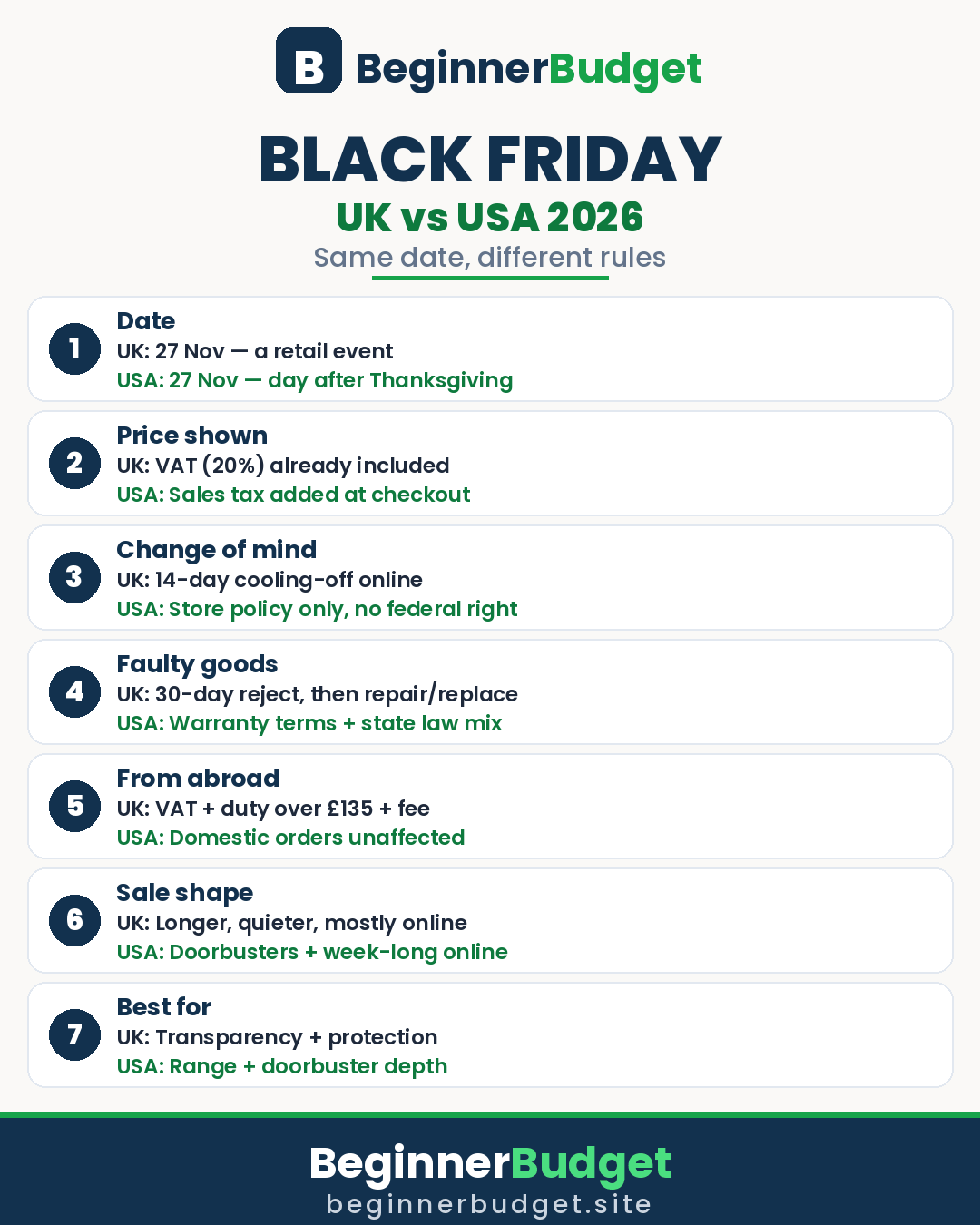
So who actually gets the better deal? It depends on where you live. If you're in the UK, your best deals are almost always domestic: the price is honest, the returns are protected by law, and faulty goods have a clear remedy. A US price has to beat the UK price by a wide margin — after tax, shipping, duty, VAT, handling and conversion fees — before it's genuinely cheaper, and for most everyday items it doesn't. If you're in the USA, your best deals are domestic too, and your edge is range: deeper doorbuster discounts and a bigger in-store event. The one group that should think twice is anyone buying across the border in either direction for a modest saving — the extra costs and the weaker returns position usually eat it.
One more honest note: the biggest "deal" in either country is often not buying at all. A 30% discount on something you didn't need is still 100% spending. Our companion guide, Black Friday 2026: Shop Smart Without Going Into Debt, covers the budgeting side — lists, totals, and the buy-now-pay-later traps — if debt is the part that worries you.
Your Before-You-Buy Checklist
Run through this before any Black Friday purchase, on either side:
- Screenshot the pre-sale price of the exact item now, so you can tell a real discount from a pumped-up "was" price.
- Compare final checkout totals, not sticker prices — include US sales tax, delivery, and any import charges.
- Read the returns policy, including whether sale items have different terms and whether a restocking fee applies.
- Check the warranty region for anything expensive, especially if the model comes from another country.
- Do the landed-cost maths for cross-border orders: price + shipping + duty + 20% import VAT + courier fee + conversion fee.
- Check the delivery date — a "deal" that arrives after Christmas isn't a Christmas present.
- If you're putting it on credit, have a payoff plan before you buy, not after. Our guide to pay off debt fast is the place to start if the balance is already there.
Frequently Asked Questions
Is Black Friday the same day in the UK and the USA?
Yes. In 2026, Black Friday is Friday, 27 November in both countries. In the USA it follows Thanksgiving (Thursday, 26 November); in the UK it is a retail event that uses the same date.
Do UK prices include tax?
Yes. Prices shown by UK retailers normally include VAT at the standard rate of 20% for most goods, so the shelf price is what you pay at checkout (plus delivery if charged). US prices normally exclude sales tax, which is added at checkout and varies by state and locality.
Can I return something I bought from a US store while I am in the UK?
It depends on the store's own returns policy — the USA has no federal cooling-off right for ordinary retail purchases. International return postage is usually at your expense, and getting any import VAT or duty refunded is a separate claim, so check the policy before you buy.
Do I pay customs on a US order under £135?
For non-excise goods worth £135 or less, there is no UK customs duty, and VAT is normally charged by the seller or marketplace at checkout. Over £135, customs duty may apply depending on the product, plus 20% import VAT and a courier handling fee.
Is Cyber Monday bigger in the USA?
Yes. Cyber Monday (Monday, 30 November 2026) began in the USA as the online follow-up to the in-store Black Friday weekend and remains a bigger event there. UK retailers run Cyber Monday offers too, but mostly as an extension of Black Friday week.
Black Friday rewards the shopper who compares properly: final totals, return terms, warranty region, and landed cost. Do those four checks and the better deal — whichever country it's in — will be obvious.