
Experian vs ClearScore vs Credit Karma UK 2026

There is no single UK credit score, and that is the whole point of this comparison. If you have ever opened Experian, ClearScore and Credit Karma and wondered why the numbers look nothing alike, you are not doing anything wrong — the three services are measuring different things. Each one reports the file held by a different credit reference agency, and each agency scores on its own scale. A 700 means something completely different on each of them. This guide compares the three services head-to-head on what actually matters: which agency each one covers, what its scale really is in 2026 (two of the three scales have changed recently), what is free and what is a paid upsell, how often each score updates, and which one to check first depending on what you are applying for.
Why You Have Three Scores, Not One
The UK has three main credit reference agencies: Experian, Equifax and TransUnion. Each one keeps its own file on you, built from the information lenders choose to report to it. Because not every lender reports to all three agencies, and because each agency updates at slightly different times, the three files are never identical — and each agency turns its file into a score using its own formula and its own scale.
That is why the three free services exist as a trio rather than a single winner. Experian's free service shows you the Experian file. ClearScore is not an agency itself; it shows you the Equifax file, free, under a long-running partnership. Credit Karma shows you the TransUnion file, free. None of them can show you the other two agencies' scores, because each agency runs its own consumer platform. Anyone promising "all three scores in one free app" is either selling you something or showing you a partial picture.
There is one more thing to understand before any comparison: the score you see on any of these services is a guide, not the number a lender uses. When you apply for credit, the lender runs your report data through its own internal scoring model, together with your income and application details. The consumer score is still useful — it tells you roughly how your file looks and whether something on it needs attention — but a "Good" band does not guarantee approval, and a lower band does not guarantee rejection. What lenders actually read is the report underneath the score: payment history, balances, defaults, and how much credit you already use.
The practical consequence is simple. Checking one service gives you one-third of the picture. Checking all three gives you the full picture, and it costs nothing. The rest of this guide is about doing that efficiently, reading the three numbers correctly, and not paying for anything you can already get free.
Head-to-Head: Experian vs ClearScore vs Credit Karma
Here is the comparison at a glance. The details behind each row follow in the sections below, including the two scale changes that make most older guides out of date.
| Feature | Experian | ClearScore | Credit Karma |
|---|---|---|---|
| Agency covered | Experian | Equifax | TransUnion |
| Score scale (2026) | 0–1,250 | 0–1,000 | 0–999 (new scale, rolling out late 2026 to June 2027; older accounts may still show 0–710) |
| Cost of the free service | Free | Free, permanently — no premium tier | Free |
| Score updates | Typically monthly | Weekly | Weekly |
| Full credit report included free? | Score and summary free; full report detail sits behind the paid CreditExpert product | Yes — full Equifax report free | Yes — full TransUnion report free |
| Paid upsell to watch for | CreditExpert, around £14.99 a month | None — revenue comes from credit offers shown in the app | Personalised credit-card and loan offers in the app |
| Best for | Mortgage and high-street lender checks; the largest agency's file | Spotting errors across your full Equifax report; weekly tracking | Weekly TransUnion tracking and pre-approval odds on offers |
Two rows in that table deserve emphasis, because they are where older articles go wrong. First, Experian's scale is no longer 0–999: Experian updated its credit score range from 0–999 to 0–1,250 in November 2025, so any guide still quoting 999 as the Experian maximum is out of date. Second, TransUnion is changing its UK score from 0–710 to 0–999, rolling out through its credit-monitoring partners in phases from late September 2026 to June 2027 — so you may see either version for now, depending on which partner shows it and when. If your Credit Karma score suddenly looks different without your finances changing, the new scale is the likeliest explanation, not a sudden change in your creditworthiness.
On cost, the honest summary is that all three headline services are genuinely free, and you never need to pay to see a score. The differences are in what else you get: ClearScore and Credit Karma include the full report free, while Experian's free account gives you the score and a summary, with fuller report detail and alerts behind CreditExpert. Separately, every agency must by law give you a free statutory credit report if you ask for it directly — so even Experian's full report is obtainable free, just not through the slickest route.

Score Bands Compared: What "Good" Means on Each Scale
Comparing raw numbers across these services is meaningless. A score of 700 is "Fair" on Experian's new scale, "Very Good" on Equifax's, and "Good" on TransUnion's new scale. The only comparison that works is band-to-band: where does your number sit on its own scale? This table uses the bands published in ClearScore's guide to all three agencies' scales, with TransUnion's new bands from TransUnion itself.
| Band | Experian (0–1,250) | Equifax via ClearScore (0–1,000) | TransUnion via Credit Karma — new (0–999) | TransUnion — old (0–710) |
|---|---|---|---|---|
| Excellent | 1,121–1,250 | 811–1,000 | 786–999 | 628–710 |
| Very Good | 1,001–1,120 | 671–810 | — (no separate Very Good band) | — |
| Good | 861–1,000 | 531–670 | 653–785 | 604–627 |
| Fair | 641–860 | 439–530 | 563–652 | 566–603 |
| Low / Poor | 0–640 (Low) | 0–438 (Poor) | 488–562 (Low) | 551–565 (Poor) |
| Very Low / Very Poor | — | — | 0–487 (Very Low) | 0–550 (Very Poor) |
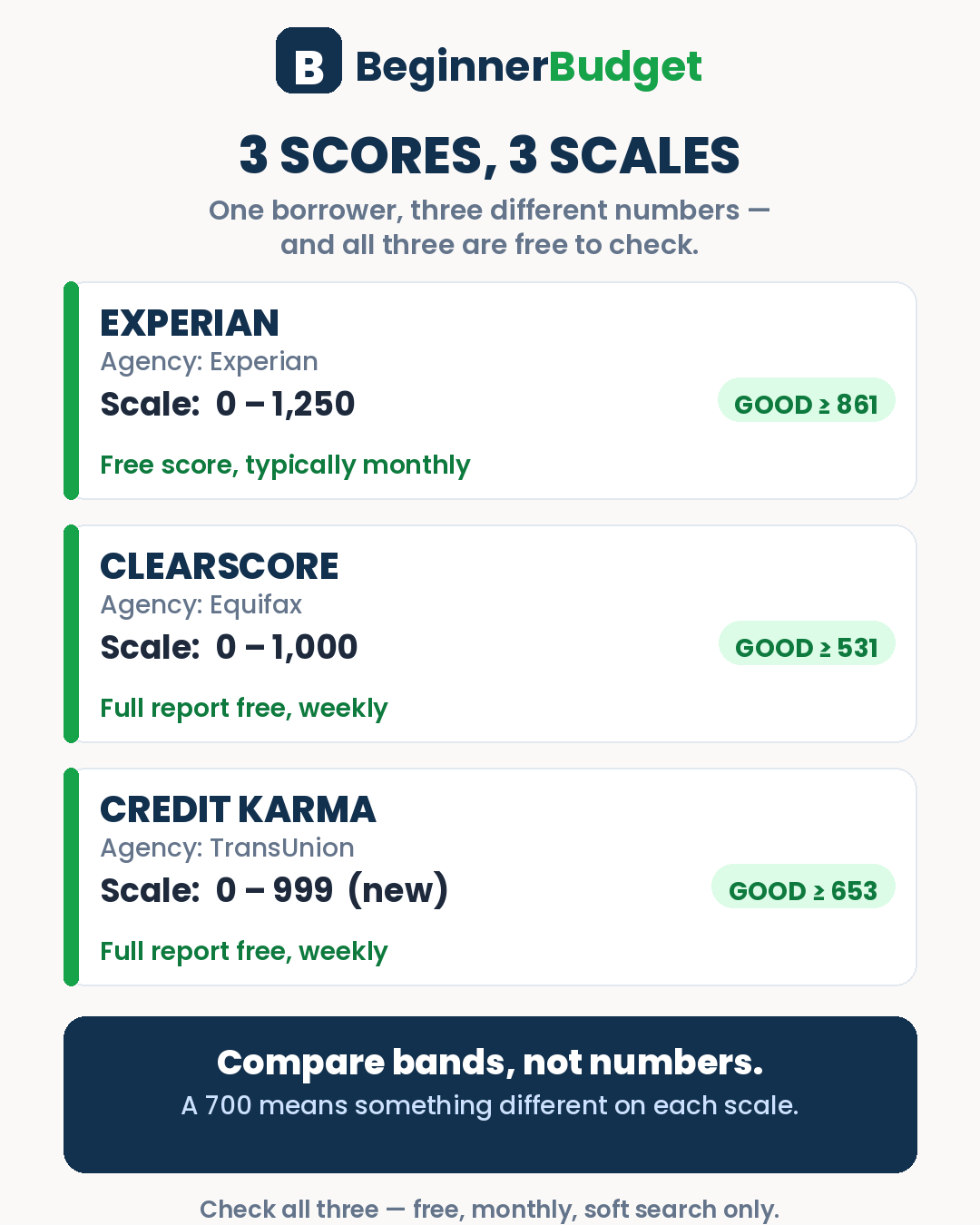
The most useful line in that table is the "Good" row: a good score starts at 861 on Experian's scale, 531 on Equifax's, and 653 on TransUnion's new scale. If you remember only one set of numbers from this article, remember those three. They are also a good reality check on older guides: if a guide tells you a "good" Experian score is 881–960, it is quoting the retired 0–999 scale, and its other numbers are probably stale too.
One more caution on bands: agencies update their models and presentations from time to time, and the band labels can change even when your underlying report does not. ClearScore itself notes that its published bands are general guidance and may be updated periodically. If a band label moves but nothing on your report changed, check the scale first before worrying about the score.
Illustrative example: imagine the same borrower with a clean payment record and one credit card at low utilisation. Their three scores might read roughly 920 on Experian (Good), 610 on Equifax (Good) and 700 on TransUnion's new scale (Good) — three wildly different numbers, all saying the same thing. That is a normal, healthy result. The warning sign is not "different numbers" — it is when one band is far below the others, which usually means one agency's file holds something the others do not, such as a missed payment, an old default, or an account the other agencies never recorded.
Experian in Detail
Experian is the largest of the three UK credit reference agencies, and its file is the one many high-street lenders check — including, according to comparison guides, major banks such as HSBC, Barclays and Halifax. That reach is the strongest reason to keep an eye on your Experian score even though its free service is the least generous of the three.
What the free service gives you. A free Experian account shows your Experian credit score and a summary of your credit report, and it typically updates monthly. It does not give you the same full-report depth that ClearScore and Credit Karma include free. If you want the full report through Experian's own polished interface, that is the paid CreditExpert product, which costs around £14.99 a month and adds fuller monitoring and alerts. You do not need it to see your score — and if you only want the full Experian report, you can request your statutory report from Experian directly for free instead.
What to watch for. The upsell is the main trap: the free account's sign-up journey steers toward CreditExpert, and it is easy to start a paid trial without meaning to. If you ever take a trial, set a calendar reminder for the day before it ends. The second trap is the old scale: because Experian only changed to 0–1,250 in November 2025, a huge amount of older content still describes the 0–999 scale. If your Experian score looks much higher than you expected, check whether you are reading it against the new scale before celebrating — or worrying.
Who should check Experian first? Anyone about to apply for a mortgage or a mainstream bank product, since those lenders are the most likely to check Experian's file. Also anyone who has only ever checked ClearScore or Credit Karma: if your Experian file holds a surprise, a mortgage application is a bad time to discover it.
ClearScore in Detail
ClearScore is the cleanest deal of the three. It shows your Equifax credit report and score, it updates weekly, and it is permanently free — there is no premium tier to be upsold into. ClearScore is a credit broker, not a lender and not an agency: it does not calculate your score, it presents the Equifax score and report to you. That distinction matters because it means your ClearScore number is an Equifax number, and it should be judged against Equifax's 0–1,000 scale, not against Experian's or TransUnion's.
What you get. The full Equifax report, free, updated weekly — which makes ClearScore the best of the three for actually reading your report rather than just glancing at a number. That matters because errors live in reports, not in scores: a wrong address, an account you never opened, a settled debt still showing as outstanding. Weekly updates also mean you see changes faster than Experian's monthly rhythm, so if something appears on your Equifax file, you find out within days, not weeks.
How it makes money. ClearScore shows you personalised credit-card and loan offers based on your profile. You do not have to take any of them, and taking one is a separate credit application with its own hard search. The business model is worth understanding because it explains the weekly nudges: the app is free because lenders pay to be shown to people likely to be accepted. Treat every offer as advertising, not advice — the "likelihood" shown is an estimate, not an approval.
Scale history worth knowing. Equifax's scale itself changed in April 2021, from 0–700 to 0–1,000, which is why older guides quote bands like 420–465 as "good" — those are retired 0–700 bands. On the current scale, Good is 531–670, Very Good is 671–810, and Excellent is 811–1,000. If you find an old screenshot of your own ClearScore number, do not compare it with today's number unless you know which scale each one used.
Who should check ClearScore first? Anyone who has never read a full credit report, anyone rebuilding credit who wants weekly feedback, and anyone who wants one genuinely free, no-upsell service. If you only use one service, this is the strongest single pick — but it still only covers one agency, so it is a starting point, not the whole picture.

Credit Karma in Detail
Credit Karma, owned by Intuit, shows your TransUnion credit report and score, free, updated weekly. Like ClearScore, it is a monitoring service rather than an agency: TransUnion holds the file and calculates the score, and Credit Karma presents it. In the UK it is a different product from Credit Karma in the USA, which shows different bureaus' data on a different scoring model — a confusion that catches people who read American advice online, covered in the UK vs USA section below.
What you get. Your full TransUnion report and score, free, with weekly updates, plus personalised credit-card and loan recommendations based on your profile. As with ClearScore, those recommendations are advertising: they estimate your chance of acceptance, they do not guarantee it, and applying creates a hard search on your file.
The scale transition — read this before panicking. TransUnion is replacing its UK consumer score. The old scale ran 0–710 (Excellent 628–710, Good 604–627, Fair 566–603, Poor 551–565, Very Poor 0–550). The new scale runs 0–999 (Excellent 786–999, Good 653–785, Fair 563–652, Low 488–562, Very Low 0–487), and it is rolling out through monitoring partners in phases from late September 2026 until full rollout by June 2027. During the transition you may even see two different TransUnion scores from two different providers. TransUnion itself stresses that the underlying report information does not change — only the number and bands change. So if your Credit Karma score jumps or drops sharply with no change in your borrowing, check which scale you are on before doing anything else.
Who should check Credit Karma first? Anyone applying for credit with a lender known to check TransUnion, anyone who wants weekly updates on a third agency's file, and anyone comparing offers — Credit Karma's pre-approval estimates are a reasonable first filter, as long as you treat them as estimates. If your TransUnion score is the one lagging behind the other two, this is also where you will spot a TransUnion-only problem, such as a lender that reports to TransUnion but not to the other agencies.
Which Agency Will Your Lender Check?
The frustrating, honest answer is: you usually cannot know in advance, and it varies by lender and by product. Lenders can check any one agency, or more than one, and they do not publish a reliable list of which they use for which product. Comparison guides note tendencies — Experian is the largest agency and widely used by high-street banks, TransUnion is used by some banks including Barclays and by specialist lenders — but tendencies are not guarantees, and a lender can change its provider without telling you.
That uncertainty is exactly why checking all three is the right strategy rather than picking a favourite. Think of it as three separate health checks: a clean Experian file does not prove your Equifax file is clean, because the files hold different data. The most common real-world pattern is a borrower with two healthy scores and one weak one, caused by a single item that only one agency recorded — a missed payment reported to one agency, a default that aged off one file but not another, or an account a lender reported inconsistently.
There is one practical exception. If you are about to apply for something specific and you have time, check all three a month or two before applying, fix anything wrong, and then re-check the agency most likely to be used closest to the application. That gives disputes time to resolve, since corrections are not instant. Applying first and discovering a problem afterwards is the most expensive version of this mistake.

If you are currently building or rebuilding credit, our guide to improving your UK credit score covers the habits that lift all three files at once — on-time payments, low utilisation, and not applying for lots of credit at once — because the three agencies reward the same behaviour even though they score it differently.
The Paid Upsells: What to Skip
None of the three services requires payment, but the sign-up journeys are designed to make paying feel normal. Here is what to decline, politely and confidently.
| Upsell | What it costs | What you actually get | Verdict |
|---|---|---|---|
| Experian CreditExpert | Around £14.99 a month | Fuller Experian report detail, monitoring and alerts | Skip unless you are actively repairing a damaged file and want daily-style monitoring — and even then, set a trial reminder |
| Any "see all three scores in one place" paid service | Varies, often monthly | Usually repackaged free data plus a dashboard | Skip — the three free services above already give you all three files |
| Credit-repair firms promising to "fix" your score | Often hundreds of pounds | Usually disputes you can raise yourself, free | Skip — disputes are free and the section below shows how |
| ClearScore premium tier | Does not exist | — | Nothing to skip; this is the point of ClearScore |
The general rule: if a service charges you to see information that an agency must give you free on request, you are paying for presentation, not for data. Presentation can be worth paying for in specific situations — for example, daily monitoring during an active identity-theft case — but for ordinary checking, the free routes in this guide are enough.
Check All Three in 30 Minutes: Step by Step
Set aside half an hour and do all three in one sitting, so you can compare the reports while the details are fresh. You will need photo ID and your address history for the last few years, which the services use to match you to the right file.
- Start with Experian. Create a free Experian account, decline CreditExpert, and note your score and its band on the 0–1,250 scale. Skim the summary for anything unfamiliar.
- Move to ClearScore. Sign up free, open the full Equifax report, and read it properly — every account, every address, every search. Note your score on the 0–1,000 scale and its band.
- Finish with Credit Karma. Sign up free, open the full TransUnion report, and note your score — checking first whether it is on the old 0–710 scale or the new 0–999 scale — and its band.
- Compare bands, not numbers. Write down the three bands side by side. Three similar bands (for example, all "Good") is a healthy result. One band far below the others is your investigation target.
- Save or screenshot each report. You want a dated record of what each file showed, so that if something changes later you can prove when it changed.
- Set a repeat reminder. Monthly is enough for most people; weekly if you are about to apply for a mortgage or you are rebuilding credit. ClearScore and Credit Karma update weekly, Experian's free score typically monthly, so a monthly check catches everything.
If you have never checked any of them before, our step-by-step guide to checking your credit score free in the UK walks through the sign-up process in more detail, including what to do if a service cannot match you to a file.
When Your Scores Disagree — or a Report Has an Error
Small disagreements are normal. Different data, different formulas, different scales — the bands should be roughly similar, but they will rarely match exactly. Investigate when one band is clearly out of line with the other two, or when you find something on a report that is simply wrong.
Step 1: Confirm it is real. Re-read the entry. Is it your account, or a similar name or old address? Is a settled account showing as outstanding? Is a default older than it should be? Defaults generally stay on a UK credit file for six years from the default date, so a default older than that should have dropped off.
Step 2: Raise a dispute with the agency holding the wrong data. Each agency has its own dispute process — raise it with the agency whose file is wrong, not with the service that showed it to you. ClearScore and Credit Karma will point you to Equifax and TransUnion respectively, because they do not hold the data themselves. Provide evidence: statements, settlement letters, or correspondence showing the correct position.
Step 3: Contact the lender too. If a lender reported the wrong information, asking the lender to correct it at source fixes the problem for all three agencies at once, rather than one dispute at a time. Keep copies of everything and note dates; if a dispute drags on, you can escalate to the Financial Ombudsman Service, and the Information Commissioner's Office deals with data-accuracy complaints.
Step 4: Do not apply for new credit while a serious error is unresolved. A wrong default or an unfamiliar account can change a lending decision. Sorting it first is worth more than any score-boosting trick, and it is free. If you suspect fraud — an account you never opened — contact the lender and the agency immediately, and consider protective registration with CIFAS, the UK fraud-prevention service.
5 Mistakes People Make Comparing These Services
1. Comparing the raw numbers. A 700 on one service and a 700 on another are different scores. Compare bands, not numbers — or better, compare each score with its own scale's "Good" threshold (861 Experian, 531 Equifax, 653 TransUnion new scale).
2. Trusting old scale guides. Experian moved to 0–1,250 in November 2025, Equifax moved to 0–1,000 in 2021, and TransUnion is moving to 0–999 through 2027. Any guide quoting Experian 0–999, Equifax 0–700 or TransUnion 0–710 as current is out of date, and its band advice will mislead you.
3. Paying for a score. Every score in this comparison is free. If you are paying a monthly fee just to see a number, cancel it and use the free routes — and remember that statutory reports are free from each agency on request.
4. Reading American advice as UK advice. Credit Karma in the USA shows Equifax and TransUnion data on the VantageScore model, and the USA has its own system of free weekly reports. UK Credit Karma shows TransUnion data on the UK TransUnion scale. American articles about "your Credit Karma score" do not describe the UK product.
5. Checking once and never again. Credit files change: accounts open and close, balances move, errors appear. A single check is a snapshot, not a system. Monthly checks take a few minutes and catch problems while they are still cheap to fix. Pair the habit with a budgeting routine — our spending-tracking guide shows five methods, and the same weekly-review habit that keeps spending honest keeps credit files honest too.
UK vs USA: The Same Names, a Different System
It is easy to get confused because the USA has three bureaus with similar names — Experian, Equifax and TransUnion operate there too — but the systems work differently. In the USA, consumers can get free weekly credit reports from all three bureaus through AnnualCreditReport.com, the officially authorised site, and scores are commonly shown on the FICO or VantageScore models, which use a 300–850 range. In the UK, there is no single authorised portal: you go to each agency's free route separately, as this guide describes, and each agency uses its own scale.
The practical lesson for UK readers is to ignore American score numbers entirely. A "good" American score of 670 on a 300–850 scale has nothing to do with a "good" UK score of 861 on Experian's 0–1,250 scale, 531 on Equifax's 0–1,000 scale, or 653 on TransUnion's new 0–999 scale. If an article or video quotes a 300–850 score, it is describing the American system, and its advice about thresholds will not apply to you. Conversely, if you ever move between the two countries, your credit history does not move with you — you start building a file from scratch in the new country.
The Verdict: Which One Should You Use?
There is no single winner, because the three services cover three different files — but there is a clear strategy.
| If you are… | Start here | Then check |
|---|---|---|
| About to apply for a mortgage | Experian (largest agency, widely checked by high-street lenders) | ClearScore and Credit Karma the same week |
| Checking for the first time | ClearScore (full report free, weekly, no upsell tier) | Experian and Credit Karma the same day |
| Rebuilding credit | ClearScore (weekly feedback on the full report) | Credit Karma weekly; Experian monthly |
| Comparing loan or card offers | Credit Karma (TransUnion file + pre-approval estimates) | ClearScore for the Equifax view before applying |
| Short on time, want one habit | All three, once a month, same day | — |
The bottom line: use all three, judge each score only against its own scale, never pay for a number you can see free, and treat a band that lags behind the other two as a lead to investigate, not a verdict on your finances. Do that monthly and you will know more about your credit position than most people who pay for it — and you will catch the errors and surprises before a lender does. If your files are healthy and you want to push them higher, the next step is behaviour, not another app: our credit-score improvement guide and our debt payoff guide cover the two moves — on-time payments and lower utilisation — that lift all three scores at once.
Frequently Asked Questions
Which is most accurate: Experian, ClearScore or Credit Karma?
None is "most accurate" — they report different agencies' files, and each file is accurate for the data that agency holds. The most accurate picture comes from all three together. If one file disagrees with the other two, that file is the one to investigate, not the service to blame.
Is ClearScore really free forever?
Yes. ClearScore states its service is permanently free with no premium tier; it earns money by showing you credit offers. You never need to pay to see your Equifax score or report through ClearScore.
Does checking your credit score affect it?
No. Checking your own score or report is a soft search: it is visible to you but not to lenders, and it never lowers your score. You can check as often as you like. A hard search happens when you apply for credit, and that is the one that can temporarily affect your file.
Why is my score different on Experian, ClearScore and Credit Karma?
Because each service shows a different agency's file on a different scale: Experian 0–1,250, Equifax via ClearScore 0–1,000, and TransUnion via Credit Karma 0–999 on the new scale (or 0–710 on the old scale during the 2026–2027 transition). Different data plus different scales means different numbers — compare bands, not raw numbers.
Which credit score do mortgage lenders check in the UK?
There is no single answer: lenders can check any agency, and many check more than one. Experian is the largest agency and is widely used by high-street lenders, which is why checking your Experian file before a mortgage application matters — but checking all three before applying is the safer move.
Is UK Credit Karma the same as US Credit Karma?
No. UK Credit Karma shows TransUnion UK data on the UK TransUnion scale. US Credit Karma shows different bureaus' data on a different scoring model, and the USA uses a separate free-report system. American score numbers and thresholds do not apply in the UK.
What is a good credit score in the UK?
It depends on the scale: Good starts at 861 on Experian's 0–1,250 scale, 531 on Equifax's 0–1,000 scale, and 653 on TransUnion's new 0–999 scale. Above those thresholds you are in Good or better territory on that agency's scale — but remember that lenders use their own models, so a band is a guide, not a guarantee.
Should I pay for Experian CreditExpert?
For most people, no. The free Experian account gives you your score and a summary, ClearScore and Credit Karma give you full reports free, and statutory reports are free from each agency on request. CreditExpert is worth considering only if you want fuller Experian monitoring during active credit repair — and if you take a trial, diary its end date.
Checking your credit is free, it never harms your score, and it takes less time than most people spend scrolling in a day. Open all three services, compare the bands, fix anything that looks wrong, and repeat monthly. That small habit protects every bigger money goal you have — from a first credit card to a mortgage — because every one of them starts with the file a lender reads about you.
Sources and further reading: ClearScore's guide to UK credit score bands and scales; TransUnion's announcement of its new UK consumer credit score; Experian's guide to why scores differ between sites; MoneyHelper, the UK government's money guidance service, on checking your credit report. Lenders' agency choices and offer-eligibility estimates vary, and score bands are general guidance that agencies may update — always check the scale shown in your own account.
Outbound references: ClearScore — what is a good or bad credit score · TransUnion — the new UK credit score · Experian — why your score differs between sites · MoneyHelper — free, impartial money guidance