
7 Steps to Get Out of Your Overdraft UK 2026

An overdraft doesn't feel like debt. There's no statement that lands with a thud, no collector calling, no fixed date circled on the calendar. Your card just keeps working, payday arrives, and the balance creeps back to zero — until the next month starts and you're back in the red again. That's exactly why overdrafts are so expensive to live in: they charge some of the highest interest rates on the UK high street, and they never force a finish line. This guide gives you one.
What your overdraft actually costs you
First, the vocabulary, because banks use two words that sound similar and mean different things. An arranged overdraft is one you agreed with your bank in advance: a limit, say £1,000, that you can spend up to. An unarranged overdraft happens when you go over that limit, or you go overdrawn without any agreement at all — a direct debit landing a day early is the classic way it happens.
Since April 2020, banks have had to charge overdrafts at a single annual interest rate, with no extra fees for unarranged borrowing and no higher rate for going over your limit than for staying within it. That's a genuine improvement on the old daily-fee maze. But the rates themselves are high: MoneyHelper reports that bank and building society overdraft rates range from around 19% to 40% or more. Many of the big high-street accounts sit at the top of that range, around 39.9%.
What does that mean in pounds? Here's the cost of sitting in an overdraft for one month, at three different rates. These are illustrative calculations at a fixed rate, assuming the balance doesn't move during the month:
| Balance for the month | At 19% EAR | At 35% EAR | At 39.9% EAR |
|---|---|---|---|
| £500 | about £7 | about £12 | about £14 |
| £1,000 | about £14 | about £25 | about £28 |
| £2,000 | about £29 | about £50 | about £56 |
Fourteen pounds a month doesn't sound like a crisis. But that's the trap: an overdraft you live in for a year at £1,000 and 39.9% costs roughly £330 in interest, and you've still got the £1,000 to repay at the end of it. Compare that with a regular savings account paying around 5% — your money earns a fifth of what your overdraft charges. That's why clearing an overdraft usually beats saving, and why this guide treats it as a debt to kill, not a facility to manage. If you're weighing it against other debts, our guide to how to pay off debt fast explains why the highest-rate debt goes first — and an overdraft is very often that debt.
Step 1: Get your exact numbers
You can't plan around a feeling. Open your banking app and write down four numbers: your current overdrawn balance, your arranged limit, your interest rate (shown as EAR or APR on the account details screen), and whether you have any interest-free buffer. Some accounts give you the first £50, £100 or even £500 interest-free — MoneyHelper notes some providers offer buffers up to £500 — and you only pay interest on what's above it.
While you're there, check two more things. First, how many days a month you actually spend in the red — your statements will show it, and most banking apps now chart it. Second, whether your bank sends you overdraft alerts. Since the 2020 reforms, banks must automatically enrol you in alerts warning you when you're about to be charged, but it's worth confirming they're switched on and going to a number you actually read. One reader's story is typical: they thought their overdraft cost "a few pounds here and there" and discovered it was £38 a month, every month, for over a year. That's £456 gone, with nothing to show for it.

Step 2: Stop the leak first
Paying off an overdraft while still spending from the same account is like bailing out a boat with a hole in it. Before you set a payoff amount, plug the hole:
- Move your spending, not your salary. Open a second current account with no overdraft — a basic bank account works, and it can't charge you overdraft fees because it doesn't offer one. Have your salary land in the overdrawn account, then move your spending money to the second account on payday. Bills and food come from the clean account; the overdrawn account just gets its monthly payoff payment. Several readers in debt forums swear by this split, and it works because it removes willpower from the equation.
- Switch your direct debits' timing if you can. If three big bills land the day before payday, ask the providers to move them a few days later. One mistimed direct debit can tip you over your limit and undo a month of progress.
- Turn on balance-after-bills in your app. Monzo, Starling and most high-street apps now show what you'll have left after upcoming bills. If yours doesn't, a five-minute weekly check — open the app every Sunday, note the balance — catches drift before it becomes a spiral. Our guide to how to track your spending has five methods, and the weekly review is the one that sticks for most people.
- Kill the silent drains. Subscriptions you forgot, a streaming service nobody watches, a gym membership from January — cancel two or three and you've often found your payoff payment without touching your lifestyle.
None of this is glamorous. All of it is the difference between a plan that works and a plan you abandon by week three.
Step 3: Build a payoff plan you can keep
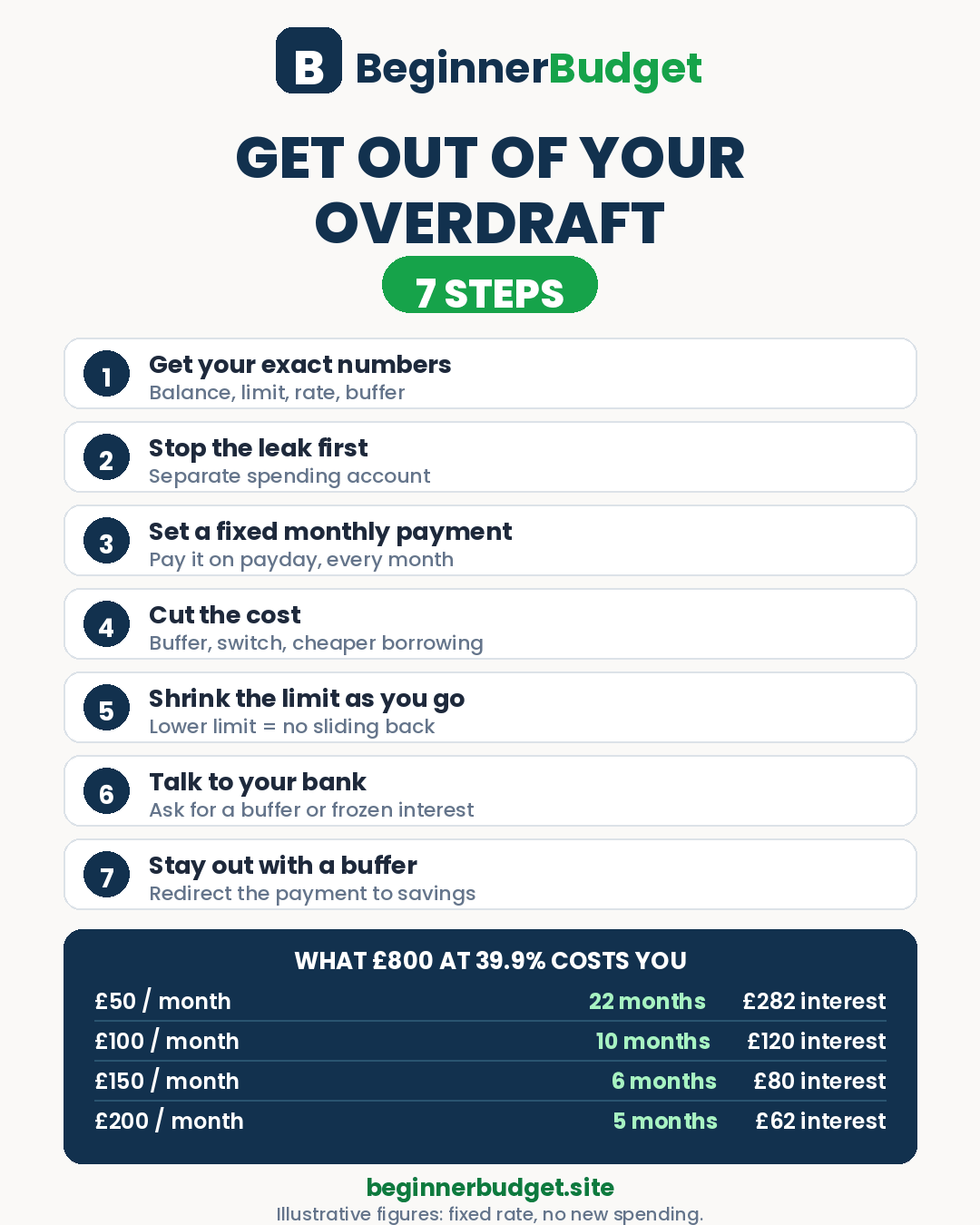
Here's where most guides wave their hands and say "pay more than the minimum." An overdraft has no minimum payment, so you have to invent one — and it has to survive real life. Pick a fixed amount, treat it like a bill, and pay it the day your salary lands, before you can spend it. The table below shows what that looks like on an £800 overdraft at 39.9% EAR. These are illustrative figures, assuming the rate stays fixed and you don't dip back in:
| Monthly payment | Time to clear £800 | Interest paid (approx.) |
|---|---|---|
| £50 | about 22 months | about £282 |
| £100 | about 10 months | about £120 |
| £150 | about 6 months | about £80 |
| £200 | about 5 months | about £62 |
Read that table twice. Doubling your payment from £50 to £100 doesn't just halve the time — it more than halves the interest, from £282 to £120. Every extra tenner you find is worth real money here, because it cuts both the months and the interest on those months. If £100 feels impossible right now, start at £50 and raise it by £10 every time something ends — a subscription, a bill dropping, a pay rise. The direction matters more than the starting number.
Two rules make the plan stick. First, pay on payday, automatically if your bank allows a standing order from the overdrawn account to itself — some do, some don't, and if yours doesn't, set a same-day phone reminder. Second, never "borrow" the payoff back mid-month. The day you dip back in for £40 because the week ran long, the plan resets. That's what the separate spending account in Step 2 is for.
Step 4: Cut the cost while you pay it off
Paying it off is half the job. Paying less interest while you do it is the other half. Work through these in order, and skip any that don't fit — a cheaper option you can't actually get is worse than useless, because it stalls the plan:
- Ask for a bigger interest-free buffer. It's a phone call, it costs nothing, and some banks will grant one if you ask — especially if you've been a customer for years. Even £250 interest-free on a £1,000 overdraft cuts your interest by a quarter overnight.
- Check whether your bank is even competitive. Some current accounts charge far less than 39.9% — a few still price overdrafts in the teens or twenties. If you're paying top whack and your credit file is in decent shape, switching the account (not the overdraft — see the switching section below) can save you more than any budgeting trick.
- Consider a personal loan — carefully. If your overdraft is large (think £1,000+) and you can't see yourself clearing it within a year, a personal loan at a lower rate with a fixed end date can be cheaper and, just as importantly, finite. The maths only works if the loan rate is genuinely lower, the term is fixed, and — this is the part people skip — you don't run the overdraft back up again afterwards. If you take the loan and keep the overdraft facility at its old limit, you've doubled your debt, not halved it.
- Think twice about 0% money-transfer cards. Some cards let you move money to your bank account at 0% for a year or more, which can clear an overdraft interest-free. But there's usually a transfer fee of around 3–4%, the 0% period ends, and if you miss a payment the deal can collapse. Worth it for a disciplined payoff; a trap if the card becomes new spending money.
- Use savings — usually yes, with one exception. Money sitting in an account earning 5% while your overdraft charges 39.9% is losing you money every single month. Using savings to clear an overdraft is almost always the right call. The exception: don't empty your last £200 if it means the next emergency goes straight back onto a credit card. Keep a small buffer, clear the rest, and rebuild the buffer from the money you were paying in interest.
Step 5: Shrink the limit as you go
This is the step everyone forgets, and it's the one that stops the relapse. As your balance falls, ask your bank to reduce your limit to match. Cleared £300 of a £1,000 overdraft? Drop the limit to £700. Cleared half? Drop it to £500. Two things happen: you can't accidentally slide back to the old depth, and the temptation of "available" money disappears from your app's balance display.
There's a second reason that matters more than it sounds. Banks can see how much of your limit you use, and a maxed-out overdraft sitting at its limit for months is a signal — to lenders, and to your bank's own systems — that you're stretched. A shrinking limit with a shrinking balance tells the opposite story. When you finally reach zero, ask to remove the facility entirely, or keep a tiny one (£50–£100) purely as a buffer against a mistimed direct debit. Decide which one you are: if the overdraft was ever a habit, remove it. If it was genuinely a one-off emergency, a small buffer is fine.
Step 6: Talk to your bank (and what to ask for)

People avoid this call because they expect a lecture. In practice, banks have dedicated financial-difficulty teams, and under the FCA's repeat-use rules they're expected to identify customers who keep using their overdraft and offer help — not just watch the interest roll in. Here's a script that works:
- "I'm in my overdraft most months and I want a plan to clear it. Can you review my limit and rate?" — opens the door to a buffer, a lower rate, or a managed reduction plan.
- "Can you refund some of the interest I've paid?" — worth asking if charges hit during a period when you were ill, lost work, or dealing with a bereavement. Banks do refund in hardship cases, and they won't offer unless you ask.
- "Can we agree a repayment plan over a fixed period?" — some banks will freeze interest while you repay over an agreed term. That's a big deal: frozen interest turns your payoff into pure progress.
- "I'm worried you'll remove my overdraft." — say it out loud. MoneyHelper warns that banks can withdraw an overdraft if they think you're over-using it and in difficulty, so it's better to approach them with a plan than to wait for a letter. A customer with a plan is a customer they can work with.
If the call doesn't help, or you feel pushed into something you can't afford, that's the moment to get free, independent advice — see the next-but-one section. You don't have to accept the first offer, and you don't have to handle it alone.
Step 7: Stay out once you're clear
Getting to zero feels like the finish line. It isn't — the first three months after clearing an overdraft are when most people slide back, because the old habits are still warm and the payoff money suddenly feels "spare." Redirect it before it evaporates: the day your overdraft hits zero, set up a standing order for the same amount into a separate savings account. You were living without that money anyway. That's the start of your emergency buffer, and it's the thing that stops the next broken boiler from becoming the next overdraft.
Then keep the habits that got you out: the Sunday balance check, the separate spending account, the alerts switched on. If you're still deciding which comes first — a buffer or killing the debt — our guide to emergency fund or pay off debt first settles it, and if you're starting from nothing, here's how to build an emergency fund from zero. A £500 starter buffer is the single best overdraft insurance there is, because it turns the next emergency into a savings withdrawal instead of a borrowing event.
If you genuinely can't pay it
Sometimes the honest answer is that no monthly amount works, because the money simply isn't there. That's not failure — it's information, and there's a system built for exactly this situation:
- Free debt advice first, always. StepChange, Citizens Advice and National Debtline all give free, confidential advice, and they deal with overdrafts every single day. They'll go through your whole budget, not just the overdraft, and they'll tell you straight if a formal solution fits. Don't pay a company for this — the free services are the good ones.
- Breathing Space. In England and Wales, a regulated debt adviser can start a 60-day Breathing Space: during it, interest and charges on qualifying debts (including overdrafts) are frozen, enforcement action pauses, and creditors can't contact you about those debts. It buys you two months to agree a plan with proper advice behind you. GOV.UK's Breathing Space guide explains who qualifies and how to apply.
- Priority debts come first. Rent, council tax, gas and electricity arrears carry consequences an overdraft doesn't — eviction, court action, disconnection. If you're choosing what to pay this month, those come before the overdraft, every time. A debt adviser will help you rank them properly.
- Don't borrow to pay it. A payday loan to clear an overdraft trades a 39.9% problem for a far worse one. If someone is offering you quick money to clear a bank debt, that's a red flag, not a rescue.
Stuck because you can't switch banks?
There's a particular trap with overdrafts: you want a cheaper account, but you can't switch because the new bank won't take on your overdraft, and you can't clear the old one to leave. You're not imagining it — this is a recognised problem, sometimes called being an "overdraft prisoner."
Three routes out. First, ask your current bank for a managed reduction plan (Step 6) — banks do agree these, and a shrinking overdraft is easier to move than a static one. Second, check whether the new bank offers an overdraft as part of the switch: some do, subject to a credit check, and the Current Account Switch Service moves your payments in 7 working days once you're accepted. Third, if your credit file is the blocker, spend a few months on the payoff plan first — even partial progress changes the picture — and check your file is accurate while you're at it, since errors on it cost people approvals they should have had. The switching question is one place where patience pays: six months of steady payoff beats another year of hoping a new bank says yes.
UK vs USA: what changes
This guide is written for the UK, where overdrafts are a standard current-account feature with a regulated single interest rate. In the USA, the picture is different: checking accounts may offer overdraft protection, but many Americans instead face a flat fee per overdrawn transaction — historically around $35 a time — and the rules around opting in are different. The payoff logic in this guide still holds (highest cost first, fixed monthly payment, separate spending account), but the numbers, the switching service and the Breathing Space scheme are UK-only. If you're in the USA, check your bank's fee schedule first: a flat-fee overdraft punishes small slips hardest, which makes the separate-spending-account trick in Step 2 even more valuable.
Frequently Asked Questions
How long does it take to get out of an overdraft?
It depends on the balance and the monthly payment. On an £800 overdraft at 39.9%, £50 a month takes about 22 months, £100 a month takes about 10 months, and £200 a month takes about 5 months (illustrative figures, assuming the rate stays fixed and you don't dip back in). The honest answer for your case is in your banking app: balance, rate, and a payment you can keep.
Does being in my overdraft hurt my credit score?
Staying within your arranged limit and making steady repayments doesn't damage your score by itself — but going over your limit without agreement, or sitting maxed out for months, can. Lenders also look at how much of your available credit you use, so a shrinking overdraft balance with a shrinking limit looks better than a static one at its ceiling. Checking your own file is free and doesn't hurt your score.
Can my bank take away my overdraft?
Yes. An overdraft isn't guaranteed, and banks can reduce or remove it, particularly if they believe you're over-using it and in financial difficulty. That's one reason to approach your bank with a plan rather than waiting for a letter — and to keep a separate spending account so a sudden removal doesn't leave you unable to buy food.
Should I use my savings to pay off my overdraft?
Almost always yes, because the overdraft rate (often around 39.9%) dwarfs any savings rate (around 5%). The one exception: don't empty your last small buffer if the next emergency would go straight back onto a credit card. Keep a little back, clear the rest, and rebuild the buffer from the interest you were paying.
Is a personal loan better than staying in my overdraft?
It can be, if the loan rate is genuinely lower, the term is fixed, and you don't run the overdraft back up afterwards. It fails when people take the loan, keep the old overdraft limit, and end up with both. If you take a loan to clear an overdraft, shrink or remove the overdraft facility the same week.
Can I switch banks while I'm in my overdraft?
Sometimes, if the new bank agrees an overdraft as part of the switch — it's subject to a credit check. If not, you need to clear the old overdraft first, or agree a managed reduction plan with your current bank. The Current Account Switch Service itself takes 7 working days once you're accepted.
What is Breathing Space and do I qualify?
Breathing Space is a government scheme in England and Wales that freezes interest and charges on qualifying debts, including overdrafts, for 60 days while you get debt advice. You apply through a regulated debt adviser, you must live in England or Wales, and you can't have used standard Breathing Space in the last 12 months. GOV.UK's Breathing Space guide has the full eligibility list.
Official sources for the figures in this article: Overdrafts explained (MoneyHelper) and Overdraft debt advice (StepChange). Interest figures are illustrative examples at fixed rates, not quotes — your bank's actual rate is in your account terms. If you're struggling, free debt advice is available from StepChange, Citizens Advice and National Debtline.