
ISA Allowance 2026/27: 7 Things to Do Before April 2027

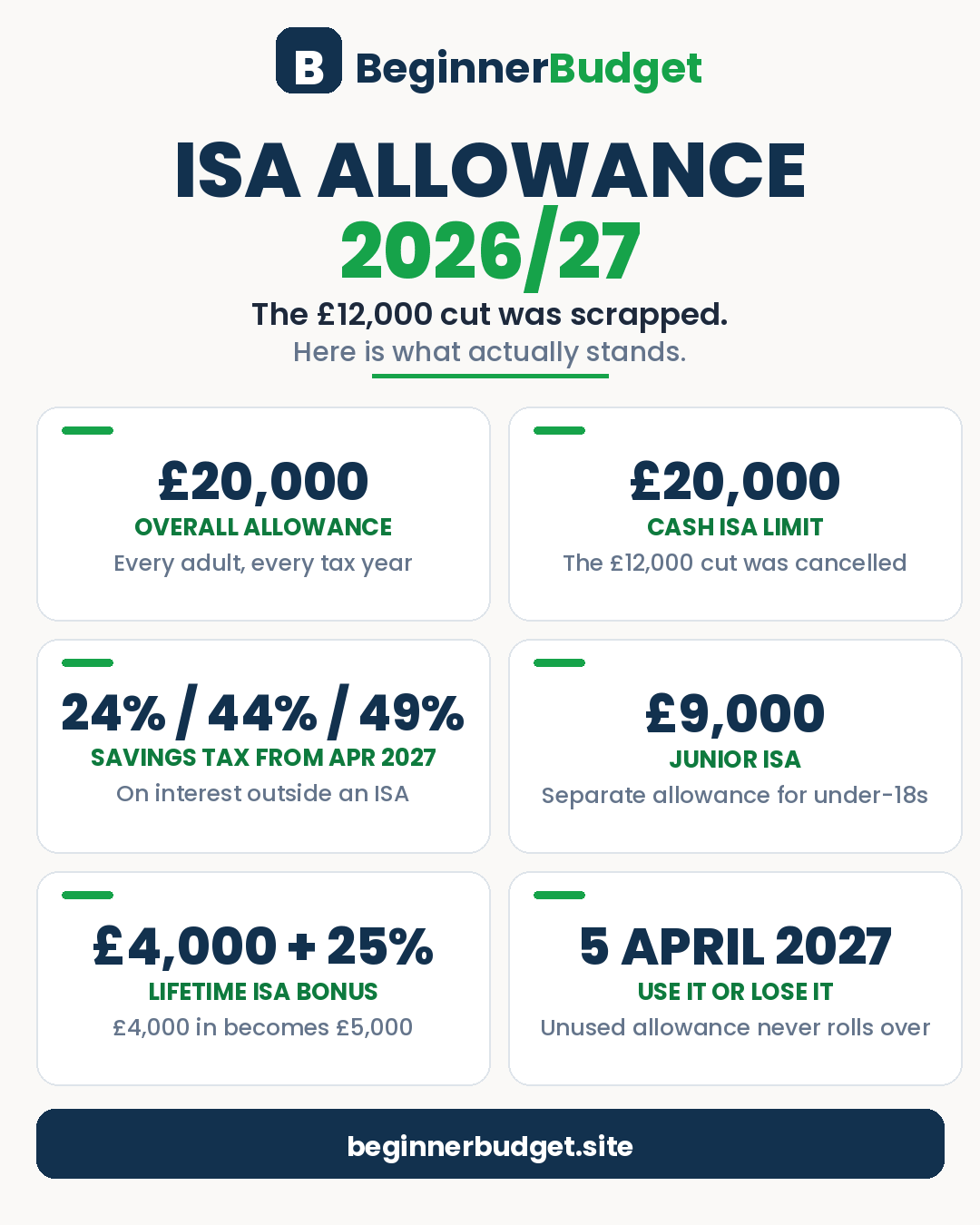
If you've read anything about ISAs this year, you've probably seen the scary headline: "Cash ISA limit cut to £12,000 from April 2027." Forget it. That cut was scrapped at the Budget on 28 October 2026. Your ISA allowance stays at £20,000 — in cash, in investments, or split between the two — and the thing that actually changes in April 2027 is the tax on savings interest held outside an ISA. This guide gives you the post-Budget truth: what your allowance is, what changed, what didn't, and the seven moves worth making before 5 April 2027.
The headline: what actually changed at Budget 2026
Here's the short version, because most of what's ranking on Google right now is out of date. The government did plan to cut the cash ISA limit to £12,000 for under-65s from 6 April 2027. That plan was already law — it was sitting in the Individual Savings Account (Amendment) (No. 2) Regulations 2026. Then, at Budget 2026 on 28 October 2026, the Chancellor reversed it. The Budget's overview of tax legislation and rates (OOTLAR, paragraph 2.5) says the government will "retain the cash ISA limit at £20,000 for all savers over 18 years old from April 2027," with amending regulations to follow in November 2026.
So if you're under 65 and you've been rushing to stuff £20,000 into a cash ISA before April 2027 "while you still can" — relax. You still can after April 2027 too. The deadline that a dozen articles warned you about no longer exists.
What did change, and what most of those same articles get wrong on the numbers, is the tax on savings interest outside an ISA. From 6 April 2027, savings income tax rates rise to 24% (basic rate), 44% (higher rate) and 49% (additional rate) — two points above the 22%, 42% and 47% rates that had previously been legislated (OOTLAR, paragraph 1.1). That makes the ISA wrapper more valuable, not less — which is exactly why the rest of this guide matters.
| Rule | What was planned for April 2027 | What actually happens (Budget 2026) |
|---|---|---|
| Overall ISA allowance | £20,000 | £20,000 — unchanged |
| Cash ISA limit, under 65 | £12,000 | £20,000 — the cut is scrapped |
| Cash ISA limit, 65 and over | £20,000 | £20,000 — unchanged (the age split is now moot) |
| Junior ISA limit | £9,000 | £9,000 — unchanged |
| Lifetime ISA limit | £4,000 | £4,000 — unchanged |
| Tax on savings interest outside an ISA | 22% / 42% / 47% | 24% / 44% / 49% from 6 April 2027 |
One honest caveat: the Budget documents don't say what happens to the side-rules that were built around the cut — the charge on cash held inside a Stocks & Shares ISA, and the ban on transferring from a Stocks & Shares ISA into a cash ISA. Those were tied to the £12,000 cap, and the amending regulations promised for November 2026 should settle them. If you read an article that states those side-rules as settled fact for April 2027, it's guessing. This guide will stick to what's actually confirmed.
Your 2026/27 ISA allowance, explained in plain English
An ISA — Individual Savings Account — is a tax-free wrapper. Money inside it earns interest, dividends or growth without UK tax, year after year. You get a fresh allowance every tax year, which runs from 6 April to the following 5 April. For 2026/27, that allowance is £20,000 per adult. You must be 18 or over for an adult ISA (16 or over for a cash ISA only, under separate rules).
Three things beginners usually get wrong:
- It's £20,000 across all your ISAs combined, not £20,000 each. Put £12,000 in a cash ISA and £8,000 in a Stocks & Shares ISA and you've used the lot. Put £20,000 in one and you can't add to another until next tax year.
- Use it or lose it. Unused allowance doesn't roll over. If you put in £5,000 this year, you can't put in £35,000 next year to catch up. The clock resets every 6 April.
- You can open more than one type in the same year. Cash ISA plus Stocks & Shares ISA in the same tax year is fine, as long as the total stays within £20,000.
Here's how the £20,000 breaks down across the ISA family in 2026/27:
| ISA type | 2026/27 limit | Best for |
|---|---|---|
| Cash ISA | Up to £20,000 (within the overall allowance) | Emergency money and short-term goals — tax-free interest, no risk to the capital |
| Stocks & Shares ISA | Up to £20,000 (within the overall allowance) | Goals 5+ years away — higher long-term growth potential, but value can fall |
| Lifetime ISA | £4,000 (counts toward the £20,000) | First home or retirement — government adds a 25% bonus, so £4,000 becomes £5,000 |
| Innovative Finance ISA | Up to £20,000 (within the overall allowance) | Peer-to-peer lending — higher rates, higher risk, not covered by FSCS in the same way |
| Junior ISA | £9,000 (separate — doesn't eat into your adult allowance) | Children under 18 — a parent or guardian opens it, the child takes control at 18 |
Sources: GOV.UK's ISA guide and the Budget 2026 OOTLAR Annex A rates-and-allowances tables. If a number in this article doesn't trace back to one of those, it's labelled as an illustrative example — and you'll see one of those in the savings-tax section below.

The £12,000 cut that never happened
It's worth understanding how we got here, because the confusion is still everywhere — including in articles published by big banks and trading platforms that haven't been updated since the Budget.
The timeline runs like this. In June 2026, the government published a factsheet setting out the plan: from April 2027, under-65s could put only £12,000 a year into cash ISAs, with the remaining £8,000 of the allowance reserved for investment-type ISAs. The idea was to nudge cautious savers toward the stock market. Draft regulations followed in July 2026, and the final regulations (SI 2026/1018) made it law. Savers over 65 kept the full £20,000 cash limit, from the start of the tax year in which they turn 65.
Then came Budget 2026 on 28 October 2026, and the whole thing was reversed. The cash ISA limit stays at £20,000 for everyone over 18 from April 2027. The government says it will work with industry on a new ISA incentive for first-time investors instead — but that incentive has no design, value or start date yet, so don't make plans around it.
There's a second Budget 2026 change worth knowing if you're saving for a first home. From 29 October 2026, the Lifetime ISA withdrawal charge for buying a property above the £450,000 price cap falls from 25% to 20% (other unauthorised withdrawals still carry the 25% charge). And looking further ahead, a new First Time Buyer ISA is announced from April 2029 — up to £4,000 a year with a 25% government bonus, paid on withdrawal for a first home costing up to £450,000 — which will eventually replace the Lifetime ISA for new savers. Existing Lifetime ISA holders keep their current rules.
So if you're reading an article that still tells you the £12,000 cash limit is coming: it's stale. Check the publication date. Anything written before 28 October 2026 on this topic needs a Budget-2026 correction, and that's exactly the gap this article fills.
The change that did happen: savings tax rises to 24%
Here's the part that should actually change your behaviour. From 6 April 2027, tax on savings interest outside an ISA rises to 24% for basic-rate taxpayers, 44% for higher-rate taxpayers and 49% for additional-rate taxpayers (OOTLAR, paragraph 1.1). Those rates apply across the whole UK.
Now, that doesn't mean every saver pays more. Two protections stay in place: the Personal Savings Allowance lets basic-rate taxpayers earn £1,000 of interest tax-free each year (£500 for higher-rate taxpayers), and the starting rate for savings gives 0% on up to £5,000 for people on low incomes. The Treasury's own line is that most taxpayers won't see a bigger bill from these two changes combined — but if your savings are large enough to blow past your allowances, the extra two points sting.
A worked example makes it concrete (illustrative example — your rates and allowances will differ):
- You hold £30,000 in an ordinary savings account paying 4.5%. That's £1,350 of interest in a year.
- As a basic-rate taxpayer, your £1,000 Personal Savings Allowance covers the first £1,000. The remaining £350 is taxable.
- At the new 24% savings rate, that's £84 of tax. Inside a cash ISA, the same £1,350 would be £0 of tax.
- As a higher-rate taxpayer, only £500 is covered — so £850 is taxable at 44%, which is £374. Inside an ISA: still £0.
That's the honest maths behind the "ISA wrapper is more valuable than ever" line. It's not magic — it's just that the tax drag on unprotected savings gets heavier from April 2027, while the ISA shelter stays exactly the same size. If your total savings are small enough that your interest stays inside your Personal Savings Allowance, an ISA saves you nothing right now — but it still banks tax-free room for the years when your savings grow bigger. That's the judgment call: small saver today, bigger saver tomorrow.
One more thing to check before April: interest rates on cash ISAs themselves. Providers reprice around Budgets and Bank of England decisions, so the "best" cash ISA in November may not be the best in March. Don't chase a headline rate that drops after three months — check whether it's a fixed rate, a variable rate, or a bonus rate with an expiry date.
7 things to do before 5 April 2027
The tax year ends on 5 April 2027. Your 2026/27 allowance dies with it. Here's the checklist, in order:
- Check how much allowance you've used. Add up everything you've paid into ISAs since 6 April 2026. If you're not sure, your provider's app or statement shows year-to-date subscriptions. This one number drives every decision below.
- Use the allowance before you save anywhere else. If you have cash sitting in an ordinary savings account and unused ISA allowance, moving it inside the wrapper before 5 April is usually the single highest-value move on this list. Bed-and-ISA isn't a thing for cash — you just transfer or subscribe.
- Build your emergency fund first. If you don't have one yet, don't start with investing. A cash ISA holding 3–6 months of essential expenses is the foundation everything else sits on — see our guide to building an emergency fund from zero for the step-by-step.
- Split the allowance by goal, not by provider. Cash ISA for money you'll need within a couple of years; Stocks & Shares ISA for money you won't touch for five-plus years. If you want to keep goals visually separate, sinking funds are the same idea applied to your monthly budget.
- Don't let the old £12,000 deadline rush you into investing. If someone told you to "invest £8,000 before April or lose it," that advice expired with the Budget. Investing is worth doing for long-term goals — our guide to how to start investing as a beginner walks through it — but do it because the goal fits, not because a deadline that no longer exists scared you.
- Check what you actually hold. Open your statements and list every account: cash ISA, Stocks & Shares ISA, Lifetime ISA, ordinary savings. If you can't list them off the top of your head, that's the problem to fix — our guide to tracking your spending works just as well for tracking accounts. You can't manage an allowance you can't see.
- Set a calendar reminder for early March 2027. Providers get swamped in the last week of the tax year, and transfers can take days. Do the ISA subscription in March, not on 5 April, when a processing delay could cost you the whole year's allowance.

Cash ISA vs Stocks & Shares ISA after April 2027
With the cut scrapped, the choice goes back to what it always should have been: your time horizon, not a government sub-limit.
| Cash ISA | Stocks & Shares ISA | |
|---|---|---|
| Risk to your capital | None (up to the £85,000 FSCS limit per banking group) | Real — value can fall, especially over short periods |
| Returns | Interest, roughly tracking savings rates | Growth + dividends; historically higher over 10+ years, never guaranteed |
| Access | Usually instant or a few days (fixed-rate versions lock you in) | A few days to sell; flexible ISAs let you replace withdrawals in the same tax year |
| Best for | Emergency fund, house deposit within 2 years, money you can't afford to lose | Retirement top-ups, goals 5+ years away, money you won't panic-sell |
| 2027/28 limit | £20,000 (within the overall allowance) | £20,000 (within the overall allowance) |
The rule of thumb hasn't changed: if you'll need the money within five years, keep it in cash. If you won't need it for five-plus years and you can stomach a 20% dip without selling, investing has historically rewarded patience. The mistake is doing either one for the wrong reason — keeping 20 years of retirement money in cash because you're scared, or investing next year's house deposit because someone on social media told you cash is "dead money." Neither is clever. Match the account to the goal and you'll be fine.
And skip this if it doesn't apply to you: if you're under 18, or saving for a child, the Junior ISA (£9,000 a year, separate from your own allowance) is the wrapper to look at — it just isn't this article's main story.
UK vs USA: what changes
This is a UK-only topic, so the honest USA box is short: the USA has no ISA. There is no American equivalent with the same rules — no £20,000-a-year tax-free wrapper you can fill with cash or investments and withdraw tax-free at any age. American tax-advantaged saving runs through different accounts with different rules: 401(k)s tied to an employer, and Individual Retirement Accounts (IRAs) with their own annual limits, income limits and withdrawal penalties. A Roth IRA is the closest cousin in spirit — you contribute after-tax money and qualified withdrawals are tax-free — but the limits, eligibility rules and penalty structure are entirely different, and it is a retirement account, not a flexible savings wrapper.
If you're a UK reader living in the USA, or vice versa, don't assume your ISA travels with you. Tax residency changes everything about which wrappers work and what gets taxed where. That's a conversation for a qualified adviser, not a blog post — but the first fact to know is that the £20,000 allowance in this article is a UK-resident benefit.
Frequently Asked Questions
What is the ISA allowance for 2026/27?
£20,000 per adult, across all your ISAs combined. The tax year runs from 6 April 2026 to 5 April 2027, and unused allowance doesn't carry forward.
Is the cash ISA limit still being cut to £12,000?
No. The cut for under-65s was planned and even legislated, but Budget 2026 on 28 October 2026 scrapped it. The cash ISA limit stays at £20,000 from April 2027 for all savers over 18. Articles written before the Budget that still describe the cut are out of date.
How much can I put in a cash ISA in 2027/28?
Up to £20,000, within the overall £20,000 ISA allowance — the same as 2026/27. The age split (under-65 vs 65-and-over) no longer matters, because the cut it was attached to was cancelled.
What happens if I don't use my ISA allowance?
Nothing bad — but you lose it. Unused allowance doesn't roll into the next tax year. If you have cash in an ordinary savings account and unused allowance, moving it into an ISA before 5 April is usually worth doing.
Can I have a cash ISA and a Stocks & Shares ISA in the same year?
Yes, as long as the total you pay in across all your ISAs stays within £20,000 for the tax year. You can also split the allowance any way you like — £15,000 cash and £5,000 investments, for example.
What tax do I pay on savings interest outside an ISA from April 2027?
From 6 April 2027, savings income tax rates are 24% (basic rate), 44% (higher rate) and 49% (additional rate), charged only on interest above your Personal Savings Allowance (£1,000 for basic-rate taxpayers, £500 for higher-rate) and any starting-rate-for-savings entitlement.
Should I open a Lifetime ISA or wait for the First Time Buyer ISA?
If you're saving for a first home now, the Lifetime ISA is live today: £4,000 a year plus a 25% bonus, with the withdrawal charge above the £450,000 price cap now 20% instead of 25%. The First Time Buyer ISA doesn't arrive until April 2029 and its final rules aren't set. Don't wait three years for an account that doesn't exist yet if you're buying sooner — but if your purchase is years away, it's worth watching how the new ISA's rules land.
Official sources for the figures in this article: Budget 2026: Overview of tax legislation and rates (GOV.UK) and Individual Savings Accounts (GOV.UK). Tax rules change — check GOV.UK before acting on anything here, and consider regulated advice for large or complex decisions.