
Why Budgets Fail: 7 Fixes That Work in 2026

If your budget has failed before, the budget was probably badly designed — not you. A budget that only works when you are perfectly disciplined, never surprised by a bill, and never tempted by anything fun is not a plan; it is a trap. Real life includes birthdays, car repairs, bad weeks, takeaway cravings and partners who spend differently from you. A budget that survives real life is built for those things from the start. Below are the seven failures that break most budgets, the psychology behind each one, and the exact fix — plus a 30-day reset plan you can start this week.
Why a Failed Budget Feels Like a Personal Failure (It Isn't)
Ask someone why their budget failed and they almost always blame themselves: "I have no discipline," "I'm just bad with money," "I can't stick to anything." That self-blame is the first thing to throw out, because it points at the wrong problem. A budget is a system. When a system fails for most of the people who try it, the system is the problem, not the people.
Think about how most budgets are actually built. Someone sits down on the 1st of the month, full of good intentions, and writes a perfect plan: every pound or dollar assigned, no waste anywhere, fun spending cut to almost nothing. It looks great on paper. Then real life arrives. A friend's birthday dinner. A tyre that needs replacing. A week where cooking every night feels impossible. The plan has no room for any of it, so the first surprise breaks it — and once it is broken, it feels pointless to keep going. That is not a character flaw. That is a design flaw: the plan assumed a perfect month, and perfect months do not exist.
There is a second, quieter reason budgets feel like failures: people judge a budget by whether they followed it exactly, instead of by whether it improved their money. A budget you follow 80% of the time and that leaves you with savings at month-end is a success, even if you overspent on eating out twice. A budget you follow 100% for three weeks and then abandon completely is a failure, even though it looked perfect for a while. The goal is not a flawless spreadsheet. The goal is a system you are still using in six months. Everything in this guide is built around that goal.
One more honest point before the fixes: sometimes the numbers genuinely do not add up. If rent, bills and groceries already exceed your take-home pay, no budgeting technique will fix that — that is an income or housing-cost problem, not a budgeting problem, and it needs a different plan (extra income, cheaper housing, or debt advice). The fixes below assume your essential costs fit inside your income with at least a little room. If they do not, start with our guide to building your first budget and the free debt advice links at the end of this article.
Fix 1: Your Budget Is Too Strict
The failure: You cut every non-essential to zero — no takeaways, no streaming, no coffee with friends, no fun at all — and held on for two or three weeks. Then you snapped, spent far more than the old "normal" in a single weekend, and concluded budgeting does not work for you.
Why it happens: Restriction creates rebound. Psychologists call the pattern the "what-the-hell effect": once a strict rule is broken, the brain treats the whole plan as ruined and gives itself permission to go all the way. It is the same pattern as a crash diet ending in a binge. A budget that bans fun does not remove the desire for fun; it just delays it and makes it bigger.
The fix — budget fun money on purpose: Give yourself a fixed, guilt-free fun line every month, and protect it like a bill. The amount matters less than the fact that it exists. For example (illustrative example, not a rule): if your take-home pay is £2,000 a month, a £60–£100 fun line is 3–5% of income — small enough not to wreck your goals, large enough that a coffee or a takeaway does not feel like a crime. When the fun money is spent, fun spending stops until next month — but it stops because the pot is empty, not because you "failed." That difference matters: an empty pot is a fact, not a verdict on your character.
A useful test: if your budget has no line for anything you enjoy, it is not a budget yet — it is a punishment with a spreadsheet. Add the fun line first, then trim elsewhere. If you want a ready-made split to start from, the 50/30/20 rule already includes a 30% wants category, which is exactly this idea built into a method.
Fix 2: One Slip and You Quit (All-or-Nothing Thinking)
The failure: You overspent on one category — say, groceries went £40 over — and decided the month was ruined. You stopped tracking, stopped checking, and told yourself you would "start fresh next month." Next month, the same thing happened.
Why it happens: Monthly budgets invite monthly verdicts. When the unit of success is the whole month, a single bad week poisons the whole thing. Nobody would judge a fitness plan by one missed gym session, but people judge budgets exactly that way.
The fix — switch from monthly verdicts to weekly resets: Make Monday (or whatever day suits you) your reset day. Every week, you look at the week just gone, move money between categories if needed, and start the new week clean — no matter what last week looked like. Overspent on groceries? Move £20 from fun money to groceries for this week and carry on. The budget is not broken; it is adjusted, which is what budgets are for.
Two rules make weekly resets work. First, never let a bad week roll silently into a bad month: the reset forces you to notice and adjust while there is still time to fix it. Second, never "borrow" from next month to cover this month without writing it down — that is how a small overspend becomes a slow debt spiral. Write the adjustment down, even if it is one line in a notes app. A budget that is adjusted weekly is a living plan; a budget that is only judged monthly is a pass-or-fail exam, and exams get abandoned.
Fix 3: You Budgeted on Gross Pay, Not Take-Home Pay
The failure: Your budget looked fine on paper but the money ran out by the 20th of every month, even though you "followed" it. You felt like you were leaking money somewhere, but you could never find the leak.
Why it happens: Most people know their salary, not their take-home pay — and the gap between the two is large. Income tax, National Insurance (UK) or payroll taxes (USA), pension contributions and student-loan repayments all come out before the money reaches your account. A budget built on the gross figure is over-committed from day one, so it fails no matter how disciplined you are.
The fix — budget only on what actually lands in your account: Open your bank statement and find the real number: the pay that arrived last month, after all deductions. That is your budgeting income. If your pay varies, use the lowest typical month, not the average — averages hide the bad months that break budgets.
| What people budget on | Why it breaks | What to use instead |
|---|---|---|
| Gross salary (before tax) | Overstates income by hundreds a month; the plan is impossible from day one | Take-home pay from your bank statement |
| Best month's pay | Good months fund a lifestyle that bad months cannot sustain | Lowest typical month's pay; treat extra as a bonus |
| Salary ÷ 12 (monthly-paid assumption) | Weekly or biweekly pay does not arrive in neat monthly chunks | Map actual paydays to actual bills (see our biweekly paycheck guide) |
Illustrative example: imagine a UK worker earning £36,000 a year. That sounds like £3,000 a month — but after income tax, National Insurance and a small pension contribution, take-home pay might be around £2,350 a month (illustrative figures only; your exact number depends on your tax code and deductions). A budget built on £3,000 would overspend by roughly £650 every single month. No amount of discipline fixes a £650 planning error. Check your own number today — it takes two minutes and it is the single most common budget fix there is.
Fix 4: You Forgot the Irregular Bills
The failure: Your monthly budget worked beautifully for three months. Then car insurance, a birthday, Christmas, or an annual subscription landed in the same month, and the whole plan collapsed. You paid it on a credit card and spent months catching up.
Why it happens: Monthly budgets only see monthly bills. The biggest budget-breakers are the bills that do not arrive monthly: annual insurance, car tax or MOT, Christmas, birthdays, holidays, school costs, annual subscriptions, and home or car repairs. They are entirely predictable in total — you just do not know exactly which month they will hit. A budget with no line for them is a budget with a hole in it.
The fix — turn irregular bills into a monthly line: List every irregular cost you can think of, add up the yearly total, divide by 12, and save that amount every month into a separate pot. This is called a sinking fund, and it is the single most effective anti-failure device in budgeting.
| Irregular cost (illustrative example) | Yearly total | Monthly sinking-fund line |
|---|---|---|
| Car insurance + car tax/MOT | £600 | £50 |
| Christmas + birthdays | £480 | £40 |
| Annual subscriptions (streaming, apps, memberships) | £240 | £20 |
| Home/car repairs buffer | £360 | £30 |
| Total | £1,680 | £140/month |
The figures above are an illustrative example, not a prescription — your own list will look different, and that is the point. Build your own list, even if it is rough. £140 a month set aside beats a £600 surprise on a credit card every time, and it turns "emergencies" that were actually predictable into ordinary planned spending.

Fix 5: Two People, One Budget, No Agreement
The failure: One partner budgets carefully while the other spends freely, or both partners have different ideas about what "being careful" means. Resentment builds, the budget becomes a source of arguments, and eventually one or both partners quietly stop following it.
Why it happens: A budget is a set of shared priorities, but most couples never actually agree on the priorities — they just share an account and hope. One person thinks takeaways are a reasonable weekly treat; the other thinks they are waste. Neither is wrong, but without an agreement, every purchase becomes a negotiation, and negotiations get exhausting.
The fix — agree the big lines together, then give each person freedom inside them: Sit down once a month (a "money date" — 20 minutes, no blame, snacks help) and agree only the big numbers: rent and bills, total food spending, total savings, and each person's personal allowance. Then stop policing each other's personal allowance. If your partner's allowance goes on trainers and yours goes on books, that is the system working, not failing. Personal allowances turn money from a control issue into a freedom issue, and they end most budget arguments at the root.
For couples starting from scratch, our couple budgeting guide covers joint vs separate accounts, proportional splits for unequal incomes, and how to run the monthly money date. The key rule from that guide applies here too: a budget both partners helped write is a budget both partners will defend.
Fix 6: You Only Look at the Numbers at Month-End
The failure: You tracked everything diligently — every receipt, every transaction — and discovered at the end of the month that you had overspent by £200. Tracking told you where the money went, but it was too late to change where it was going.
Why it happens: Tracking looks backward; budgeting looks forward. A month-end review is an autopsy, not a check-up. By the time you see the problem, the money is gone and the only options left are guilt or a credit card.
The fix — check weekly, while you can still steer: Pick one 15-minute slot a week (Sunday evening works well) and check three numbers only: money in so far, money out so far, and what is left in each big category. If eating out is nearly gone and there are two weeks left, you know now — while you can cook for a few nights — instead of discovering it on the 30th. Weekly checks also catch the invisible leaks early: subscriptions you forgot, delivery fees stacking up, small app purchases that feel like nothing individually. Our spending-tracking guide compares five tracking methods by effort and accuracy, so you can pick one you will actually keep using. The best method is the one you will still be using in three months, not the most detailed one.
Fix 7: You Set It and Forgot It
The failure: You built a good budget once, in January. By June, your rent had gone up, a subscription price had risen, your pay had changed — and the budget still said January's numbers. It quietly stopped matching reality, so you quietly stopped using it.
Why it happens: Budgets decay. Prices rise, pay changes, habits shift, kids grow, cars age. A budget is not a monument; it is a living document. The version that worked six months ago is not supposed to still work unchanged — and treating it as permanent guarantees it will fail.
The fix — schedule two reviews a year, and one rule for life changes: Put two 30-minute budget reviews in your calendar now: one in January and one in July. In each review, update pay, rent, bills, subscriptions and savings targets, and delete categories you no longer use. And adopt one standing rule: any life change (new job, move, new baby, new car, relationship change) triggers a budget review within two weeks, not "sometime." That single rule prevents most slow budget deaths.

The 7 Failures at a Glance
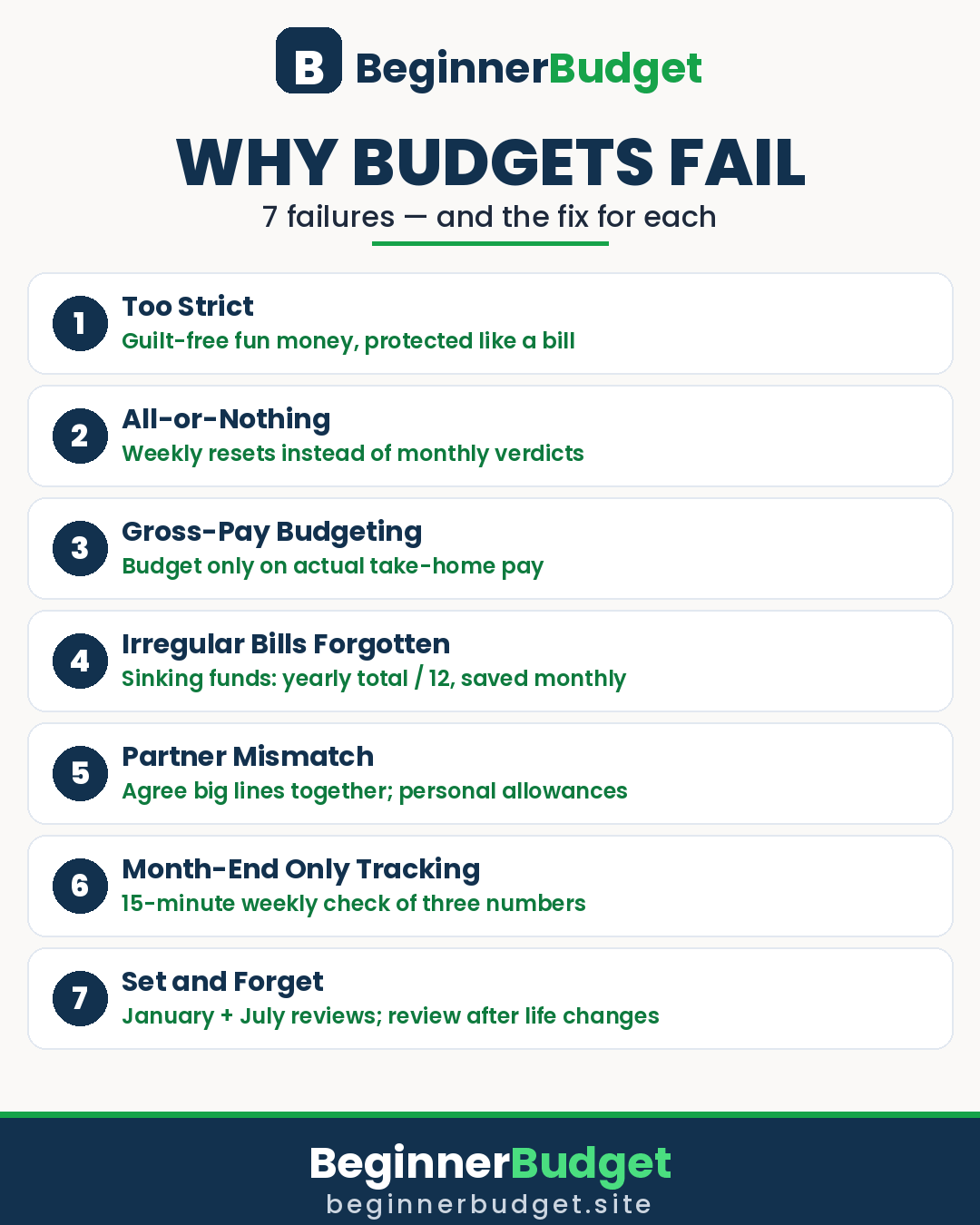
| Failure | Symptom | Fix |
|---|---|---|
| Too strict | Three good weeks, then a big blowout | Guilt-free fun money, protected like a bill |
| All-or-nothing | One overspend ends the whole month | Weekly resets instead of monthly verdicts |
| Gross-pay budgeting | Money runs out by the 20th every month | Budget only on actual take-home pay |
| Irregular bills forgotten | A "surprise" bill wrecks a good month | Sinking funds: yearly total ÷ 12, saved monthly |
| Partner mismatch | Arguments, secret spending, quiet quitting | Agree big lines together; personal allowances for the rest |
| Month-end only tracking | You find out too late to fix anything | 15-minute weekly check of three numbers |
| Set and forget | Budget slowly stops matching reality | January + July reviews; review after any life change |
The 30-Day Budget Reset Plan
If your budget has failed — or if you have never had one that lasted — do not try to fix all seven failures at once. Work this plan week by week. It is deliberately small: each week adds one habit, so by day 30 you have a system instead of a single burst of motivation.
Week 1 — Find your real number. Write down last month's actual take-home pay from your bank statement. Cancel one subscription you do not use. Open a separate savings pot or account for sinking funds, even if it starts empty.
Week 2 — Build the forgiving version. Write a simple budget on take-home pay with four lines only: essentials, fun money, sinking funds, and savings. Keep categories broad — five to eight lines total, not twenty. If you want a structured starting method, the 50/30/20 rule and zero-based budgeting both work; pick the one that feels easier, not the one that sounds more impressive.
Week 3 — Run your first weekly review. On Sunday evening, check your three numbers (in, out, left) and make one adjustment. If a category is empty, move money from another — do not just feel bad about it. Tell your partner or a friend your one money goal for the month; saying it out loud makes it real.
Week 4 — Future-proof it. List your irregular bills and set up the sinking-fund transfer. Put January and July budget reviews in your calendar. Then judge the month honestly: did you end with more saved than last month, even a little? If yes, the reset worked — even if no week was perfect. Keep the system, not the guilt.
If your budget keeps failing because spending feels out of control in a specific area — takeaways, shopping, subscriptions — a short, focused reset can help more than another spreadsheet. Our no-spend challenge guide explains how a 7- or 30-day reset works without turning into another crash diet. And if the real problem is that there is nothing left after essentials, read our emergency fund from zero guide — a £500 starter buffer changes how every future surprise feels.
UK vs USA: What Changes
The seven failures are the same in both countries, but the details differ in ways that matter for your budget:
| Detail | UK | USA |
|---|---|---|
| Take-home pay gap | Income tax + National Insurance + pension auto-enrolment; check your payslip, not your salary | Federal + state tax + Social Security/Medicare + 401(k) or health premiums; your pay stub tells the truth |
| Irregular bills to watch | Car tax, MOT, TV licence, council tax (10 vs 12 monthly payments — check yours), Christmas | Property tax, car registration, health deductibles, holiday spending, quarterly estimated taxes if self-employed |
| Free help if debt is the real problem | StepChange, Citizens Advice, National Debtline — free, confidential advice | NFCC member agencies, CFPB resources — free or low-cost counselling; avoid fee-charging "debt settlement" firms |
| Payday timing | Usually monthly; budget month-to-month | Often biweekly (26 paychecks) — two months a year bring a third paycheck; send it straight to savings |
If debt itself is why your budget cannot work — minimum payments eating everything before you start — that is not a budgeting failure, and no fix in this article will solve it alone. Get free advice first: in the UK, Citizens Advice budgeting help is a good starting point, and MoneyHelper's free budget planner can build your first realistic plan in minutes. In the USA, the Consumer Financial Protection Bureau publishes free budgeting resources. Fixing debt and fixing a budget are different jobs — do them in the right order.
Frequently Asked Questions
Why do I keep failing at budgeting?
Usually because the budget was too strict, built on gross pay, missing irregular bills, or never reviewed — not because you lack discipline. Work through the seven fixes above and find which one matches your pattern; most people recognise theirs immediately. Fix that one first.
How long does it take for a budget to work?
Give any new budget at least three full months before judging it. The first month is mostly discovery — you are learning what you actually spend. The second month is adjustment. By the third month, the numbers start to reflect your real life, and the weekly review starts to feel quick instead of painful.
Should I restart my budget every month?
No — restart weekly, not monthly. A monthly restart turns every slip into a failure. A weekly reset lets you adjust and carry on, which is how a budget survives a whole year. Keep the same budget structure for at least three months and only change the numbers inside it.
Is it normal to overspend in the first month of a budget?
Yes, completely normal — and it is useful information, not failure. First-month overspending usually reveals that the budget was unrealistic (too little for groceries, no fun money, no irregular bills), not that you are bad at budgeting. Adjust the numbers and go again.
What if my partner won't budget?
Do not force a shared spreadsheet on someone who hates spreadsheets. Agree only the big shared numbers (bills, savings, total food) and give each person a personal allowance they control freely. Many reluctant partners join in once the system stops feeling like surveillance and starts feeling like freedom.
Do budgeting apps help if my budgets keep failing?
Apps help with tracking, but they cannot fix a badly designed budget — an app will faithfully track a too-strict plan straight into the same failure. Fix the design first (fun money, sinking funds, weekly reviews), then pick an app that matches the method. Our budgeting mistakes guide covers the other common traps, including app-hopping and over-complicated category systems.