
Winter Fuel Payment 2026: £300, Who Gets It & When

Winter is when heating bills bite hardest, and the Winter Fuel Payment exists for exactly that squeeze. It's a yearly, tax-free payment from the government to help older households with heating costs — not a loan, not something you repay (unless your income tops £35,000), and not something that affects your other benefits. The rules changed in recent years, so what your neighbour got last winter — or what you remember from 2024 — may not match this winter's rules. Here's the current position, checked against GOV.UK: who qualifies, how much you get, when it lands, whether you need to claim, and what to do with the money once it arrives.
Who gets it — and who doesn't
The test has two parts, and both have to be true. First, you must have been born on or before 27 June 1960. Second, you must usually live in England, Wales or Northern Ireland. The amount you get then depends on your circumstances during one specific week — the "qualifying week" of 21 to 27 September 2026. That week has already passed, so your situation during those seven days is what counts, not your situation today.
Most people who qualify get the payment automatically because they already receive the State Pension or another qualifying benefit. That automatic route covers a long list: Pension Credit, Universal Credit, Attendance Allowance, Personal Independence Payment (PIP), Carer's Allowance, Disability Living Allowance, income-related Employment and Support Allowance, War Pensions Scheme awards, Industrial Injuries Disablement Benefit, Incapacity Benefit and Industrial Death Benefit. If you get any of those, DWP already has your details and your bank account — sit tight and watch for the letter.
You won't qualify if any of these applied during the qualifying week: you usually live outside England, Wales or Northern Ireland; you were only visiting the UK during that week but normally live elsewhere; you were in prison for the whole week; you were in hospital getting free treatment for the whole week and the year before it; or your permission to stay in the UK says you cannot claim public funds. These are narrow exclusions, but they trip people up every year — especially the hospital rule, which needs the full week plus the preceding year, not just a short stay.
Care homes have their own wrinkle. You can still get the payment if you live in a care home, at a lower rate (see the table below). The exception: you won't get it if you receive Universal Credit, Pension Credit or income-related ESA and you lived in a care home for the whole time from 29 June 2026 or earlier. If you moved into a care home after that date, or you don't claim those benefits, the care-home rate still applies.
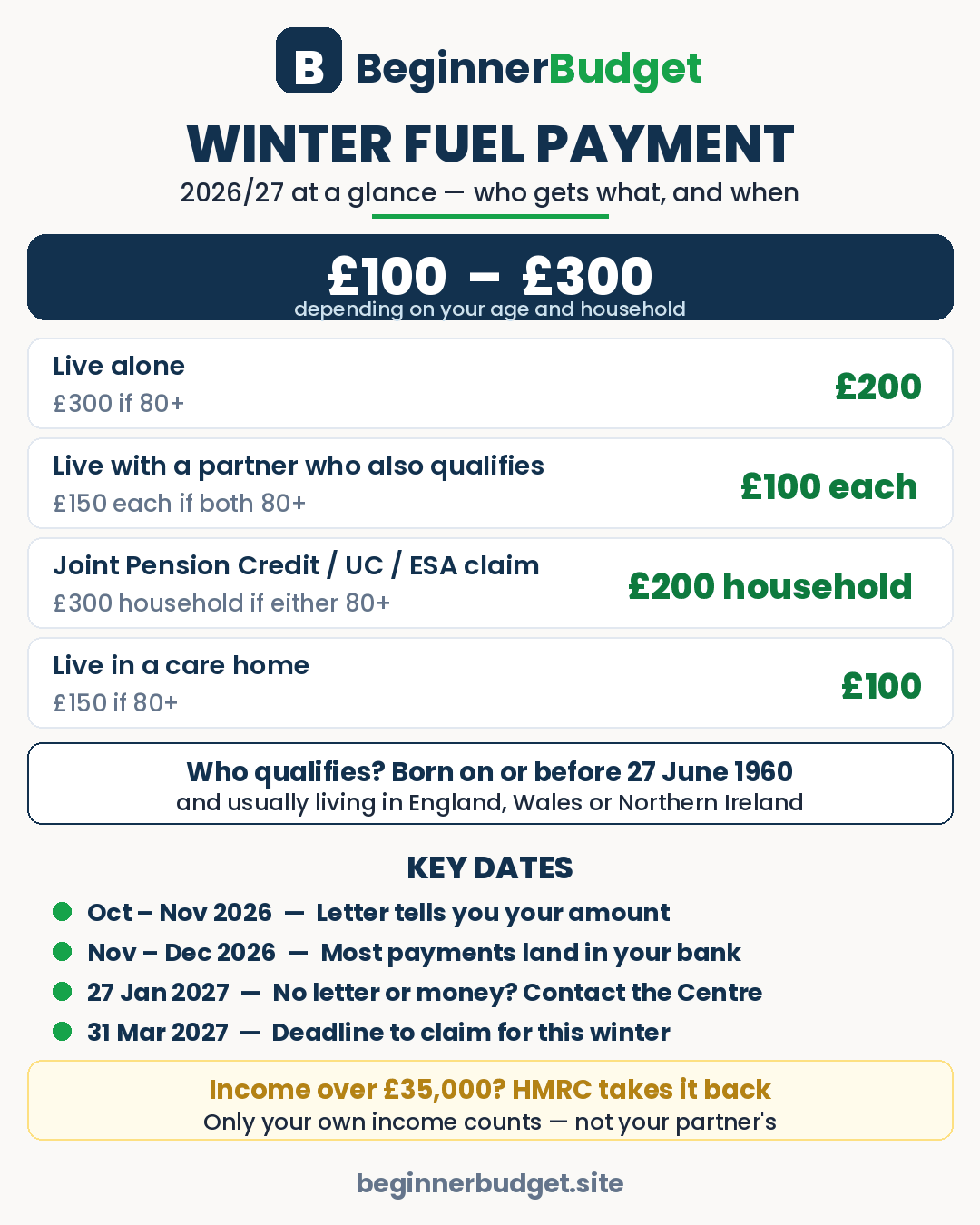
How much you'll get: the full table
Your payment depends on two things: when you were born, and who you lived with during the qualifying week. "Over 80" here means born before 28 September 1946 — that is, aged 80 or over during the qualifying week. Everyone else who qualifies was born between 28 September 1946 and 27 June 1960.
| Your situation (21–27 Sept 2026) | Born 28 Sept 1946 – 27 June 1960 | Born before 28 Sept 1946 (80+) |
|---|---|---|
| You live alone, or nobody you live with qualifies | £200 | £300 |
| You live with someone else who also qualifies, and neither of you gets Pension Credit, Universal Credit or income-related ESA | £100 each | £150 each if both are 80+; £100/£200 split if only one is 80+ |
| You and your partner jointly claim Pension Credit, Universal Credit or income-related ESA | £200 for the household | £300 for the household if either of you is 80+ |
| You get Pension Credit, Universal Credit or income-related ESA (not a joint claim) | £200 | £300 |
| You live in a care home and qualify | £100 | £150 |
Two things worth spelling out. First, the payment is per person in most cases, but a joint benefit claim turns it into one household payment — so a couple jointly claiming Pension Credit gets £200 or £300 between them, not £200 or £300 each. Second, the money doesn't affect your other benefits. It won't reduce your Pension Credit, your housing support or anything else. That's stated plainly on GOV.UK, and it's one of the few benefits where you don't have to worry about a knock-on cut.

The £35,000 clawback, explained
Here's the part that confuses the most people, so let's be precise. Everyone who qualifies gets paid first — including people earning over £35,000. Then HMRC takes it back, but only from the person whose own income tops the threshold. Your partner's income doesn't count toward your total, and your income doesn't count toward theirs. It's individual, not household.
How does HMRC take it back? Usually by changing your tax code, so a bit more tax comes out of your pension or wages each month. If you file a Self Assessment return, it goes through your tax bill instead — and you must include the payment on your return each year you receive it. GOV.UK's own worked example puts the monthly effect at roughly £30 to £33 more tax per month for a £200 payment collected over the year. That's the number to keep in mind if you see your tax code change in January 2027 and wonder why.
There's a timing quirk worth knowing about. HMRC starts collecting the 2026 payment through your tax code in January 2027 — while it may still be collecting the 2025 payment. GOV.UK calls this out directly: if you don't opt out, your tax code changes again in April 2027 to keep collecting the 2026 payment and start collecting the 2027 payment in advance. So for a few months you can be paying back two winters at once. It's not an error, and it's not a penalty — it's just how the collection timetable overlaps. If the double deduction looks wrong, check your tax code notice before assuming a mistake.
One more date: you can no longer opt out of the Winter Fuel Payment for 2026 to 2027 — that window has closed. But you can opt out for 2027 to 2028 from 21 December 2026, if you'd rather not receive a payment that HMRC will only take back. If your income sits just over £35,000, opting out for next winter saves the whole pay-and-claw-back round trip. And if you previously opted out and want back in for this winter, contact the Winter Fuel Payment Centre before 31 March 2027.
When it's paid: dates and the January checkpoint
The timetable for winter 2026 to 2027 runs like this. Letters go out in October or November 2026 telling you how much you'll get and which bank account it will go into — normally the same account your State Pension or other benefits go into. Most payments then land in November or December 2026. On your bank statement, the payment usually shows with your National Insurance number followed by "WFP", so it's easy to spot if you're checking statements.
| When | What happens |
|---|---|
| 21–27 September 2026 | Qualifying week — your circumstances in this week decide eligibility and amount |
| October–November 2026 | Letter arrives: how much you'll get, and which account it goes to |
| November–December 2026 | Most payments made automatically into your bank account |
| 21 December 2026 | Opt-out opens for winter 2027 to 2028 |
| 27 January 2027 | Checkpoint: if you have no letter and no payment by now, contact the Winter Fuel Payment Centre |
| 31 March 2027 | Deadline to claim for winter 2026 to 2027 |
That 27 January 2027 checkpoint matters. Don't wait until spring to chase a missing payment — GOV.UK names that date specifically. If the letter never came and the money never landed, call the Winter Fuel Payment Centre (0800 731 0160) with your National Insurance number to hand. And watch out for scams while you wait: DWP will never call, text or email asking for your bank details or passwords to "release" your payment. Any message that does is a scam — report it and delete it.
Do you need to claim?
Most people don't. If you receive the State Pension or any of the qualifying benefits listed above, the payment is automatic. You only need to claim if you don't get any of those benefits and either you've never had a Winter Fuel Payment before, or you deferred your State Pension since your last payment. That's a small group — but if you're in it, the payment won't just turn up on its own.
Claims for this winter opened by post on 21 September 2026 and by phone on 19 October 2026. To claim by post, fill in the Winter Fuel Payment claim form and send it to the Winter Fuel Payment Centre, Mail Handling Site A, Wolverhampton WV98 1LR. To claim by phone, call the Centre — you'll need your National Insurance number, your bank or building society details, the date you married or entered a civil partnership (if that applies), and to say whether you were in hospital, a care home or prison during the qualifying week. One detail that catches people out: payments can't go into a National Savings & Investments (NS&I) account unless you already get other benefits paid into that account.
The hard deadline is 31 March 2027. Miss it and the payment for this winter is gone — there's no late-claims window. If you think you might need to claim and you're not sure, check sooner rather than later; a five-minute call beats a missed deadline. And if you disagree with a decision on your claim, you can challenge it through mandatory reconsideration — GOV.UK explains that route on the same page.
If your circumstances change — you move house, move into a care home, or anything else that could change your amount — tell the Winter Fuel Payment Centre as soon as possible. An unreported change can mean you're overpaid, and overpayments have to be repaid. The same applies if you were paid by mistake or gave wrong information. Reporting early keeps a small admin fix from turning into a debt letter.
Scotland, Wales and Northern Ireland
England and Wales follow the rules in this guide, and Northern Ireland is covered by the same Winter Fuel Payment scheme. Scotland is the exception: you cannot get a Winter Fuel Payment if you live in Scotland. Instead, the Scottish Government pays the Pension Age Winter Heating Payment through Social Security Scotland. It's a separate scheme with its own rules and payment timetable, so if you live in Scotland, the dates and amounts in this article don't apply to you — check the Pension Age Winter Heating Payment page on mygov.scot instead. The same £35,000 income principle applies there: higher-income pensioners have the payment recovered through the tax system.
If you moved between Scotland and elsewhere during the qualifying week, your usual residence during that week decides which scheme covers you. That's an edge case, but it's exactly the sort of thing worth a call to the relevant payment centre rather than a guess — guessing wrong means claiming from the wrong scheme and waiting months to find out.

What to do with the payment: a simple budget plan
Getting the payment is only half the story. The other half is what you do with it — and this is where most guides stop short. The payment is meant for heating, but nobody checks how you spend it. Spending it well means it actually covers the winter it was paid for, instead of vanishing into the weekly shop in November and leaving January's bill uncovered.
Here's a straightforward split that works for most households. Think of the payment in four parts: heating bills first, a buffer second, debt or arrears third if you have any, and only then anything else. A worked example makes it concrete (illustrative example — adjust the split to your own bills):
| If you get | Heating bills | Winter buffer | Arrears or debt |
|---|---|---|---|
| £200 (living alone, under 80) | £120 — set aside against the next two bills | £50 — held for a cold snap or a higher-than-expected bill | £30 — toward any energy arrears, if you have them |
| £300 (living alone, 80+) | £180 — set aside against the next two bills | £70 — held for a cold snap | £50 — toward arrears, or into your emergency fund if you're clear |
Why hold a buffer instead of spending the lot on the next bill? Because winter bills aren't flat. A cold January can push a monthly direct debit up on review, and a payment that looked generous in November can feel thin by February. If you have no arrears, that buffer money does a second job: it seeds or tops up an emergency fund, so the next surprise — a broken boiler, not just a big bill — doesn't land on a credit card. And if your bills are already under control, check your wider position with our guide to UK energy bills and the winter 2026 price cap, which covers the supplier help and payment plans that sit alongside this payment.
One practical move: when the payment lands, move the buffer portion into a separate pot or account the same day. Money that stays in the current account gets spent by default; money in a separate pot gets spent on purpose. If your bank supports savings pots or spaces, that's a two-minute job. If it doesn't, even a separate basic savings account does the trick — the point is friction, not cleverness.
Other help that stacks with it
The Winter Fuel Payment isn't the only winter help, and the others stack — you don't have to pick one. Check each of these, because missing one is like leaving money on the table:
- Warm Home Discount — £150 off your bill. A one-off £150 discount on your electricity bill (or gas, if your supplier does it that way) if you get Pension Credit or live in a low-income household. Details are on GOV.UK's Warm Home Discount page. Our next guide in this series will cover claiming it step by step.
- Cold Weather Payment — £25 per cold week. If you get certain benefits and the temperature in your area drops to zero degrees or below for seven days in a row, you get £25 for that week. It's automatic for people who qualify — no claim, no form.
- Pension Credit — the one that unlocks the rest. Pension Credit tops up weekly income for pensioners on low incomes, and claiming it also opens the door to the Warm Home Discount, help with housing costs, council tax support and a free TV licence if you're over 75. A surprising number of eligible pensioners don't claim it — check your entitlement on GOV.UK's Pension Credit page, even if you assume you won't qualify.
- Help from your supplier. Suppliers must offer help if you're struggling — payment plans, breathing space, and in some cases grants or debt support. Talk to them early, before arrears build up; the help is much easier to arrange when you're one bill behind than six.
- Council support. Your local council may run a Household Support Fund or similar scheme for essentials, including energy. Rules vary by area, so check your council's website — GOV.UK links to it from the Winter Fuel Payment page.
Put together, the picture is better than any single scheme suggests. A pensioner household on Pension Credit could plausibly receive the Winter Fuel Payment, the £150 Warm Home Discount and Cold Weather Payments in a hard winter — each from a different pot, each automatic or near-automatic once you're in the system. The expensive mistake isn't claiming the wrong thing; it's never checking at all. If you take one action from this section, make it the Pension Credit check — it has the biggest knock-on effect of anything here.
5 mistakes people make with this payment
1. Using last year's dates. The qualifying week and birth cutoff move every year. For winter 2026 to 2027 the week was 21 to 27 September 2026 and the cutoff is 27 June 1960. Articles quoting September 2025 dates are describing last winter, not this one. If a page you're reading doesn't mention 2026 dates, it's stale.
2. Believing the £500 figure. There's no £500 Winter Fuel Payment for this winter. The confirmed range is £100 to £300 per person, straight from GOV.UK. The £500 number circulating online doesn't match any official guidance — ignore it, and be wary of any page that leads with it.
3. Thinking your partner's income counts. The £35,000 threshold is individual. If your income is £20,000 and your partner's is £40,000, your payment isn't clawed back — only theirs is. Couples get this wrong in both directions: some assume they're both safe, others assume they're both caught. Check each person's income separately.
4. Assuming Scotland works the same way. It doesn't. Scotland has its own Pension Age Winter Heating Payment, and the Winter Fuel Payment simply doesn't apply there. If you live in Scotland and you're waiting for a DWP letter, you'll wait forever — check Social Security Scotland instead.
5. Assuming it's automatic when it isn't. If you don't receive the State Pension or a qualifying benefit, and you've never had the payment before, nobody is coming to find you. You have to claim — and the deadline, 31 March 2027, is unforgiving. The people who miss out most often aren't ineligible; they're eligible and never applied.
UK vs USA: is there an American version?
This is a UK-only payment, so the honest USA box is short: there is no American Winter Fuel Payment. The USA has no federal payment that lands in every older household's bank account each winter. What it does have is LIHEAP — the Low Income Home Energy Assistance Program — a federal programme run by states that helps low-income households with heating and cooling costs. It's means-tested, application-based and varies by state, which makes it a very different animal: you apply, you may wait, and the help depends on your state's rules and funding. If you're a UK reader living in the USA, LIHEAP (via your state's energy assistance office) is the closest equivalent to investigate — but don't expect the UK pattern of an automatic payment. And if you're a USA reader wondering whether the UK system applies to you, it doesn't: the payment in this article is tied to UK residence and UK benefits.
For UK readers, the comparison is still useful for one reason: it shows what the Winter Fuel Payment is not. It's not means-tested at the point of payment — everyone eligible gets it, and only the £35,000 clawback sorts out higher earners afterwards. That design is unusual, and it's why the payment reaches millions of households with so little paperwork.
Frequently Asked Questions
Who gets the Winter Fuel Payment in 2026?
People born on or before 27 June 1960 who usually live in England, Wales or Northern Ireland, based on their circumstances during the qualifying week of 21 to 27 September 2026. People in Scotland get the Pension Age Winter Heating Payment instead.
How much is the Winter Fuel Payment for winter 2026 to 2027?
Between £100 and £300. If you live alone or nobody you live with qualifies, it's £200 (or £300 if you were born before 28 September 1946). Couples who both qualify usually get £100 each, or £150 each if both are 80 or over. Care-home residents get £100 or £150.
When will I get my Winter Fuel Payment?
Most payments are made in November or December 2026, after a letter in October or November telling you the amount. If you have no letter and no payment by 27 January 2027, contact the Winter Fuel Payment Centre.
Do I need to claim the Winter Fuel Payment?
Usually not — it's automatic if you get the State Pension or a qualifying benefit such as Pension Credit, Universal Credit or Attendance Allowance. You need to claim only if you get none of those benefits and you've never had the payment before, or you deferred your State Pension since your last payment. The claim deadline is 31 March 2027.
Will the Winter Fuel Payment affect my other benefits?
No. GOV.UK states plainly that the money won't affect your other benefits. It also won't count against Pension Credit or housing support.
What happens if my income is over £35,000?
You still get paid, but HMRC takes the payment back — usually by changing your tax code, or through your Self Assessment tax bill. Only your own income counts, not your partner's. Collection starts in January 2027, and for a few months you may be paying back two winters at once.
Can I opt out of the Winter Fuel Payment?
Not for winter 2026 to 2027 — that window has closed. You can opt out for 2027 to 2028 from 21 December 2026, which suits people over the £35,000 threshold who'd rather skip the pay-and-claw-back cycle.
What if I live in Scotland?
You can't get the Winter Fuel Payment. Scotland pays the Pension Age Winter Heating Payment through Social Security Scotland instead — check mygov.scot for its rules and timetable.
Official sources for the figures in this article: Winter Fuel Payment (GOV.UK), The Warm Home Discount Scheme (GOV.UK) and Pension Credit (GOV.UK). Rules change — check GOV.UK before acting on anything here, and consider regulated advice for large or complex decisions. For a wider view of winter costs, see our guides to the cost of living in the UK in 2026 and the UK Autumn Budget 2026 changes.