
Cash ISA vs Stocks and Shares ISA: 7 Rules to Choose

Ask ten people "cash ISA or stocks and shares ISA?" and you'll get ten confident answers — most of them useless, because they're answering a different question than the one you're actually asking. You're not choosing a winner. You're matching money to a date. This guide gives you the two-question test that settles it, the side-by-side numbers, the April 2027 update that half the internet still gets wrong, and seven rules you can apply to your own £20,000 allowance tonight.
What each ISA actually is
First, the bit that trips up beginners: an ISA isn't an investment. It's a wrapper — a tax-free box the government lets you put money in. What grows inside the box depends on what you put in it.
A Cash ISA is a savings account inside that wrapper. Your bank or building society pays you interest, tax-free. The amount in the account never goes down because of markets — it only goes up as interest lands. Easy-access versions let you withdraw whenever you like; fixed-rate versions pay a bit more but lock the money away for a set term.
A Stocks & Shares ISA is an investment account inside the same wrapper. Your money buys shares, funds, ETFs, or bonds. Dividends and growth inside it are tax-free, same as the cash version. The difference is the value moves — up most years over long stretches, down sometimes, and occasionally down a lot. You can get back less than you put in, and that's not a small-print risk, it's the whole deal.
Both share the same yearly allowance: £20,000 per adult for 2026/27, across all your ISAs combined. That's the detail people mess up most. It's not £20,000 in each — it's £20,000 total. Put £14,000 in cash and £6,000 in investments and you're done for the year. Put £20,000 in one and you can't add to the other until 6 April.
If the allowance itself is new to you, our ISA allowance 2026/27 guide walks through the full family — Lifetime, Junior, and Innovative Finance ISAs included — and the 5 April deadline.
Cash ISA vs Stocks & Shares ISA, side by side
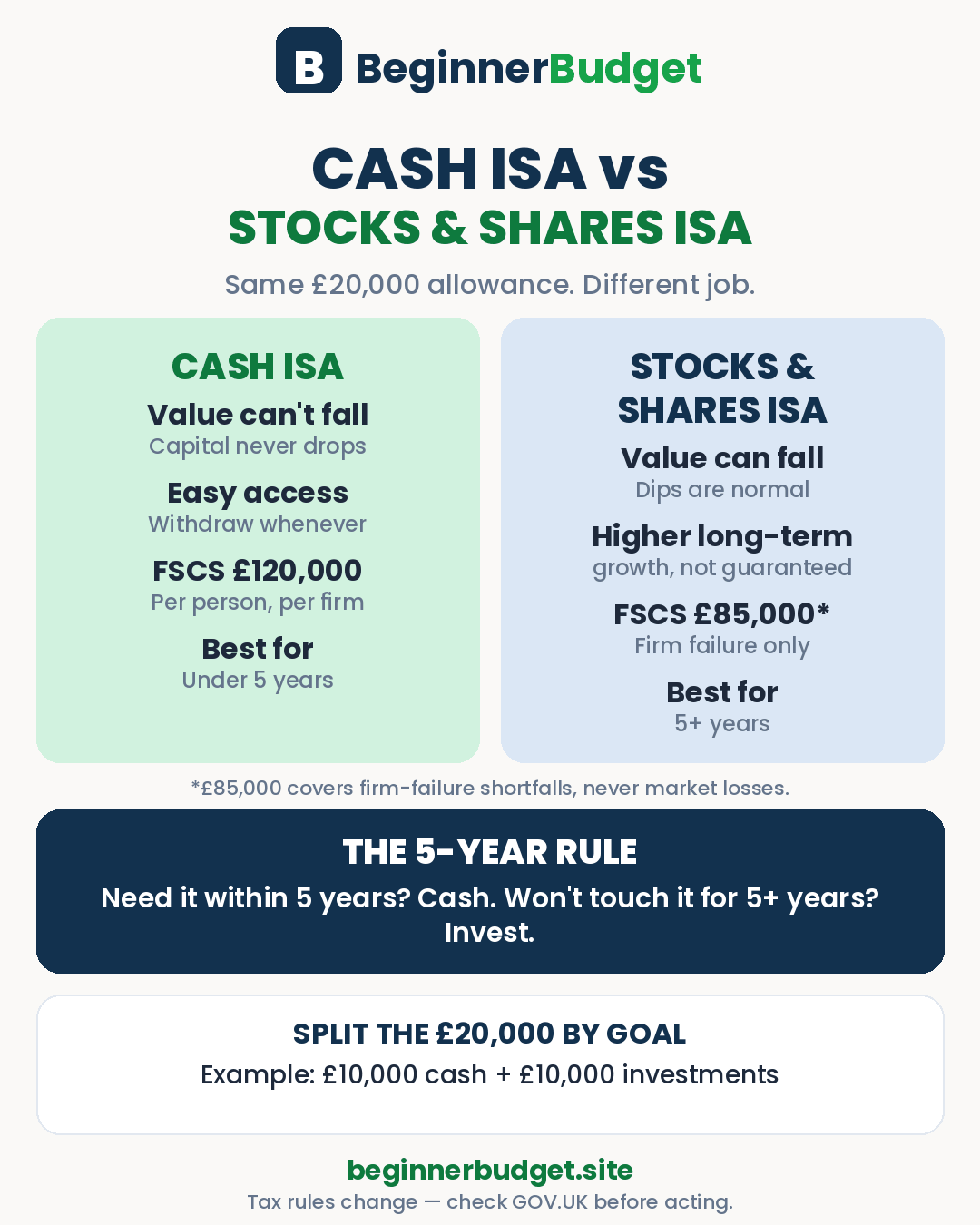
Here's the whole comparison on one screen. Everything after this table is just this table, explained properly.
| Cash ISA | Stocks & Shares ISA | |
|---|---|---|
| What it holds | Cash earning interest | Shares, funds, ETFs, bonds |
| Can the value fall? | No — your capital doesn't drop with markets | Yes — sometimes sharply, over short periods |
| Returns | Interest, roughly tracking savings rates | Growth plus dividends; higher over long periods, never guaranteed |
| Access | Usually instant (easy access) or at term end (fixed rate) | A few days to sell investments, then withdraw |
| FSCS protection | Up to £120,000 per person, per authorised firm, for deposits | Up to £85,000 per person, per firm, for shortfalls if the firm fails — never for market losses |
| Fees | None, typically | Platform fee plus fund charges — check both before opening |
| Best for | Emergency fund, house deposit in 1–2 years, any money you can't afford to lose | Retirement top-ups, goals 5+ years away, money you won't panic-sell |
| 2026/27 limit | Up to £20,000 (within the shared allowance) | Up to £20,000 (within the shared allowance) |
Two rows in that table deserve a closer look, because both get misquoted constantly. First, the FSCS numbers: the deposit limit rose from £85,000 to £120,000 per person, per authorised firm on 1 December 2025. If you're still splitting savings around the old £85,000 line, you're working from stale information. But note the trap: the limit is per authorised firm, not per brand. Two brands can share one banking licence, so £70,000 with each of two same-group brands is £140,000 under one £120,000 limit. Check the licence, not the logo.
Second, the investment side: that £85,000 figure people quote for Stocks & Shares ISAs doesn't cover your investments falling in value. It covers shortfalls if the firm itself fails and something's missing. Your shares are normally held separately from the firm's own money, so a platform going bust doesn't wipe out your portfolio — but a market crash is yours to ride out, and no compensation scheme refunds it.
The April 2027 update most articles get wrong
Here's why this guide exists, honestly. Search this topic right now and the top results are split down the middle — and half of them are out of date. Several ranking pages still state that from 6 April 2027, under-65s can only put £12,000 a year into cash ISAs. That was the plan. It was even written into regulations. Then Budget 2026 on 28 October 2026 cancelled it. The cash ISA limit stays at £20,000 for all savers over 18 from April 2027, within the same £20,000 overall allowance.
So if anyone tells you to rush money into a cash ISA "before the £12,000 cap hits" — that deadline doesn't exist anymore. Don't let a stale article rush you into investing either, by the way: the old advice to "invest the other £8,000 or lose it" died with the same Budget.
What does change on 6 April 2027 is the tax on savings interest held outside an ISA: 24% for basic-rate taxpayers, 44% for higher-rate, 49% for additional-rate. Your Personal Savings Allowance still shelters the first £1,000 of interest a year (£500 if you're a higher-rate taxpayer), so small savers may feel nothing — but once your interest passes those allowances, the ISA wrapper saves you real money. That's the change worth acting on, and it's the opposite of the story most stale articles tell: the wrapper got more valuable, not smaller.
The numbers: what £200 a month really does
Comparisons without numbers are just vibes, so here's a worked example — clearly labelled as illustrative, because nobody can promise you these returns.
Say you put £200 a month away for 10 years. In a cash ISA paying a steady 4% a year (illustrative rate), you'd end up with roughly £29,500. In a Stocks & Shares ISA growing at a steady 6% a year (illustrative rate, and real investing is never steady), you'd end up with roughly £32,800. The gap — about £3,300 — is the reward for taking market risk and leaving the money alone for a decade.
Now flip the time horizon and the story flips with it. Over two years, that same £200 a month in cash is boring and safe: about £5,000 in, a bit of interest on top, nothing lost. In investments, two years is a coin flip — a 20% market fall in year one turns your pot into something like £4,100 even though you did everything right. Same saver, same monthly amount, totally different outcome, all because of the date on the calendar.
That's also why inflation matters, and why "cash is safe" needs a footnote. Cash doesn't lose pounds — but pounds can lose buying power. If prices rise faster than your interest rate for years on end, your cash pile buys less at the end than at the start, even though the number on the statement went up. Over 20-plus years that's the quiet cost of staying entirely in cash. Over two years, it's a rounding error. Time horizon again — it always comes back to that.

7 rules for choosing (the two-question test)
Forget product reviews for a minute. Two questions settle most cases, and the seven rules below cover the rest.
Question 1: When will you need this money? Inside five years — house deposit, wedding, car, emergency fund — cash. Beyond five years — retirement, a child's future, a goal with no fixed date — investing earns its place in the conversation.
Question 2: What will you do when it falls 20%? If the honest answer is "sell everything and swear off investing forever," don't invest that money. The long-run numbers only work if you're still holding when the recovery comes. Selling mid-fall locks in the loss and skips the rebound — the worst of both worlds.
- Under five years? Cash, no debate. MoneyHelper's rough rule says the same: only invest money you won't need for at least five years. A house deposit due in 18 months has no business riding the stock market.
- Emergency fund first, always in cash. Three to six months of essential expenses, somewhere you can reach in days, not weeks. If you don't have one yet, our guide to building an emergency fund from zero is the place to start — before any investing conversation.
- Five-plus years and steady nerves? Invest, and keep it boring. A broad, low-cost index fund beats stock-picking for most beginners, and it beats checking your balance every morning too. Our beginner investing guide walks through the first steps without the jargon.
- Split by goal, not by provider. Same person, different pots: cash ISA for the deposit, Stocks & Shares ISA for retirement. Sinking funds are the same idea applied to your monthly budget — every pound with a job and a date.
- Check the fees before you fall for the fund. A platform fee plus a fund charge, every year, quietly compounds against you. A fund that charges 1% a year needs to beat a 0.2% fund by 0.8% a year just to break even — and most don't, year after year.
- Don't chase last year's winner. The fund at the top of last year's charts is not a prediction, it's history. Picking investments by recent performance is the beginner mistake that costs the most, because it feels like research.
- Never invest money you'll need to panic-sell. Rent money, a tax bill, a deposit with a fixed date — if a market dip would force you to sell at the wrong time, that money was never investment money. Keep it in cash and sleep properly.
How to split your £20,000 allowance
Most people shouldn't pick one ISA and ignore the other. Here's how three realistic splits look — pick the shape that matches your life, then adjust the amounts.
| Split | Who it suits | Why it works |
|---|---|---|
| £20,000 cash / £0 investments | Saving for a house deposit within 2 years, or building an emergency fund | Every pound is safe and reachable; no market risk on money with a deadline |
| £10,000 cash / £10,000 investments | The middle of the road: a near-term goal plus a long-term goal | Cash covers the next few years; investments get a decade to do their thing |
| £5,000 cash / £15,000 investments | Emergency fund already sorted, main goal 10+ years away | Small cash buffer for surprises; most of the money compounding long-term |
Notice what's missing from that table: a split decided by whichever rate looks best this week. Rates change; your goals don't change nearly as fast. Decide the split from the goals, then pick providers inside each half. And remember the allowance resets every 6 April — an unused slice of this year's £20,000 doesn't roll over, so the split is worth doing before the tax year ends, not after.

5 mistakes that cost people real money
- Investing the house deposit. The classic one. A 15% market dip six months before exchange doesn't just hurt — it can cost you the purchase. Deposits live in cash, full stop.
- Keeping 25 years of retirement money in cash. The mirror-image mistake. Safe in pounds, quietly shrinking in buying power. If the goal is decades away and you can handle the ride, cash-only is the expensive choice.
- Opening a Stocks & Shares ISA and then day-trading inside it. The wrapper is tax-free, but the behaviour isn't free — frequent trading racks up costs and usually underperforms sitting still. Boring beats busy, almost every time.
- Forgetting the 5 April deadline. Unused allowance is gone for good on 6 April. Providers get swamped in the final week and transfers can take days — do it in March, not on deadline day.
- Holding far more than £120,000 cash with one banking group. Above the FSCS deposit limit, the excess isn't protected if that firm fails. Spread large cash piles across separately licensed firms — and check the licence, not just the brand name.
Transfers, flexible ISAs, and switching later
Nothing here is permanent, which is worth knowing before you agonise over the choice. You can transfer a Cash ISA to another provider, or to a Stocks & Shares ISA, without losing the tax-free status — as long as you use the provider's transfer process and never withdraw and re-pay the money yourself (withdrawing can cost you that year's allowance room). Transfers usually take a couple of weeks for cash, longer for investments, so don't start one the week you need the money.
One feature to look for when comparing cash ISAs: flexibility. A flexible ISA lets you withdraw money and pay it back in the same tax year without it counting twice against your allowance. Not all ISAs offer it, and it matters most for emergency funds — the pot you're most likely to dip into and top back up. Ask before you open, not after you withdraw.
Also worth a plain warning: rules change. Budget 2026 just proved it — a cut that was already law got cancelled in a single speech. Check the current GOV.UK ISA rules before acting on anything here, especially if you're reading this months after publication, and get regulated advice for large or complicated decisions. This guide is education, not personal financial advice.
UK vs USA: what changes
Short box, because this is a UK-only topic: the USA has no ISA. There's no American account with the same £20,000-a-year, cash-or-investments, withdraw-anytime tax-free setup. American tax-advantaged saving runs through different accounts with different rules — employer 401(k)s, and Individual Retirement Accounts (IRAs) with their own annual limits, income limits, and withdrawal penalties. A Roth IRA is the closest cousin in spirit — you contribute after-tax money and qualified withdrawals come out tax-free — but the limits, eligibility rules, and penalty structure are entirely different, and it's a retirement account, not a flexible savings wrapper.
If you're a UK reader living in the USA, or the other way round, don't assume your ISA travels with you. Tax residency changes which wrappers work and what gets taxed where. That's a conversation for a qualified adviser — but the first fact to know is that the £20,000 allowance in this article is a UK-resident benefit.
Frequently Asked Questions
Which is better, a Cash ISA or a Stocks & Shares ISA?
Neither, on its own. Cash wins for money you need within about five years, because its value can't fall. Stocks & Shares wins for money you won't touch for five-plus years, because investments have historically grown more over long periods — with falls along the way. Match the account to the date, not to a headline.
Can I have a Cash ISA and a Stocks & Shares ISA in the same year?
Yes. You can pay into both in the same tax year, as long as the total across all your ISAs stays within the £20,000 allowance. Split it any way you like — £15,000 cash and £5,000 investments, for example.
Is the cash ISA limit really still £20,000 from April 2027?
Yes. The planned £12,000 cash limit for under-65s was scrapped at Budget 2026 on 28 October 2026. Articles written before that Budget that still describe the cut are out of date.
Is my money safe in a Stocks & Shares ISA?
Your investments aren't protected against market falls — that's the risk you accept. What is protected: your assets are normally held separately from the platform's own money, and the FSCS covers up to £85,000 per person, per firm, for shortfalls if the firm fails. Cash deposits, including cash inside a Cash ISA, are protected up to £120,000 per person, per authorised firm.
What happens if the market falls just after I invest?
Nothing, unless you sell. Falls are normal and expected — the long-run case for investing only works if you stay invested through them. If a fall would force you to sell because you need the money, that money shouldn't have been invested in the first place.
Can I transfer money from a Cash ISA to a Stocks & Shares ISA?
Yes, using the new provider's ISA transfer process — don't withdraw and re-pay it yourself, or you can lose allowance room. Cash transfers usually take a couple of weeks; investment transfers take longer.
Does a Cash ISA beat inflation?
Sometimes, not always. If your interest rate beats price rises, your money gains buying power; if it doesn't, your pile grows in pounds but buys less. Over short periods this barely matters. Over decades, it's the main reason long-term money usually belongs in investments.
Official sources for the figures in this article: Individual Savings Accounts (GOV.UK), Banks, building societies and credit unions (FSCS), and Budget 2026: Overview of tax legislation and rates (GOV.UK). Tax rules change — check GOV.UK before acting on anything here, and consider regulated advice for large or complex decisions.