
15 Ways to Cut Energy Bills UK 2026: Save £313 a Year

Your energy bill went up again, and it feels like there's nothing you can do about it. There is — just not the thing the headlines talk about. You can't change the price cap, you can't negotiate with Ofgem, and you can't control wholesale gas prices. What you can control is how much energy your home actually uses, and that's where every pound of saving in this guide comes from. Fifteen changes, ranked by what they save, with the honest numbers where official ones exist and no made-up figures where they don't.
Your bill in 60 seconds: what you're actually paying for
Every UK gas and electricity bill has two parts, and mixing them up is why so many "money-saving" tips disappoint. The unit rate is what you pay for each kilowatt-hour (kWh) you use. The standing charge is a fixed daily fee for being connected at all — you pay it even if you use nothing. Cutting your usage only shrinks the first part, so it helps to know both numbers before you start.
From 1 October to 31 December 2026, the Ofgem price cap winter 2026 guide puts the average Direct Debit rates in England, Scotland and Wales at 26.32p per kWh for electricity and 7.97p per kWh for gas, with standing charges of 54.83p a day for electricity and 29.68p a day for gas. Add those two standing charges together and you get 84.51p a day — about £308 a year — before you've switched a single light on. That's not a reason to give up; it's a reason to focus on usage, because usage is the only part you control.
| What you're paying | Electricity (Oct–Dec 2026) | Gas (Oct–Dec 2026) |
|---|---|---|
| Unit rate | 26.32p per kWh | 7.97p per kWh |
| Standing charge | 54.83p per day | 29.68p per day |
| Typical annual bill (cap figure) | £1,723 for a typical dual-fuel household paying by Direct Debit | |
One more thing the headlines usually skip: £1,723 is not a maximum bill. It's what a typical household using a typical amount would pay at those rates over a year. Use more than typical and you pay more; use less and you pay less. That's the whole game, and it's a game you can win. Also note the cap only covers standard variable tariffs in Great Britain — if you're on a fixed deal, your rates are locked until the fix ends, and Northern Ireland has its own separate system.
The 15 changes, ranked by saving
Don't try to do all 15 this weekend. Start at the top of the table and stop when the next change feels like more hassle than it's worth to you. The first three rows alone cover most of the money for most homes.
| # | Change | Cost | Typical saving |
|---|---|---|---|
| 13 | Check your tariff and pay by Direct Debit | Free | Varies — often the biggest single lever |
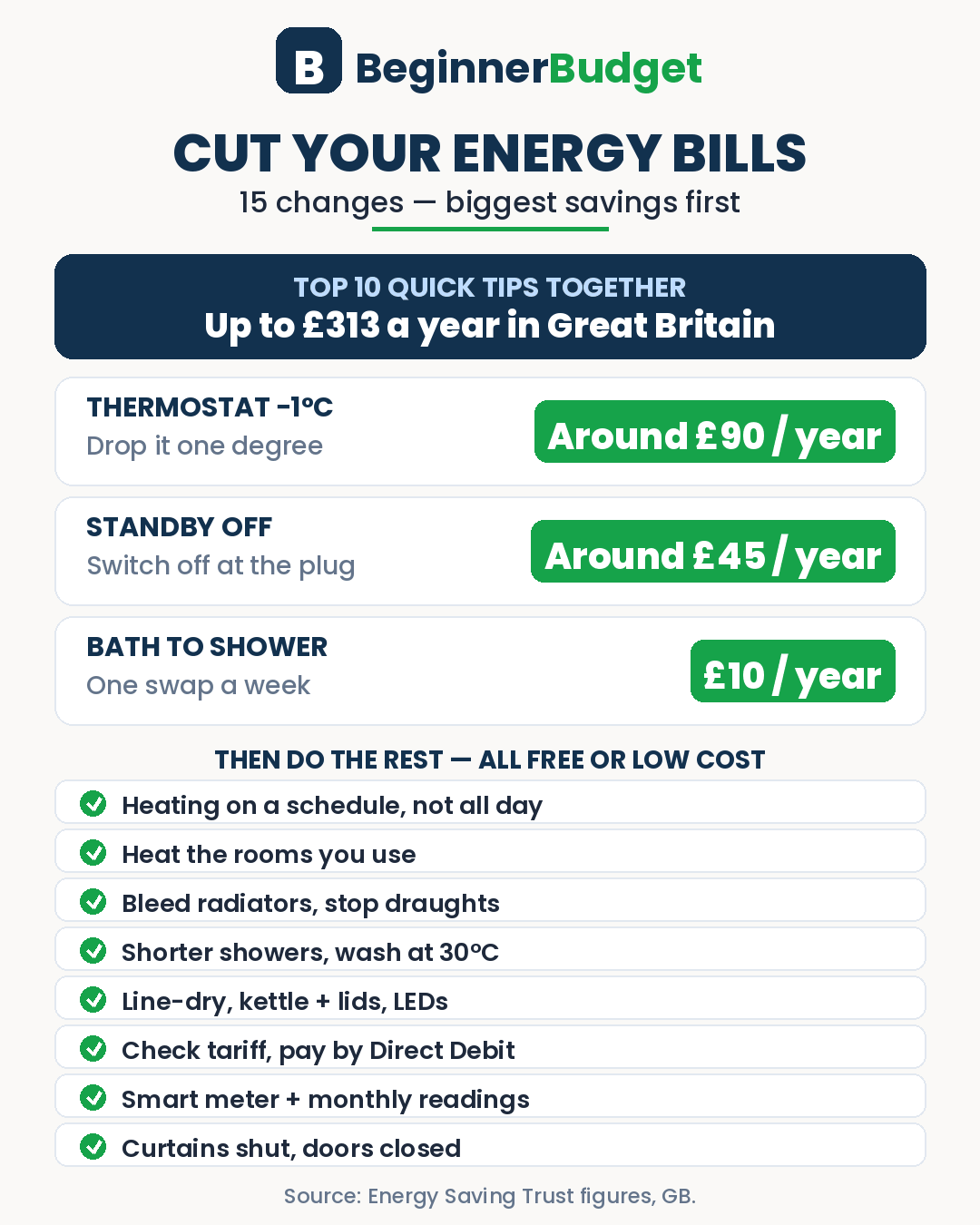
| 1 | Drop the thermostat by 1°C | Free | Around £90 a year (Energy Saving Trust, GB) |
| 11 | Switch appliances fully off, not standby | Free | Around £45 a year (Energy Saving Trust, GB) |
| 7 | Swap one bath a week for a 4-minute shower | Free | £10 a year (Energy Saving Trust, GB) |
| 2 | Put heating on a schedule | Free | Varies — stops paying to heat an empty home |
| 3 | Heat the rooms you use (TRVs / zone control) | Free–low | Varies — big in larger homes |
| 4 | Bleed radiators and keep them clear | Free | Varies — a cold radiator is wasted heat |
| 5 | Draught-proof doors, windows and letterbox | Low | Varies — comfort gain is immediate |
| 6 | Shorter showers | Free | Varies — every minute off a power shower helps |
| 8 | Wash at 30°C, full loads only | Free | Varies — heating water is the expensive part |
| 9 | Line-dry instead of tumble drying | Free | Varies — tumble dryers are hungry machines |
| 10 | Kettle, lids and small-appliance cooking | Free | Varies — small wins, daily |
| 12 | Switch to LEDs | Low | Varies — LEDs use far less than old halogens |
| 14 | Get a smart meter and submit readings | Free | Varies — stops estimated-bill surprises |
| 15 | Curtains shut, doors closed | Free | Varies — keeps paid-for heat in the room |
Where a figure above says "around £90" or "around £45", that's the Energy Saving Trust's figure for Great Britain — not a guess, and not a promise for your home. Where it says "varies", that's honest too: your saving depends on your home, your tariff and how much you currently use. Any guide that gives you a precise pound figure for draught-proofing your specific front door is inventing it.
Heating: changes 1–5
Heating is the biggest slice of most UK energy bills, so it's where the biggest savings live. If you only change one thing this winter, change something in this section.
1. Drop the thermostat by 1°C
Turn it down one degree — from 21°C to 20°C, say — and live with it for a week. The Energy Saving Trust puts the saving at around £90 a year in Great Britain for a gas-heated home. Most people stop noticing after a couple of days, especially with a jumper on. Don't go below 18°C if anyone in the home is elderly, very young, or has a health condition that makes cold risky; saving money is never worth a cold-related illness.
2. Put your heating on a schedule
Heating an empty house all day is paying to keep your furniture warm. Set the timer so the heating comes on 30 minutes before you get up and before you get home, and goes off when you're out or asleep. A home holds its heat for a while after the boiler stops, so you won't wake up freezing — you'll just stop paying for hours nobody benefits from.
3. Heat the rooms you use
If your radiators have thermostatic valves (the numbered knobs), turn down the ones in rooms you barely use — the spare bedroom, the hallway — and keep the living areas comfortable. Close the doors to the cooler rooms so the warm air stays where you are. In a bigger home this one change can matter more than any gadget, because you're shrinking the space you're paying to heat.
4. Bleed your radiators and keep them clear
Feel the top of each radiator when the heating's been on a while. Cold at the top and warm at the bottom means trapped air, and trapped air means the radiator can't do its job — so the boiler runs longer for the same warmth. Bleeding takes a radiator key and two minutes per radiator, and there are free step-by-step videos from suppliers if you've never done it. While you're at it, don't dry clothes on radiators or push the sofa hard against one: both block the heat from reaching the room.
5. Draught-proof the gaps
Hold your hand near the front door, the windows and the letterbox on a windy day. If you can feel cold air coming in, that's warm air — paid-for warm air — going straight out. Self-adhesive draught strips and a letterbox brush cost a few pounds, fit in an afternoon, and make the house feel warmer at the same thermostat setting. That comfort gain is the real prize here: a draught-free room at 19°C feels warmer than a draughty one at 21°C.
Hot water: changes 6–7
Hot water is the second-biggest energy user in most homes, and it's the one people waste without noticing, because the cost hides inside a shower or a bath that feels free.
6. Shorten your showers
A power shower can chew through a surprising amount of energy, because it's heating water as fast as it pours it away. Cutting a daily shower from 8 minutes to 4 roughly halves that cost, and a shower timer or a favourite 4-minute song makes it easy to stick to. You don't need a cold shower or a miserable one — just a shorter one.
7. Swap one bath a week for a shower
A bath uses far more hot water than a short shower. The Energy Saving Trust says swapping just one bath a week for a 4-minute shower saves £10 a year in Great Britain. That's only one swap, one person, one week — a household of four making the same swap saves more, and nobody's asking you to give baths up entirely. Keep the Sunday bath. Just don't take one every night out of habit.

Kitchen and laundry: changes 8–10
8. Wash clothes at 30°C, and only full loads
Most of a washing machine's energy goes on heating the water, not spinning the drum. Modern detergents clean fine at 30°C for everyday washing, so save the hot washes for bedding, towels and anything actually dirty. And wait for a full load: two half loads use roughly twice the energy of one full one, for the same pile of clothes.
9. Line-dry when you can
Tumble dryers are among the hungriest appliances in the house. A washing line, a clothes horse near (not on) a radiator, or an airer in a ventilated room costs nothing to run. If you must tumble dry, spin the load at high speed first so there's less water to evaporate, and clean the filter every time — a clogged filter makes the machine work harder and longer.
10. Cook smarter: kettle, lids, small appliances
Only boil the water you need in the kettle — boiling a full kettle for one cup wastes energy twice over, because you pay to heat water you pour away. Put lids on pans so food cooks faster on a lower heat, match the pan to the ring size, and for small meals use the microwave or air fryer instead of heating the whole oven. None of these saves a fortune alone. All of them together, every day, add up.

Standby and lighting: changes 11–12
11. Switch appliances fully off at the plug
TVs, games consoles, set-top boxes and chargers sip power all day on standby. The Energy Saving Trust puts the total at around £45 a year in Great Britain — and in Northern Ireland around £55. A switched extension lead by the TV turns the whole lot off with one click at bedtime, so you don't have to crawl behind the furniture every night. Leave the fridge, the router if you need it overnight, and anything with a timer alone; everything else can go off.
12. Switch to LEDs
If any bulb in your home is still an old halogen, swapping it for an LED is one of the cheapest upgrades there is. LEDs use a fraction of the electricity for the same light and last far longer, so the bulb pays for itself and then keeps saving. Do the rooms you use most first — kitchen, living room, hallway — and work through the rest as old bulbs die.
Tariff, payment and meter: changes 13–14
13. Check your tariff — and how you pay
This is the change people skip because it sounds boring, and it's often the one worth the most. First, check what tariff you're on: if your fixed deal has ended, you've probably rolled onto your supplier's standard variable tariff, which follows the price cap. Compare fixed deals against the cap before you switch — a fix below the cap saves money if prices rise, but check the exit fees and the length before you commit. Second, check how you pay. Paying by monthly Direct Debit is usually the cheapest payment method, because suppliers charge more for paying on receipt of bill or by prepayment in many cases. One phone call or a few clicks in your supplier's app can change both, and it's worth doing before winter, not during it.
14. Get a smart meter, and read your meter anyway
A smart meter sends readings to your supplier automatically, so your bills reflect what you actually used instead of an estimate. Suppliers fit them free in Great Britain — ask yours if you don't have one. But even with a smart meter, glance at your usage once a month: the in-home display shows what each appliance costs to run in real time, and that feedback is what actually changes habits. If you don't have a smart meter yet, submit a reading every month yourself. Estimated bills are how people end up with a nasty catch-up bill in January.
If bills are already a struggle, talk to your supplier before you fall behind — under Ofgem's rules they have to work with you on a payment plan you can afford. The grants section below lists the help worth checking, including the £150 Warm Home Discount rebate.
Keeping the heat you paid for: change 15
15. Curtains shut, doors closed
Close the curtains when it gets dark — they add a layer of insulation over the coldest surface in the room, the window glass. Open them on sunny winter days to let free heat in, then shut them at dusk. And keep internal doors closed so the warm rooms stay warm and the cool rooms stay cool, instead of everything settling at a lukewarm average you're still paying full price for. It sounds too simple to matter. Try it for a week and feel the difference in the evening.
Grants and help if you're struggling
Cutting usage helps, but if the bill itself is unaffordable, check the help that exists before you cut back on heating you actually need. Start with the Warm Home Discount guide: eligible households in Great Britain get a £150 rebate on their electricity bill. Then check the bigger schemes — the Energy Company Obligation (ECO4) can fund insulation and heating upgrades in less efficient homes, the Great British Insulation Scheme covers single insulation measures for a wider group, and the Boiler Upgrade Scheme offers a grant toward a heat pump in England and Wales. Eligibility depends on your benefits, income and home, so treat any list as a starting point and check the official criteria before you assume you qualify. If you're on a low income more broadly, our guide on how to save money fast on a low income covers the other support worth claiming alongside energy help. And if you're behind on payments, talk to your supplier first and ask about the Priority Services Register if you're elderly, disabled, or have a health condition — it gives extra free services, like bills in accessible formats and advance notice of planned power cuts.
Renting? Here's what you can still do
Renters get told energy saving is a homeowner's game. It isn't. Almost everything in this guide needs no permission: thermostat, schedule, showers, washing, standby, LEDs, tariff, meter readings, curtains. The two things that do need a landlord's say-so are draught-proofing that changes the property and any insulation or heating upgrade — and for those, it's worth asking in writing, because a warmer, cheaper-to-run flat is easier to let. Ask for the property's Energy Performance Certificate too: it rates the home from A to G and lists recommended improvements, and it tells you what you're moving into before you sign. If the EPC is poor and the rent reflects a warm, efficient home, that's a negotiation point, not just a complaint.
Your first-week plan
Don't try to do everything at once. Here's the order that gets you the most saving for the least effort:
- Day 1: Drop the thermostat 1°C, set the heating schedule, and switch the TV setup fully off at the plug tonight.
- Day 2: Log in to your supplier's app, check your tariff and payment method, and submit a meter reading.
- Day 3: Bleed any cold-topped radiators and fit draught strips on the front door.
- Day 4: Set showers to 4 minutes, wash the next load at 30°C, and hang it to dry.
- Day 5: Swap remaining halogen bulbs in the rooms you use most for LEDs.
- Day 6: Check Warm Home Discount eligibility and any grant you might qualify for.
- Day 7: Look at your smart meter display or your usage for the week, and keep the three changes that felt easiest. The ones that stick are the ones that save.
5 mistakes that quietly waste money
- Leaving the heating on all day "because it's cheaper." It isn't, for most homes. Heating an empty house costs more than reheating it — a timer beats an all-day burn.
- Cranking the thermostat to 30°C to warm up faster. The boiler doesn't heat faster at a higher setting; it just overshoots and wastes energy. Set the temperature you want and let it get there.
- Paying estimated bills for months. Estimates drift, and the correction always lands at the worst moment. One reading a month keeps you honest.
- Buying gadgets before fixing habits. A smart thermostat in a draughty house with the heating on all day saves less than a £5 draught strip and a timer. Habits first, gadgets second.
- Ignoring the tariff check because the cap "protects" you. The cap limits rates, not your bill, and a fix below the cap or a cheaper payment method can beat it. Check once before winter, every year.
UK vs USA: what changes
The UK system in this guide — Ofgem's price cap, standing charges, Direct Debit, the Warm Home Discount — is specific to Great Britain. In the USA there's no national price cap: electricity and gas are regulated state by state, prices vary widely by region and provider, and many households buy from a single local utility with time-of-use plans instead of a national cap. The habits still travel — thermostat discipline, shorter showers, standby, LEDs and washing at cooler temperatures save energy anywhere — but the tariff, grant and meter advice doesn't. If you're reading from the USA, check your utility's own rebate and assistance programmes (many offer free energy audits and low-income discounts) instead of the UK schemes above. And if you're budgeting across both countries, our beginner's budgeting guide shows how to build energy costs into a monthly budget that works in either system.
Worked example: what the savings add up to
Here's an illustrative household — not a promise, just arithmetic from the official figures in this article. Take a typical dual-fuel home at the October–December 2026 cap figure of £1,723 a year, of which about £308 is standing charges you can't avoid by using less. Now apply three Energy Saving Trust figures: thermostat down 1°C (around £90), standby fully off (around £45), and one bath a week swapped for a 4-minute shower (£10). That's £145 a year from three free changes, before any tariff saving, any draught-proofing, or any shorter showers. The Energy Saving Trust's combined figure for its top 10 quick tips is up to £313 a year in Great Britain — which shows the ceiling when you stack the habits together. Your number will differ: smaller flat, smaller saving; bigger house, bigger saving. But the direction is the same, and the first three changes cost nothing to try.
Frequently Asked Questions
What is the cheapest way to reduce energy bills in the UK?
Start free: drop the thermostat 1°C, put heating on a schedule, switch appliances fully off instead of standby, and check your tariff and payment method. Those four changes cost nothing and cover the biggest savings for most homes, before you spend a penny on draught strips or LEDs.
Does turning the thermostat down by 1 degree really save money?
Yes. The Energy Saving Trust puts the saving at around £90 a year in Great Britain for a gas-heated home. You won't feel much difference after a few days, especially with a jumper — but keep it at 18°C or above if anyone in the home is elderly, very young, or vulnerable to cold.
Is it cheaper to leave the heating on all day?
For most homes, no. Heating an empty house all day costs more than letting it cool and reheating it before you get home. A timer that runs the heating around when you're actually in is cheaper than an all-day burn, and a well-insulated home holds its heat longer than people expect.
Do smart meters actually save money?
The meter itself doesn't save anything — reading it does. A smart meter ends estimated bills and shows what you're using in real time, and that feedback is what changes habits. Suppliers fit them free in Great Britain; ask yours if you don't have one yet.
What help is there if I can't afford my energy bills?
Talk to your supplier first — under Ofgem's rules they must work with you on an affordable payment plan. Then check the Warm Home Discount (£150 rebate for eligible households), ECO4 and the Great British Insulation Scheme for home upgrades, and the Priority Services Register if you're elderly, disabled, or have a health condition.
Should I fix my energy tariff or stay on the price cap?
It depends on the fix on offer. Compare the fixed unit rates and standing charge against the current cap rates (26.32p/kWh electricity, 7.97p/kWh gas for October–December 2026), check the exit fees and the fix length, and remember the cap changes every three months. A fix below the cap protects you if prices rise; a fix above it only makes sense if you value certainty over price.
Official sources for the figures in this article: Energy price cap unit rates and standing charges (Ofgem), Help with your energy bills (Energy Saving Trust), Warm Home Discount (GOV.UK) and Energy Company Obligation (GOV.UK). Rates change quarterly — check Ofgem before acting on anything here, and get qualified advice for heating or insulation work.