
Warm Home Discount 2026: 5 Steps to Claim Your £150

Here's the honest version of this scheme: most people who qualify will get the £150 without lifting a finger, and the people who miss out usually miss out for boring, fixable reasons — a letter they ignored, a name missing from the bill, or a deadline they didn't know existed. This guide covers all three, so the money actually reaches your account.
What the Warm Home Discount actually is
Forget the name for a second. The Warm Home Discount is a government scheme, paid for through energy suppliers, that knocks £150 off the electricity bill of eligible low-income households for one winter. It's a credit, not cash — it shows up on your electricity account or meter, never in your bank account. Nobody hands you £150, and nobody needs your bank details to give it to you. Remember that, because it's the single fact that kills most of the scams in the last section of this guide.
For winter 2026/27 the scheme got bigger. The government says around 6 million households across Britain are eligible this winter, after eligibility in England and Wales was widened so that every household on a qualifying means-tested benefit can get it — not just a shortlist of groups as in previous years. That's a real change, and it's why you should check even if you were turned down, or never heard anything, in a previous winter.
Three more facts up front, because they shape everything else. First, the discount goes on your electricity bill. If one supplier provides both your gas and electricity, you may be able to ask for it on the gas side instead — but with separate suppliers, it stays on electricity. Second, it's one £150 per electricity account for the winter, not £150 a month. Third, the scheme doesn't run in Northern Ireland, where the main alternative is the Affordable Warmth scheme.
Who qualifies in England and Wales
In England and Wales, eligibility comes down to three things that all had to be true on one date: 23 August 2026, the scheme's qualifying date.
- Your electricity supplier is part of the scheme. All the big suppliers are — British Gas, EDF, E.ON Next, Octopus, OVO, ScottishPower, SSE, Utilita and most others. All suppliers with more than 1,000 domestic customers are required to take part, plus some smaller ones who volunteer. If your supplier isn't in the scheme, you can't get the discount even if you receive benefits, so this is worth a two-minute check on GOV.UK if you're with a small supplier.
- You or your partner received a qualifying means-tested benefit on 23 August 2026. The qualifying benefits are Universal Credit, Housing Benefit, income-related Employment and Support Allowance (ESA), and Pension Credit. Note the word "means-tested" — contribution-based benefits on their own don't count.
- Your name, or your partner's name, is on the electricity bill. This is the one people trip over. If the bill is in a landlord's name, or an ex-partner's name, the automatic match can fail even when the benefit side is fine. There's a fix for some of these cases in the prepayment and moving section below.
If all three applied, you're in what's called the "core group" — and for most people in the core group, that's the end of the story. The Department for Work and Pensions (DWP) matches benefit records against supplier records, your supplier gets told, and the £150 lands on your account. You don't apply, you don't fill in a form, and you don't need to chase anyone — unless your letter says otherwise, which brings us to the letter.

Scotland: same £150, different rules
Scotland runs its own version of the scheme under Scottish regulations, and this is where most of the confusion lives. The qualifying date is the same — 23 August 2026 — and you still need to be named on the bill with a supplier in the scheme. What changes is who gets it automatically.
You get the discount automatically in Scotland if you or your partner received Pension Credit, or if you received Universal Credit with an extra amount because you or your child has a disability or health condition, or income-related ESA with a disability premium or pensioner premium. If you're in that group, you'll get a confirmation letter and you don't need to respond to it.
Everyone else on a qualifying benefit in Scotland may need to apply directly to their energy supplier — this is the Scottish "broader group", and places can be limited, so apply as soon as your supplier opens applications rather than waiting until February. Your supplier sets its own extra criteria, approved by Ofgem, and will tell you which benefits it accepts. If you live in Scotland and you're not sure which group you're in, the five steps in the next-but-one section work for you too — just start with your supplier, not the DWP helpline.
Your letter: the two types, and what each one means
Between late October 2026 and early January 2027, the government sends letters to households it believes are eligible — or possibly eligible. There are two kinds, and confusing them is the most expensive mistake in this whole scheme.
| Your letter says | What it means | What you do |
|---|---|---|
| "You do not need to do anything" | You're confirmed eligible. The DWP has matched you and told your supplier. | Nothing. Your supplier applies the £150 by 31 March 2027. Just check it appears. |
| "Call the helpline to confirm your details" | You're flagged as potentially eligible, but something needs checking — a name mismatch, a benefit detail, an address question. | Call 0800 030 9322 before 26 February 2027. Miss that date and the discount can be lost. |
A few things worth knowing about the letter itself. It comes by post, as a hard-copy letter — the government will not email, text, or phone you about this. If you think you should qualify but haven't had a letter by early January 2027, don't wait until March to wonder about it: contact the Warm Home Discount helpline on 0800 030 9322 (Monday to Friday, 8am to 6pm) and ask. The same number is the one to call if you're unsure whether a letter you received is genuine.
And one more trap: the letter goes to the address your supplier and the DWP hold for you. If you've moved since August and haven't updated both, the letter may be sitting at an old address while the clock runs. Update your address with your supplier first — that's the record the discount actually follows.
Broader group: how to apply in 5 steps
If you don't get the discount automatically — you're in Scotland's broader group, your supplier wasn't matched, or you think you qualify but no letter arrived — this is the route. It takes one phone call or one online form, and the earlier you do it, the better, because some suppliers cap broader-group places.
- Check your supplier is in the scheme. GOV.UK keeps the list. If yours isn't, you can't get the discount through them — switching supplier doesn't retroactively fix the qualifying date, so check before you assume.
- Contact your supplier directly and ask about Warm Home Discount eligibility. Don't go through a comparison site or a third party. Your supplier's own page or phone line is the application route, and they'll confirm which benefits they accept and what proof they want.
- Have your details ready. You'll typically need your account number, the name on the bill, and which benefit you were receiving on 23 August 2026. If the benefit is in your partner's name, say so — the claim can still work when the partner is named on the bill.
- Apply early in the window. Broader-group budgets are finite and some suppliers close applications once their allocation is used up. An October or November application beats a February one, every time.
- Watch for the credit, and chase it if it doesn't appear. Successful broader-group applicants get the £150 applied by 31 March 2027. If nothing has shown up by mid-January and you were told you qualified, call your supplier with your application reference — don't assume it's "on its way".
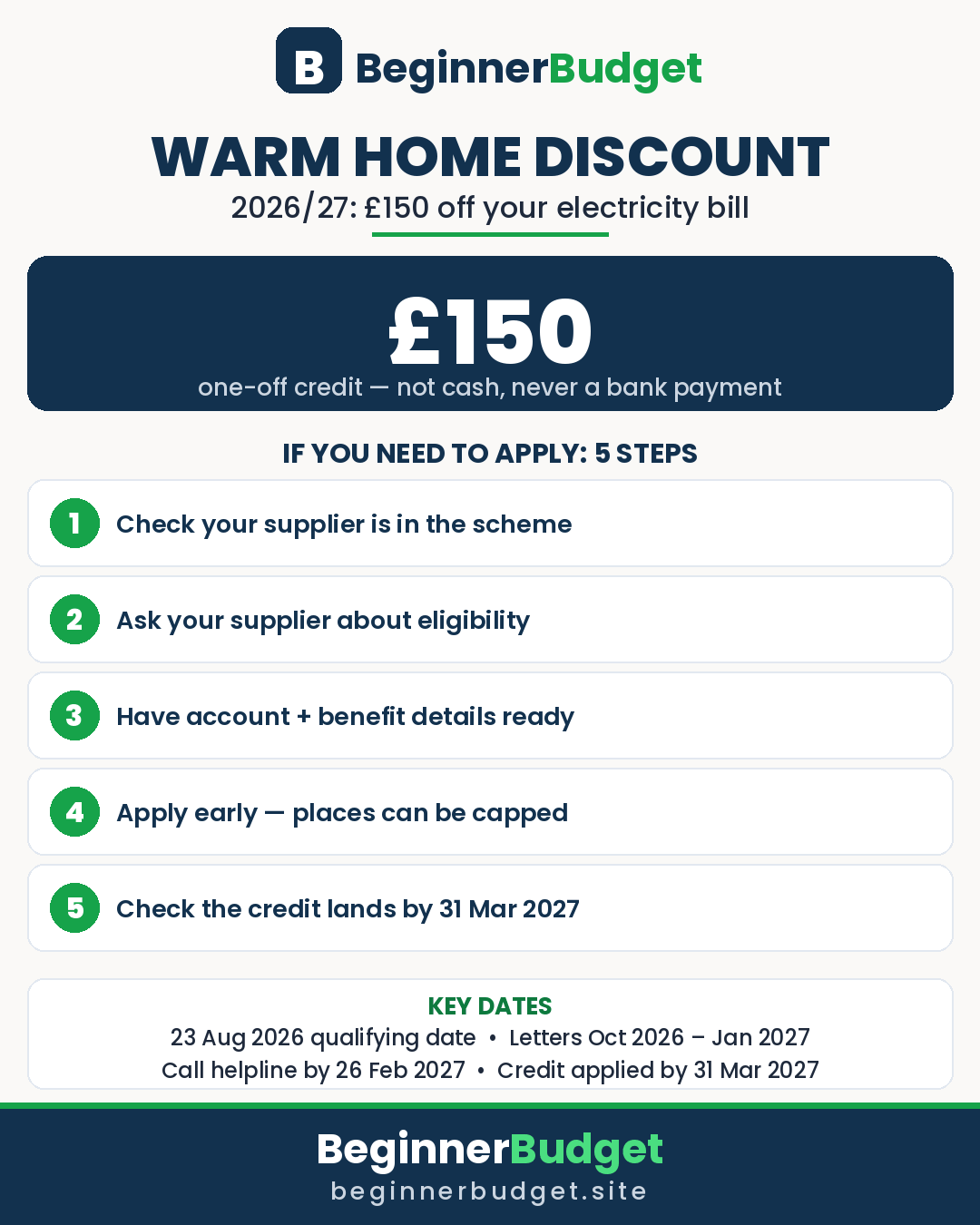
The timeline: every date that matters
Most guides bury these dates in paragraphs. Here they are, in order, because missing one of them is how people lose the money.
| Date | What happens |
|---|---|
| 23 August 2026 | Qualifying date — your benefit, supplier, and name on the bill are all checked against this date. |
| Late October 2026 – early January 2027 | Eligibility letters go out. Two types: "do nothing" or "call the helpline". |
| By 26 February 2027 | Deadline to call the helpline (0800 030 9322) if your letter asked you to confirm details. |
| By 31 March 2027 | Your supplier must have applied the £150 credit to your electricity account or meter. |
| October 2026 – March 2027 | Broader-group applications open with suppliers (exact windows vary — apply early). |
One practical tip from that table: put two reminders in your phone right now. One for early January — "Warm Home Discount letter arrived?" — and one for mid-February — "Helpline called, credit checked?" Those two checks catch nearly every way this discount goes missing.
Prepayment meters, switching, and moving house
Prepayment meters. Yes, you can still qualify with a prepay or pay-as-you-go meter — the scheme explicitly includes you. How the £150 reaches you depends on your meter. Smart prepayment customers usually get it pushed straight to the meter as credit. Traditional key or card meter customers usually get a voucher to redeem at a Post Office or PayPoint. Either way, it's the same £150, and if your supplier offers a smart meter swap, it's worth considering before the next winter window — the credit lands faster and there's no voucher to lose.
Switching supplier after 23 August 2026. If you were eligible on the qualifying date and then switched, the discount should still follow you — but the supplier who held your account on 23 August 2026 is the one the DWP matched against. Confirm with your new supplier that the credit is coming, rather than assuming the old one handled it. This is the edge case where a quick call saves a month of confusion.
Moving house. The discount attaches to the electricity account, not to you personally in the abstract. If you moved after the qualifying date, tell both your old and new supplier, and make sure the DWP and your supplier hold your current address — otherwise the letter, and the credit, can end up attached to an account you no longer hold.
Not named on the bill. If your partner is the benefit claimant and your name is on the bill (or vice versa), the match can still work — the rules look at the household, not one person in isolation. But if nobody in the household receiving the benefit is named on the bill — a landlord's name, for example — speak to your supplier about getting the claimant's name added. It's a small admin change that can be the difference between automatic and nothing.
If you're trying to cut the rest of the winter bill too, our UK energy bills winter 2026 price cap guide explains what the cap actually does to your bill, and our Winter Fuel Payment 2026 guide covers the separate payment many pensioner households get on top of this one — the two stack, and confusing them is common.

Scams: how to spot a fake Warm Home Discount message
Every winter this scheme brings a wave of scams, and this winter is worse than usual because the scheme got bigger and more people are expecting a letter. The rule is simple: the government only contacts you by hard-copy letter about the Warm Home Discount. That's it. No email, no text, no phone call, no WhatsApp message.
- Any email, text, or call claiming to be about your Warm Home Discount is a scam. Even if it uses the right logo and the right £150 figure. Delete it, don't click links, don't call numbers in the message.
- Nobody legitimate will ask for your bank details. The discount is a bill credit. Anyone asking for card numbers, bank logins, or a "processing fee" to release it is stealing from you.
- Check the number. The real helpline is 0800 030 9322. If a message gives you a different number, don't use it — look the helpline up on GOV.UK yourself.
- Unsure about a letter? Call the helpline on the number above and ask them to confirm it's genuine. That's literally what the line is for, and a two-minute call beats losing money to a convincing fake.
Scammers love a scheme where millions of people are waiting for money, because "your payment is ready" is a message people want to believe. Wanting to believe it is exactly why the letter-only rule matters.
What £150 actually does for your winter budget
Let's be straight: £150 doesn't transform a winter budget. Against a typical winter's energy costs it's a dent, not a solution. But a dent in the right place still matters, especially when it arrives as a credit you didn't have to budget for. Here's how to think about it, with an illustrative example.
Say your electricity is roughly £120 a month through winter (illustrative figure — your bill depends on your tariff and usage). A £150 credit covers about five weeks of that. If it lands in December, that's five weeks where the direct debit hurts less, or where a prepayment meter doesn't need topping up as often. The smart move, if you can manage it, is to leave the credit where it is and let it absorb the January bill — the month when heating runs hardest and money is usually tightest after Christmas.
It's also worth stacking this with the other support you may already get, rather than treating it as a one-off windfall. If you receive the Winter Fuel Payment too, the two payments land on different things — one is a bill credit, the other is a cash payment — and together they take real pressure off the coldest months. For the rest of the budget, our cost of living UK 2026 guide breaks down where a typical household's money actually goes, and our save money on groceries UK guide covers the bill most households can shrink fastest. The Warm Home Discount fixes one bill; those guides help with the rest.

Frequently Asked Questions
Do I need to apply for the Warm Home Discount?
Usually not. In England and Wales, most eligible households get it automatically — the DWP matches benefit records to supplier records and your supplier applies the credit. You need to apply only if you're in a broader group (including much of Scotland's non-automatic group), or if you think you qualify but no letter arrived.
When will I actually get the £150?
Your supplier must apply it by 31 March 2027. Most people see it between November 2026 and January 2027, either as a credit on their electricity account or, for prepayment customers, as credit on the meter or a voucher. It is not paid into your bank account.
What if I haven't received a letter by January 2027?
Call the Warm Home Discount helpline on 0800 030 9322 if you think you're eligible. Don't wait until March — the deadline to confirm details is 26 February 2027, and after that the discount can be lost.
Does the Warm Home Discount work with a prepayment meter?
Yes. Smart prepayment meters usually get the credit pushed directly to the meter. Traditional key or card meters usually get a voucher to redeem at a Post Office or PayPoint. Either way, it's the same £150.
Can I get the discount twice if I switch supplier?
No — it's one £150 per electricity account for the winter. If you switched after the 23 August 2026 qualifying date, confirm with your new supplier that the credit is coming; the supplier who held your account on the qualifying date is the one the DWP matched against.
Is the Warm Home Discount the same as the Winter Fuel Payment?
No, and this trips people up every year. The Warm Home Discount is a £150 credit on your electricity bill for low-income households on means-tested benefits. The Winter Fuel Payment is a separate cash payment, mainly for pensioner households. If you qualify for both, you get both — they stack.
What if my supplier isn't part of the scheme?
Then you can't get the discount through them, even if you receive a qualifying benefit. GOV.UK lists participating suppliers — all suppliers with more than 1,000 domestic customers must take part, so this mainly affects very small suppliers.
Does the scheme run in Northern Ireland?
No. The Warm Home Discount covers England, Scotland, and Wales. In Northern Ireland, the main alternative is the Affordable Warmth scheme — check NI Direct for its current rules.
Official sources for the figures in this article: The Warm Home Discount Scheme (GOV.UK) and Warm Home Discount (Ofgem). Scheme rules change — check GOV.UK before acting on anything here, especially if you're reading this after winter 2026/27.