
7 Best Savings Accounts UK 2026: Earn More Interest

Here's the uncomfortable truth about savings accounts: most people are earning far less than they could, and they don't know it. Your bank won't email you to say a challenger bank is paying three times your rate. This guide fixes that — the best rates in each category as of November 2026, the catches hiding behind the headlines, and a simple switching checklist that takes about twenty minutes and pays you every single month after.
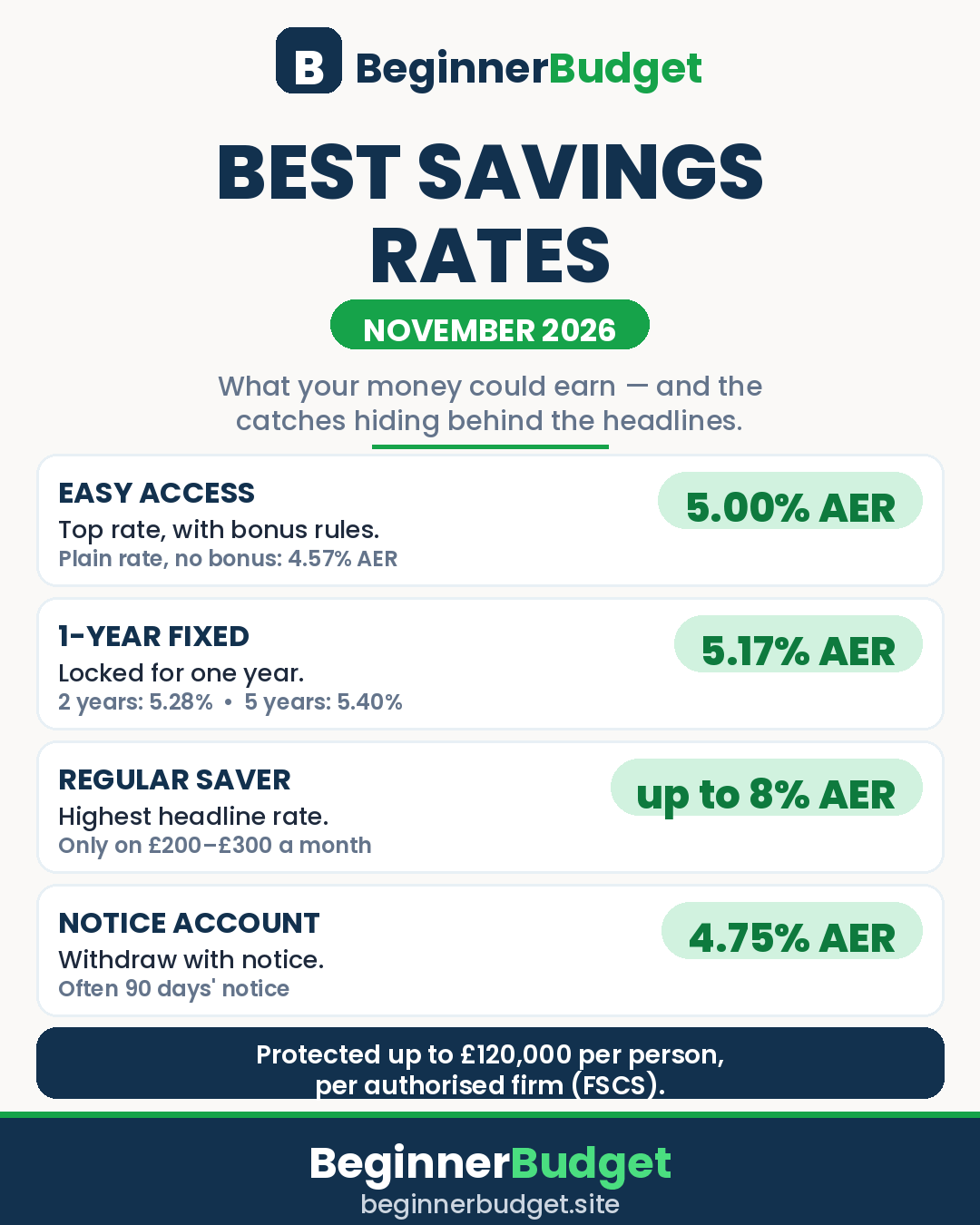
Rates at a glance: November 2026
One table, the whole market in miniature. Two warnings before you read it: first, every rate below was reported by UK comparison sites in early November 2026 and can move at any time — treat this as a snapshot, not a promise. Second, the Bank of England base rate stood at 3.75% in September 2026, with the next decision due on 5 November 2026, so the picture could shift within days of you reading this. The Bank of England's own base rate page is the one to check for the latest decision.
| Account type | Headline rate, Nov 2026 | Access | Best for |
|---|---|---|---|
| Easy access | Up to 5.00% AER (with bonus conditions); around 4.57% AER with no bonus | Instant | Emergency fund, money you might need any day |
| One-year fixed rate | Around 5.17% AER | Locked for 1 year | Money you definitely won't touch for a year |
| Two-year fixed rate | Around 5.28% AER | Locked for 2 years | Money you can leave alone longer |
| Five-year fixed rate | Around 5.40% AER | Locked for 5 years | Long-term money, if you're sure |
| Regular saver | Up to 8.00% AER | Monthly deposits, usually £200–£300 max | Building a habit from payday |
| Notice account | Around 4.75% AER | Withdraw with notice (often 90 days) | Money you can plan withdrawals for |
| Cash ISA (easy access) | Variable, typically a little below the best ordinary easy-access rates | Instant | Higher-rate taxpayers, or anyone near the tax-free interest limit |
Notice the pattern: the longer you lock money away, or the more hoops you jump through, the higher the rate. That's the whole game. The rest of this guide is about picking the right trade-off for your money, not just chasing the biggest number on the page.
What AER actually means (and why the bonus matters)
AER stands for Annual Equivalent Rate. It's the rate you'd earn over a year if the interest stayed the same and you left it in the account — including compounding, where interest itself starts earning interest. It's the only fair way to compare accounts, because it strips out whether interest is paid monthly or yearly.
Here's where beginners get caught: many headline rates include a bonus. A typical deal looks like "5.00% AER, including a 12-month bonus". That means part of the rate is temporary. When the bonus ends, your rate drops — sometimes by more than a full percentage point — and unless you move, you quietly slide onto a much worse deal. Always ask two questions before opening any account: what's the rate without the bonus, and when does the bonus end? Write the end date in your calendar the day you open the account. That one habit is worth more than picking the perfect account in the first place.
The other hidden catch is the balance cap. Some top rates only apply up to a limit — say £25,000, or £3,000, or £4,000 — and anything above it earns little or nothing. A 6% rate on £4,000 is £240 a year; a plain 4.57% rate on £20,000 is £914. The bigger balance wins, even at the lower rate. Always do the maths on your actual balance, not the headline.

Easy access: the best rates for money you might need
Easy-access accounts are where your emergency fund and your "might need it soon" money belong. You can withdraw whenever you like, with no penalty and no notice period. That flexibility costs you a little — easy-access rates sit slightly below fixed rates — but for money you can't afford to lock away, it's the only sensible home.
In early November 2026, the best easy-access headline was 5.00% AER, offered with bonus conditions — one leading example required the provider's current account and paid the top rate only up to £25,000, with a six-month bonus baked in. The best plain rate with no bonus games was around 4.57% AER, for new customers. Which one is actually better for you depends entirely on your balance and whether you'll remember to move when the bonus ends.
Our honest take: if you're the kind of person who sets things up once and forgets them — and most of us are — the plain 4.57% rate is often the better deal in practice. A bonus rate you forget to switch away from can spend most of the year paying less than the plain rate would have. If you do take a bonus deal, set the expiry reminder on day one (see the bonus-expiry trap section below).
One more thing to check: some easy-access accounts limit withdrawals per year, or pay a lower rate after a certain number of withdrawals. Read the withdrawal rules, not just the rate. An "easy access" account that quietly penalises your third withdrawal isn't as easy as it looks.
Fixed rate: lock it away, earn a little more
Fixed-rate accounts — sometimes called fixed-rate bonds — pay a guaranteed rate for a set term: one, two, three or five years. Your money is locked away for that term, and early access usually means losing interest or paying a penalty. In return, you get certainty: even if the Bank of England cuts rates tomorrow, your rate doesn't move.
Early November 2026 headlines were around 5.17% AER for one year, 5.28% for two years, and 5.40% for five years. Notice how small the jump is from one year to five: just 0.23 percentage points for four extra years of lock-in. That's why, for most beginners, a one-year fix is the sweet spot — you get most of the extra return without betting five years of your life on today's rates.
Skip a fixed rate entirely if the money is your emergency fund, a house deposit due within the term, or anything you might need in a hurry. The whole point of an emergency fund is that it's there on a bad day, not in three years' time. Our emergency fund guide walks through how much to keep instantly accessible before you even think about fixing anything.
Regular savers: the highest rates, with a catch
Regular savers pay the highest headline rates on the market — up to 8.00% AER in early November 2026 — and they're the most misunderstood accounts in this guide. The catch is the monthly cap: you can usually only pay in £200 to £300 a month, and most require you to hold the provider's current account.
That cap changes the maths completely. Put £200 a month into an 8% regular saver and you'd earn roughly £100 in interest over the year — because most of the money hasn't been in the account for the full year. Put £300 a month into a 7% account and you'd earn about £135 over the year. Those are still good returns on small amounts, and they're a brilliant way to build a saving habit, but they won't transform a £20,000 lump sum — that money needs an easy-access or fixed account instead.
Regular savers work best as a second account, not your main one: your lump sum sits in easy access or a fix, and your regular saver takes a slice of each payday and turns it into a habit. Miss a month and some accounts cut the rate, so set up a standing order for the day after payday and forget about it.
Notice accounts: the middle ground most people skip
Notice accounts sit between easy access and fixed: you can withdraw, but you have to give notice first — commonly 90 days, sometimes 30 or 120. In return you get a rate a little above easy access, around 4.75% AER in early November 2026 for a leading 90-day account.
They're genuinely underrated for one specific job: money you know you'll need on a date you can plan around. A holiday fund for next summer, a car insurance renewal, a tax bill — if you can give 90 days' notice, the extra interest is free money. They're a poor choice for emergencies, though: an emergency that gives you 90 days' warning isn't much of an emergency.
If you go for one, check what happens if you withdraw without giving notice. Some accounts just pay less interest on that withdrawal; others refuse it outright. And check the minimum balance — some notice accounts want £100 or more to open, which is fine, but a few want far more.

Cash ISA or ordinary savings account?
This is the question that decides whether a Cash ISA is worth it for you, and the answer comes down to tax. Interest on an ordinary savings account counts toward your Personal Savings Allowance: £1,000 a year tax-free for basic-rate taxpayers, £500 for higher-rate taxpayers, and £0 for additional-rate taxpayers. Interest inside a Cash ISA is always tax-free, no matter how much you earn.
Do the quick check: multiply your savings balance by your rate. If the yearly interest is comfortably below your allowance, an ordinary account paying a higher rate leaves you better off — the ISA's tax-free status is worth nothing to you if you weren't going to pay tax anyway. If your interest is near or above your allowance, the Cash ISA wins, even at a slightly lower rate, because every pound of interest above the allowance gets taxed.
Example (illustrative): £20,000 at 4.5% earns £900 a year. A basic-rate taxpayer owes nothing on that — it's inside the £1,000 allowance. But £30,000 at 4.5% earns £1,350, so £350 is taxable at 20%, costing £70. A Cash ISA at 4.3% on the same £30,000 earns £1,290 tax-free — £10 more in your pocket than the ordinary account after tax, plus no paperwork. Small differences, but they compound year after year.
If ISAs are new to you, our ISA allowance 2026/27 guide explains the full £20,000 yearly allowance and the 5 April deadline, and our Cash ISA vs Stocks and Shares ISA comparison covers when the money should stay in cash at all.
What the difference actually earns you
Rates feel abstract until you put pounds next to them. Here's what a year of interest looks like on the same money at different rates — all simple arithmetic on the stated rate, before tax, assuming the rate holds for a full year:
| Balance | At 1.5% (a typical sleepy high-street rate) | At 4.57% (a plain top easy-access rate) | Extra per year |
|---|---|---|---|
| £1,000 | £15 | £46 | £31 |
| £5,000 | £75 | £229 | £154 |
| £10,000 | £150 | £457 | £307 |
| £20,000 | £300 | £914 | £614 |
That's the real cost of leaving money in an old account you opened years ago and never reviewed: on £10,000, it's over £300 a year — £25 a month — for doing nothing except switching once. And that gap repeats every year you don't move. If your money has been sitting in the same account since before 2024, checking your rate today is probably the highest-paid twenty minutes of your month.
Where should the money live while it earns? Give every pound a job: your emergency fund in easy access, your sinking funds for predictable bills in a separate pot, and anything you won't need for a year in a fix. Our sinking funds guide shows how splitting money by purpose stops you raiding the emergency fund for a car service, and if money is tight, our guide to saving on a low income starts from where you actually are, not where a finance blog thinks you should be.
The bonus-expiry trap most guides skip
Most savings guides tell you to chase the top rate and stop there. They don't tell you what happens next — and what happens next is where banks make their money back. A bonus rate that drops from 5.00% to 3.50% after six months, on a £10,000 balance, costs you about £75 in the second half of the year compared with a plain 4.57% account. Multiply that across millions of forgetful savers and you can see why bonuses exist.
Beat the trap with a three-step system that takes five minutes when you open the account:
- Write down three things on day one: the headline rate, the rate without the bonus, and the bonus end date.
- Set two reminders: one a month before the bonus ends, one on the day itself. Your phone calendar is fine — no app needed.
- When the reminder fires, re-check the market. If your provider's underlying rate is still competitive, stay. If it isn't, switch — opening a new savings account takes minutes online and your money is never out of your control for long.
One more trap to watch: some accounts advertise a top rate that only applies if you also hold a current account, make a minimum monthly deposit, or keep the balance above a threshold. If you don't meet the condition, you get the lower rate — and the small print won't apologise. Before you apply, read the conditions as a checklist and tick each one honestly against your own situation.
The 20-minute switching checklist
Switching a savings account is nothing like switching a current account — there's no seven-day switch service, but there's also nothing to break. Your old account stays open until you move the money yourself. Here's the whole process:
- Check your current rate. Log in to your existing account and find the rate you're actually earning, not the one you signed up for years ago. That's your baseline.
- Pick the account type first, then the provider. Emergency fund? Easy access. Money for next year? One-year fix. Payday habit? Regular saver. Don't let a headline rate pick the wrong type for you.
- Confirm the rate, bonus, cap and withdrawal rules on the provider's own page. Comparison sites are a starting point, not the contract. The provider's page is the truth.
- Check the FSCS licence. Eligible deposits are protected up to £120,000 per person, per authorised firm — a limit that rose from £85,000 on 1 December 2025. Two brands can share one licence, so check the firm, not just the brand name, on the FSCS banks and building societies page. Joint accounts are covered up to £240,000.
- Open the new account, transfer the money, then leave the old account open for a week until you're sure the transfer landed and the interest is showing. Then close the old one if you like things tidy.
- Set your bonus reminder (if you took a bonus deal) before you close the tab.
That's it. No forms in the post, no phone calls, no risk to your money while it moves between two FSCS-protected accounts. And if rates fall after you fix, don't panic — a fixed rate is a contract, and your rate is locked for the term.

5 mistakes that quietly cost you interest
- Leaving everything in a current account. Current accounts are for spending, not saving. Even a good one pays far less than a dedicated savings account, and the money mixes with your spending so it quietly disappears.
- Chasing a headline rate without reading the cap. A 6% rate on £4,000 earns £240. A 4.57% rate on £20,000 earns £914. Always run the numbers on your balance.
- Forgetting a bonus expiry date. The single most expensive savings mistake, and the most common. Calendar reminder, day one, every time.
- Fixing money you might need. A fixed account that charges you interest penalties for early access can leave you worse off than easy access would have. If there's any real chance you'll need it, don't fix it.
- Keeping more than £120,000 with one banking group. Above the FSCS limit, the excess isn't protected if the firm fails. Spread larger sums across different authorised firms — and check licences, not logos.
UK vs USA: what changes
This guide is written for UK savers, and most of it doesn't transfer directly. In the USA, the equivalent protection is FDIC insurance (up to $250,000 per depositor, per bank), there's no ISA wrapper or Personal Savings Allowance, and high-yield savings accounts from online banks are the usual route to a competitive rate — the same "check the rate, check the cap, check the conditions" logic applies, but the products, tax rules and protections are different. If you're saving in the USA, look for a dedicated USA guide rather than applying UK account names to American banks. The habit, though, is universal: review your rate at least once a year, because no bank will do it for you.
Frequently Asked Questions
What is the best savings account in the UK right now?
There's no single winner — it depends on what the money is for. For money you might need any day, a top easy-access account (around 5.00% AER with bonus conditions, or around 4.57% AER with no bonus, in early November 2026) is the right home. For money you won't touch for a year, a one-year fixed account (around 5.17% AER) pays more. For a monthly habit, a regular saver (up to 8% AER on £200–£300 a month) pays the highest rate on small amounts. Pick the type first, then the provider.
How much interest will I earn on £10,000 in a savings account?
At 4.57% AER, £10,000 earns about £457 in a year, before tax. At 1.5%, the same money earns £150. The gap — £307 — is why checking your rate matters more than any budgeting trick. Your exact interest depends on whether the rate is variable, whether a bonus expires mid-year, and whether a balance cap applies.
Is my money safe in a UK savings account?
Yes, within limits: eligible deposits with an authorised UK bank or building society are protected by the Financial Services Compensation Scheme up to £120,000 per person, per authorised firm (joint accounts up to £240,000). The limit rose from £85,000 on 1 December 2025. Check the firm's licence, not just the brand — two brands can share one licence.
Should I choose a Cash ISA or an ordinary savings account?
Work out your yearly interest first. If it's below your Personal Savings Allowance (£1,000 for basic-rate taxpayers, £500 for higher-rate taxpayers), an ordinary account with a higher rate usually wins. If your interest is above the allowance, a Cash ISA wins because its interest is always tax-free. Our ISA allowance guide explains the £20,000 yearly limit in full.
Do savings rates go up and down?
Yes, if they're variable — and most easy-access rates are. Variable rates tend to follow the Bank of England base rate, which stood at 3.75% in September 2026. Fixed rates don't move during the term, which is exactly why people choose them when they think rates might fall.
Can I have more than one savings account?
Yes — as many as you like, with one exception: Cash ISAs share a single £20,000 yearly allowance across all ISAs, so you can't put £20,000 into each one. Ordinary savings accounts have no such limit, and splitting money by purpose (emergency fund, sinking funds, goals) is genuinely good practice.
What happens when my bonus rate ends?
Your rate drops to the provider's underlying rate, which can be more than a percentage point lower. Nothing else changes — the account stays open and your money stays put — but you'll earn less until you switch. Set a calendar reminder for the expiry date on the day you open the account.
Rates in this guide were reported by UK comparison sites in early November 2026 and will have moved since — always confirm the current rate, bonus terms and balance cap on the provider's own page before applying. This article is general information, not financial advice. Official sources: Bank of England base rate, FSCS deposit protection, GOV.UK Individual Savings Accounts, MoneyHelper savings accounts guide.