
What Is a Good Credit Score in the UK?

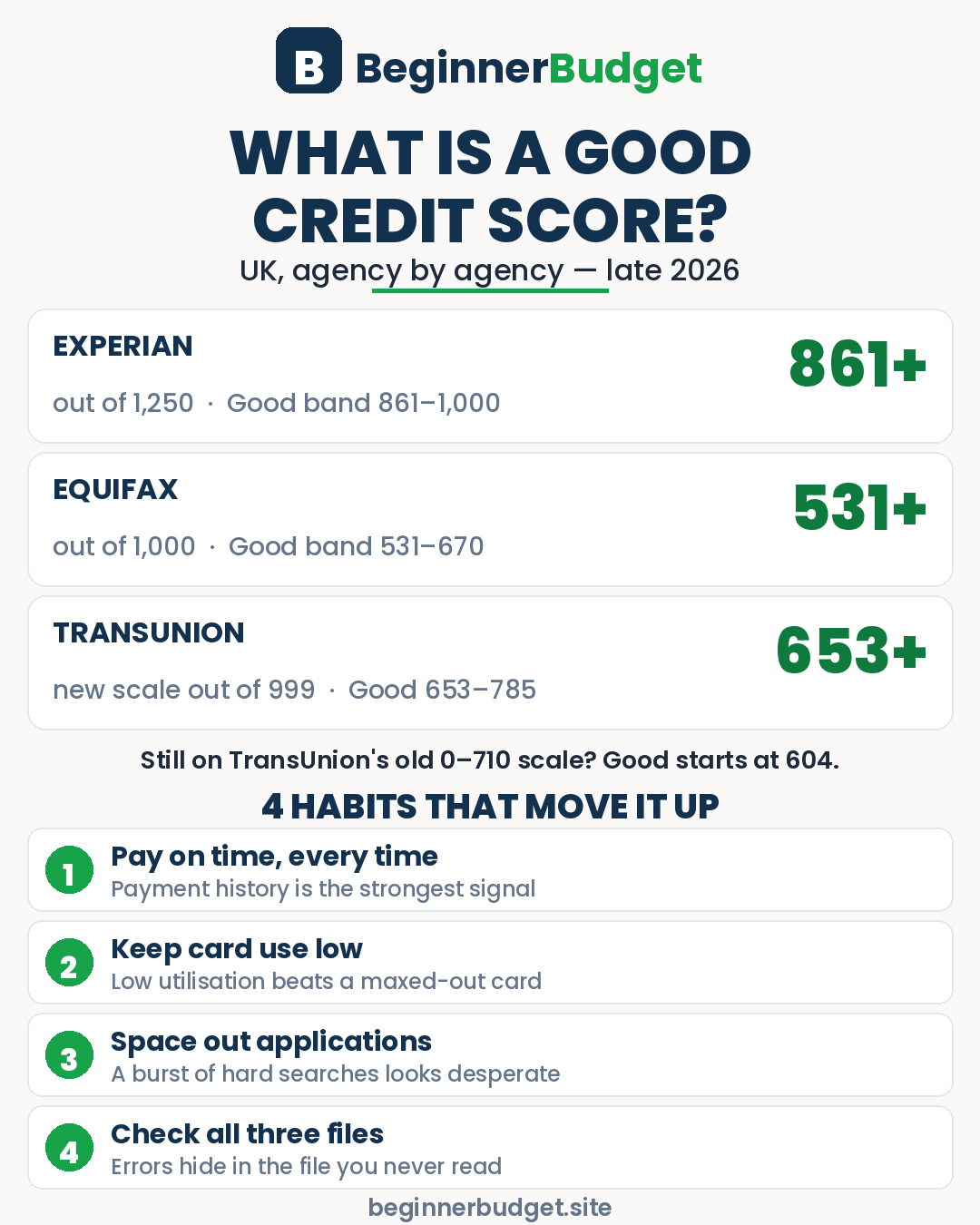
Quick answer: In the UK, a good credit score is 861 or above with Experian (out of 1,250), 531 or above with Equifax (out of 1,000), and 653 or above with TransUnion on its new 0–999 scale — or 604 or above if the site you're looking at still uses TransUnion's old 0–710 scale. There is no single UK number for "good", because the three agencies all use different scales. What matters is where you sit on your agency's scale, and whether your file underneath the number is clean.
You check your score, see a number, and feel either relieved or annoyed — and then you check a different app and get a completely different number. Both numbers can be right. That's the part nobody explains when you first look at a credit score: the UK doesn't have one credit score. It has three, made by three different companies, on three different scales, from three slightly different sets of data about you. So "what is a good credit score" only has a useful answer once you know which agency's number you're staring at. This guide gives you that answer for all three, explains why the scales changed in 2025 and 2026, and shows what a good score actually gets you when you apply for something real.
The short answer, agency by agency
If you only remember three numbers from this article, make them these. Experian calls a score good from 861 upwards, on its scale of 0 to 1,250. Equifax calls a score good from 531 upwards, on its scale of 0 to 1,000. TransUnion calls a score good from 653 upwards on its new 0 to 999 scale — but if you're looking at a site that hasn't moved to the new scale yet, good starts at 604 on the old 0 to 710 scale. Same person, same file, three different answers. That's normal, and it's not a mistake in any of the apps.
Here's the bit that actually decides whether you get approved: lenders don't use the number you see. They take the data on your file — your accounts, your payment history, your searches — and run their own scoring. Two lenders can look at the same file and reach different decisions, because they weigh things differently and they care about different risks. Your agency score is a useful summary of how your file looks. It is not the decision. A good score means your file looks healthy. A lender still checks your income, your outgoings, and whether you can afford the repayments, and a good score has never overridden an unaffordable application.
So don't chase the number for its own sake. Chase the file behind it. Pay on time, keep balances sensible, don't apply for five things in one month, and the number follows. The rest of this guide is about knowing exactly where you stand — and what to do about it if you're not where you want to be yet.
All three scales, side by side
This is the table to bookmark. Every band below comes from the agencies' own published guides, and it reflects the scales in use in late 2026 — including the changes that have left a lot of older articles out of date.
| Band | Experian (0–1,250) | Equifax (0–1,000) | TransUnion, new scale (0–999) | TransUnion, old scale (0–710) |
|---|---|---|---|---|
| Excellent | 1,121–1,250 | 811–1,000 | 786–999 | 628–710 |
| Very good | 1,001–1,120 | 671–810 | — (not used) | — (not used) |
| Good | 861–1,000 | 531–670 | 653–785 | 604–627 |
| Fair | 641–860 | 439–530 | 563–652 | 566–603 |
| Low / Poor | 0–640 | 0–438 | 488–562 (Low), 0–487 (Very low) | 551–565 (Needs some work), 0–550 (Needs work) |
Read your score against the right column and the right scale, or the whole exercise is pointless. An Experian score of 950 is good. An Equifax score of 950 is excellent. A TransUnion score of 950 is excellent on the new scale and impossible on the old one — it doesn't go that high. If a number looks wildly wrong, the first thing to check is which scale you're on, not whether your finances fell apart overnight.
One more thing worth knowing: Experian's top band used to be labelled differently, and its current bands run Low, Fair, Good, Very Good, Excellent. Equifax runs Poor, Fair, Good, Very Good, Excellent. TransUnion's new scale drops the Very Good band entirely. The labels sound similar across agencies, but they cover different ranges, so compare numbers to bands, not labels to labels.
The scale changes tripping everyone up
If you've searched this question before and got a different answer, you're not imagining it. The scales moved, and a lot of pages haven't caught up. Experian moved from a 0 to 999 scale to a 0 to 1,250 scale in November 2025, and refreshed its bands at the same time. That's why older articles say an Experian good score is 881 to 960 — that was the old scale, and it's out of date now. Your file didn't change when the scale changed. The ruler did. Experian itself estimated that 44% of people would move down a band on the new scale, 42% would move up, and 14% would stay in the same band — so if your label changed in late 2025 without you doing anything, that's probably why.
TransUnion is mid-change right now. It's rolling out a new 0 to 999 score, a process that started in September 2026 and runs in phases into 2027, and not every partner site has migrated yet. So you can genuinely see two different TransUnion numbers in two different places, on two different scales, at the same time. MoneySuperMarket, for example, still showed the old 0 to 710 scale in its guide, with good at 604 to 627. ClearScore and other newer displays show the new scale, with good at 653 to 785. Neither is wrong. They're just measuring with different rulers, and the old one is on its way out.
Equifax is the calm one. Its 0 to 1,000 scale hasn't changed, and its bands — Poor up to 438, Fair 439 to 530, Good 531 to 670, Very Good 671 to 810, Excellent 811 to 1,000 — are the same ones you'll find in guides from years ago. If you want one number that hasn't been messed about with, Equifax is it. But don't let that tempt you into only checking Equifax. Lenders can check any of the three agencies, and each one can hold slightly different information about you.
The practical rule: whenever you read a score, check the maximum. If it says "out of 1,250", you're on Experian's new scale. If it says "out of 999" for Experian, you're looking at stale information. If a TransUnion score is out of 710, it's the old scale; out of 999, it's the new one. Five seconds of checking the scale saves you from panicking over a number that means something completely different from what you think.
Why your score looks different on every site
Three agencies, three files, three scores. Each agency collects information from lenders, public records and service providers, but they don't all hear about everything at the same time, and they don't all hold exactly the same accounts. A mobile phone contract might show up with one agency before the others. A settled account might update faster in one place than another. So your Experian file and your Equifax file are cousins, not twins — and the scores built on them will differ, sometimes by a lot.
Then there's the scoring itself. Each agency weighs the same kinds of information differently. Payment history matters everywhere, but how much it matters, and how a single missed payment is weighted against years of on-time payments, varies. That's why a score of "good" with one agency and "fair" with another doesn't mean one of them is broken. It means they disagree about how much weight to give something in your file — and the only way to know what that something is, is to read the file itself, not just the headline number.
There's also a trap in free score apps: some show you a score from one agency and present it as "your credit score", full stop. It isn't. It's one agency's view. If you're about to apply for a mortgage, check all three, because you don't get to pick which agency the lender checks. Our guide to checking your credit score free in the UK walks through where to see each agency's version without paying, and our Experian vs ClearScore vs Credit Karma comparison explains which agency sits behind each free service.

What a good score actually gets you
A good score doesn't hand you money. It changes the terms on which money is offered to you, and over a mortgage or a loan, those terms are worth real amounts. Here's what a good score generally opens up, and where it stops mattering.
| What you're applying for | What a good score usually means | What still matters just as much |
|---|---|---|
| Mortgage | Access to a wider range of deals and, often, lower rates than someone with a fair score | Deposit size, income, outgoings, and the property itself |
| Credit card | Better chance of the advertised rate and a higher starting limit | Income and existing card balances |
| Personal loan | More lenders willing to lend, and cheaper rates on offer | Affordability — whether repayments fit your budget |
| Phone contract | Smoother approval for handset plans, which are a form of credit | Usually a lighter check than a loan or mortgage |
| Renting | Some landlords and agents run checks; a clean file helps | References, income, and deposit |
The honest version of the sales pitch: a good score saves you money mainly through interest rates. Borrow at a lower rate and every pound borrowed costs less to pay back. The gap between the best advertised rate and the rate offered to someone with a poor file can be enormous on the same product — that's not a scare story, it's how risk-based pricing works. Lenders charge more when they think there's more chance they won't get paid back. A good score tells them the chance looks low.
But a good score is not a guarantee of anything. Lenders still decline people with good scores, usually on affordability: the repayments don't fit the income and outgoings, or there's something specific in the file — a recent default, a county court judgment, a pattern of applications — that the headline number smooths over. And the reverse is true too. People with fair scores get approved every day, sometimes at a higher rate, sometimes with a smaller limit, sometimes after providing more documents. A good score improves your odds. It doesn't decide the outcome on its own.
What moves your score up or down
Scores move for boring reasons, and that's good news, because boring reasons are fixable. The factors below are the ones the agencies themselves point to, and they show up in every agency's guidance in roughly the same order of importance.
Payment history is the big one. Paying on time, every time, is the single strongest signal in your file. Missed payments, accounts in arrears, county court judgments and bankruptcy all drag a score down, and negative markers like these can stay on your file for up to six years. One missed payment on an otherwise clean file is a dent, not a disaster — but a pattern of them is exactly what lenders are screening for.
How much of your available credit you use matters more than people expect. Your utilisation ratio is just the amount you're borrowing divided by your total credit limit, expressed as a percentage. Lower is generally better, because it shows you're not stretched. A widely used rule of thumb is to keep utilisation low rather than maxing cards out, even if you pay them off — a card sitting at 90% of its limit looks stretched on the day the agency takes its snapshot, whether or not you clear it later.
Length of history counts. If you have no credit history at all, there's nothing to score, and it takes around six months after opening a credit account before a score even appears. From there, building a high score takes time — years, not weeks — because lenders trust a long record of steady behaviour more than a short one. That's why closing your oldest card to "tidy up" can backfire: you just shortened your history.
Applications in a burst hurt. Every formal application leaves a hard search, and lenders can see those. A lot of hard searches in a short space of time looks like someone being turned down repeatedly, and it can pull a score down. Space applications out, use eligibility checkers first — those are soft searches and don't touch your score — and don't apply for things you don't need. Our guide on whether checking your credit score affects it explains the soft vs hard search split in full.
Being on the electoral roll helps, and it's free. It takes minutes to register, and it helps agencies confirm you live where you say you live. It's one of the easiest wins in the whole credit-score world, and it's the first thing to check if your score seems stuck for no obvious reason. The same goes for financial links: a joint account or mortgage with an ex-partner can still influence how lenders see you, and you can ask agencies to add a notice of disassociation once the link is genuinely over.
UK vs USA: how "good" compares
If you're comparing notes with someone in the USA, the numbers won't line up at all, because the USA uses a different system. The main US score is FICO, which runs from 300 to 850. On FICO's published bands, Good is 670 to 739, Very Good is 740 to 799, and Exceptional is 800 to 850. Below that, Fair is 580 to 669 and Poor is 300 to 579. So an American saying "my score is 720" is saying something roughly equivalent to a UK "good" — but the scales, the agencies (Equifax, Experian and TransUnion again, but scoring differently in the US) and the rules are all different.
The idea underneath is the same, though: pay on time, don't max out your cards, don't apply for everything at once, and let time do its work. The UK/USA difference that actually catches people out is that a UK score means nothing in the USA and vice versa. Move countries and you start from scratch, credit-wise, no matter how spotless your file was at home. That's worth knowing before you move, not after.

How to check yours for free
You don't need to pay anyone to see your scores. Experian shows your Experian score free through its own app and site. ClearScore shows your Equifax score free. Credit Karma shows your TransUnion score free. Between those three, you can see all three agencies' numbers without spending a penny, and checking your own file never affects your score — those are soft searches, invisible to lenders. If a site tries to charge you for the number alone, skip it; the number is free everywhere that matters.
Check monthly, and check all three a few months before any big application. You're not just looking at the number — you're looking for errors. Wrong addresses, accounts you don't recognise, a default that isn't yours: these show up on real files, and they drag scores down until someone disputes them. A dispute with the agency, with evidence, is how errors get fixed. It takes some patience, but it's free, and it's the highest-value credit-score task most people never do.
From fair to good: a 90-day plan
Scores don't jump overnight, and anyone promising a fast fix is selling something. But ninety days of steady behaviour is enough to see real movement, especially if you're starting from fair rather than poor. Here's a plan that costs nothing and covers the levers that actually move the needle.
Days 1–7: get the full picture. Pull all three free scores and read all three files, not just the numbers. Register on the electoral roll if you aren't already. List every account, every balance, every limit, and work out your utilisation on each card. Flag anything wrong for dispute straight away — errors are the fastest win available, because fixing one can move a score more than months of good behaviour.
Days 8–30: stop the leaks. Set up direct debits for at least the minimum payment on every account, so a missed payment becomes nearly impossible. Pay down the card with the highest utilisation first, or spread payments so no single card sits near its limit. Don't apply for any new credit during this window unless you genuinely need it, and use eligibility checkers instead of formal applications when you're comparing deals.
Days 31–90: build the record. Keep using one card for small, regular spending and clearing it in full — that builds payment history without building debt. Don't close old accounts, even ones you barely use; they lengthen your history. Check your scores again at day 90 and compare like with like: same agency, same scale. If you've moved from fair into good on one agency but not the others, that's normal — files update at different speeds, and the laggard usually catches up.
If you're starting from a low score rather than fair, the same plan still applies, but the timeline stretches. Our guide to improving your credit score in the UK covers the longer rebuild, including credit-builder cards and what to do about defaults. And if debt itself is the problem, not the score, start with paying off debt fast — a score built on unaffordable borrowing isn't a good score, it's a trap.
What score do you need for a mortgage, card or loan?
There is no published minimum score for any of these, and any article that gives you one exact number is guessing. Lenders use their own scoring, not the agency's, and they combine it with affordability checks. But the bands give you a realistic sense of where you stand, and here's how to read them for each product.
Mortgages: a good score or better puts you in the range where most mainstream deals are open to you, though the best rates usually go to very good and excellent files with a solid deposit. A fair score doesn't rule a mortgage out — specialist lenders exist for exactly this — but expect fewer choices and higher rates. A low score with a recent default is the hardest combination, and that's where a broker earns their fee: they know which lenders will look at your specific file.
Credit cards: good is usually enough for mainstream cards at reasonable rates, while the headline 0% balance-transfer and rewards cards tend to go to very good and excellent files. If you're in the fair band, a credit-builder card — low limit, high rate, used carefully and cleared monthly — is the standard route up, not a punishment. Use it for a small regular payment, clear it in full, and let the history build.
Personal loans: good opens up most mainstream lenders, and the advertised representative APR is the rate at least 51% of successful applicants get — so even with a good score, you might be offered something higher. Fair means fewer lenders and higher rates, and it's worth checking whether you actually need the loan at all before accepting an expensive one. A loan taken to fix a score is a bad reason for a loan.
Phone contracts and renting: these are lighter checks. A fair score rarely blocks a phone contract on its own, and most landlords care more about income, references and deposit than about your exact band. If a check does cause a problem, it's usually something specific in the file — an unpaid bill, a default — rather than the band itself. Fix the specific thing, not the number.
Mistakes that keep a good score out of reach
Only checking one agency. Your lender might check a different one, and the one you never look at is the one holding the error. Check all three before anything big.
Applying everywhere at once. Five applications in a month looks desperate to the next lender who checks. Use eligibility checkers, shortlist one or two, and apply once. If you're declined, stop and find out why before applying somewhere else.
Maxing out a card you pay off monthly. The agency snapshots your balance before you pay it. A card at 95% of its limit looks stretched on snapshot day, even if you clear it every month. Pay mid-cycle, or spread spending across cards, if utilisation is holding you back.
Closing old accounts to "tidy up". That shortens your credit history and can cut your total available credit, which pushes utilisation up on the cards that remain. Keep old cards open, use them occasionally, and let them age.
Ignoring the file and watching the number. The number is a summary. The file is the thing lenders actually read. A wrong default, a financial link to an ex, an address you've never lived at — these are file problems, and no amount of on-time payments fixes them until you dispute them.
Paying for a score you can see free. The number is free from Experian, ClearScore and Credit Karma. Paid services can be worth it for monitoring extras, but don't pay just to see a number — and never pay someone who promises to "repair" your score. The only repair is time, corrected errors, and steady behaviour.
Frequently asked questions
What is a good credit score in the UK?
It depends on the agency: 861 or above with Experian (out of 1,250), 531 or above with Equifax (out of 1,000), and 653 or above with TransUnion on its new 0–999 scale (604 or above on the old 0–710 scale). There is no single UK number, because each agency uses its own scale.
Is 700 a good credit score in the UK?
With Equifax, yes — 700 sits in the Very Good band (671–810). With Experian, 700 is Fair (641–860). With TransUnion's new scale, 700 is Good (653–785), and on the old 710 scale it's Excellent (628–710). Same number, three different answers — always check which agency and scale you're looking at.
What is a good credit score for a mortgage?
There's no official minimum. Lenders score your file themselves and check affordability, deposit and income alongside it. As a rough guide, a good score or better opens up most mainstream mortgage deals, while fair scores usually mean fewer choices, higher rates, or a specialist lender. A good score helps, but it never guarantees approval.
Can I get a credit card with a fair credit score?
Yes. Fair scores still get approved for many cards, though often with lower limits and higher rates than the headline deals. If mainstream cards keep declining you, a credit-builder card used for small spending and cleared in full each month is the usual route to a better band.
How long does it take to get a good credit score?
From scratch, around six months after opening a credit account before a score appears at all, and longer to reach good. From fair, ninety days of on-time payments, lower utilisation and no new applications can move things noticeably. From low, think months to years, because negative markers can stay on your file for up to six years.
Does checking my credit score lower it?
No. Checking your own score or report is a soft search, which never affects your score and isn't visible to lenders. You can check all three agencies as often as you like. Only formal applications leave hard searches, and those are the ones to space out.
Your next step
Stop guessing which number you're looking at. Open your free scores, check which scale each one uses, and read the band — not just the number. If you're already good on all three, your job is maintenance: pay on time, keep utilisation low, and check in monthly. If you're fair on one or more, the 90-day plan above is your starting point, and the fastest win is usually an error you haven't spotted yet. And if a number suddenly looks wrong, check the scale first. In 2026, the ruler changed more often than the file did.
Sources: Experian's guide to a good credit score, Equifax's guide to credit scores, ClearScore's guide to good and bad scores, and MoneySuperMarket's guide to good credit scores. Band figures are the agencies' published bands as of late 2026; TransUnion's new 0–999 scale is still rolling out, so some sites still show the old 0–710 scale.
Experian: What is a good credit score? · Equifax: Why is my credit score going down? · MoneySuperMarket: What is a good credit score?