
7 Lifetime ISA Rules UK 2026: Get Your £1,000 Bonus

Here's the honest version of the Lifetime ISA: it's the most generous savings deal the UK government offers ordinary savers — free money, every year, for doing something you were going to do anyway. It's also the easiest one to get wrong, because the money is locked away behind rules that punish you for changing your mind. This guide gives you the seven rules, the real maths, the £450,000 trap that catches London buyers, and the April 2029 change that means the clock is now ticking on opening one at all.
What a Lifetime ISA actually is
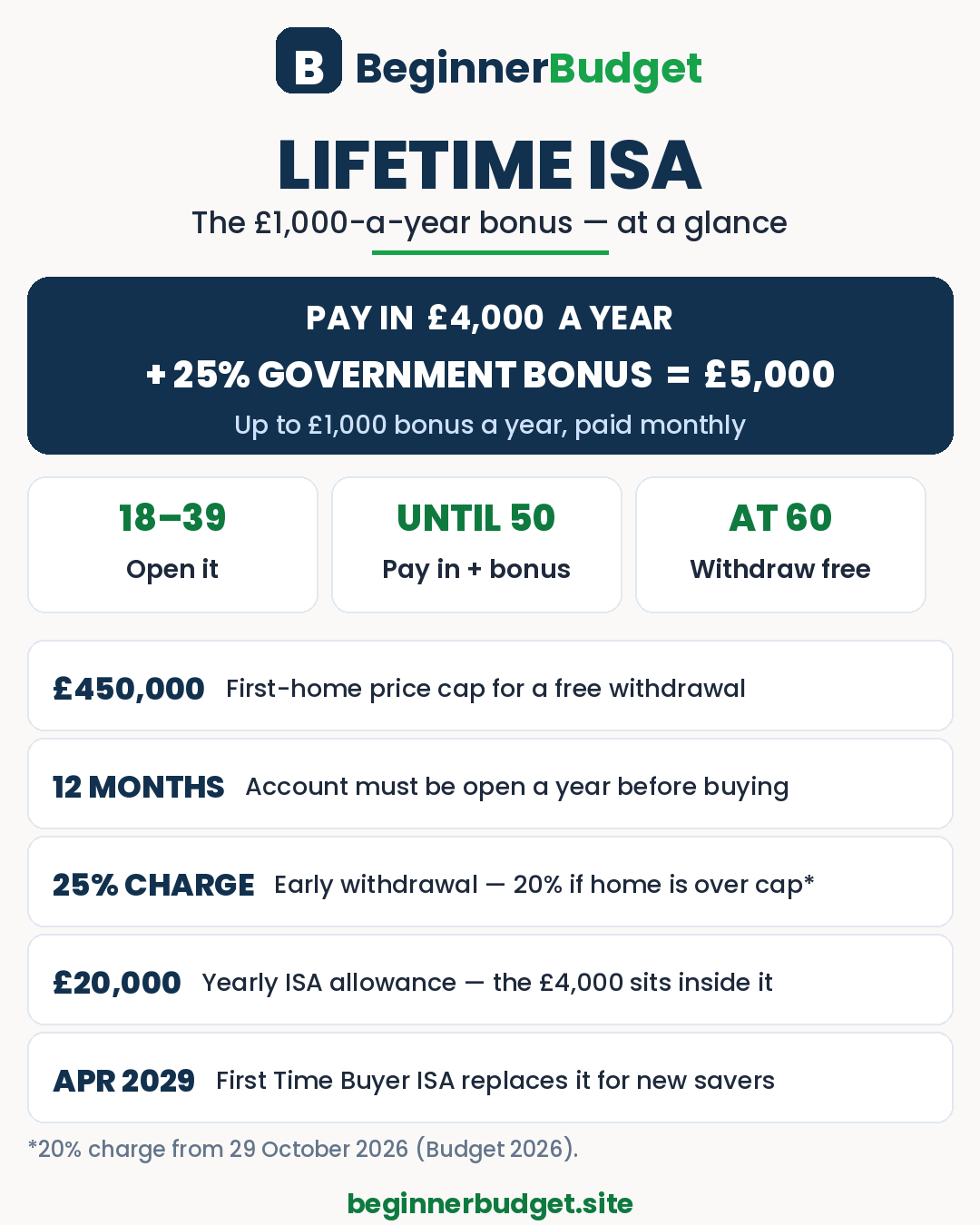
Forget the name for a second. A Lifetime ISA is a tax-free wrapper — a box the government lets you put money in — with one unusual feature: every time you put money in, the government tops it up by a quarter. Put in £4,000, get £1,000 free. Put in £400, get £100. There is no other mainstream UK savings account that does that, which is why the LISA keeps showing up in "best account" lists despite its strict rules.
It comes in two flavours. A Cash LISA works like a savings account: your money earns interest, and the amount never falls. A Stocks & Shares LISA invests your money in shares and funds: it can grow faster over long periods, and it can fall — sometimes sharply. You can hold one of each across different tax years if you like, but you can only pay into one LISA per tax year. The £4,000 you put in counts toward your overall ISA allowance 2026/27 of £20,000, so if you max out a LISA you have £16,000 left for everything else.
The LISA was launched in April 2017 to replace the Help to Buy ISA for new savers, and it's built for exactly two jobs: buying a first home, or saving for later life. That's it. It's not an emergency fund, it's not a holiday fund, and it's not a flexible savings pot you dip into when the car breaks down. Every rule below exists to enforce that.

The 7 rules, on one screen
Everything else in this guide is these seven rules, explained. If you only read one section, read this one.
| Rule | What it means |
|---|---|
| 1. Age window | You must be 18 to 39 to open one, and you must make your first payment before you turn 40. |
| 2. Yearly limit | Up to £4,000 per tax year (6 April to 5 April). This counts toward your £20,000 ISA allowance. |
| 3. The bonus | 25% on what you pay in, up to £1,000 a year, paid monthly — you don't wait until year-end. |
| 4. Pay-in deadline | You can pay in and earn the bonus until you turn 50. After that the account stays open and keeps earning interest or returns, but no new payments, no new bonus. |
| 5. The 12-month rule | You can only use it for a first home if you buy at least 12 months after your first payment into the LISA. |
| 6. The price cap | The home must cost £450,000 or less for a charge-free withdrawal. Above that, a 20% charge applies since 29 October 2026. |
| 7. The exit doors | Charge-free exits: a qualifying first home, age 60+, or terminal illness with less than 12 months to live. Anything else before 60: 25% charge. |
Two details people miss. First, anyone can gift you money to pay into your LISA — parents, grandparents, anyone — but they can't open or manage it for you. Second, you must be a UK resident to open and keep paying in, with the usual exception for armed forces and Crown servants (and their spouses or civil partners) posted overseas. GOV.UK's Lifetime ISA guide is the official source for all seven rules, and it's worth a read before you open anything.
The bonus maths: what £200 a month really becomes
Forget interest and investment growth for a minute — the bonus alone is worth seeing clearly. These are illustrative examples, not forecasts: they show the bonus maths with no growth at all, so you can see exactly what the government adds.
| You pay in | Government bonus (25%) | Pot before any interest |
|---|---|---|
| £100 a month (£1,200 a year) | £300 a year | £1,500 a year |
| £200 a month (£2,400 a year) | £600 a year | £3,000 a year |
| £333 a month (£4,000 a year) | £1,000 a year | £5,000 a year |
Stretch that £200 a month over five years and you've paid in £12,000, the government has added £3,000, and your pot is £15,000 before a penny of interest. Stretch the maximum over the full window — £4,000 a year from age 18 to 50 — and that's £128,000 of your money plus £32,000 of bonus, £160,000 before growth. Nobody's saying you'll actually do that; the point is the scale. A regular Cash ISA paying interest alone can't touch a guaranteed 25% top-up, which is exactly why the lock-in exists: the government isn't giving away free money for flexible spending.
One practical note: the bonus is calculated month by month on payments made between the 6th of one month and the 5th of the next, and it's paid monthly. So money you pay in doesn't sit bonus-less until April — it starts working within weeks.

The penalty maths nobody shows you first
Here's the part most articles bury: the 25% charge applies to the whole withdrawal, including the bonus. That's why it takes more than the bonus back. GOV.UK's own examples make it plain:
- Pay in £800, get £200 bonus, pot £1,000. Withdraw it all for a non-qualifying reason and the 25% charge is £250. You walk away with £750 — £50 less than you put in.
- Pay in £4,000, get £1,000 bonus, pot £5,000. Withdraw it all and the charge is £1,250. You walk away with £3,750 — £250 less than you put in.
That's the honest cost of changing your mind. It's not "you lose the bonus." It's "you lose the bonus and some of your own savings." And if you only need part of the money — say a £120 bill — you'd have to withdraw £160, pay £40 in charges, and keep £120. The charge scales with whatever you take out, so small emergency dips are punished just as hard as big ones.
There's one softer case, and it's new. Since 29 October 2026, if you use a LISA to buy a first home costing more than £450,000, the charge is 20% instead of 25%. On that same £5,000 pot, a 20% charge is £1,000 — you get your £4,000 back and lose only the bonus. That's a real improvement for buyers who creep over the cap, but it's still £1,000 gone, and it only applies to a genuine home purchase that meets the other conditions. Every other early withdrawal still carries the full 25%.
The lesson is blunt: don't put money into a LISA that you might need before 60 unless you're confident it's going toward a qualifying first home. Your emergency fund comes first — always. If you haven't got one yet, build an emergency fund from zero before you lock money into a LISA.
The £450,000 cap trap
The cap hasn't moved since the LISA launched in 2017. House prices have. That's the trap, and it matters most in London and the South East, where a modest first flat can sail past £450,000 without trying. Before you open a LISA, do this one check: look at what homes you'd actually buy in the area you'd actually live in, not the national average. If everything realistic sits above £450,000, the LISA's first-home door is closed to you — you'd either pay the 20% charge on a purchase above the cap, or leave the money locked until 60.
That doesn't automatically kill the LISA. If you're saving for retirement anyway, the bonus still works — you just wait until 60. But be honest with yourself about which door you're saving toward. "Maybe a house, maybe retirement" is fine as long as you're comfortable with the 60 door being the fallback. What isn't fine is assuming the cap will rise to rescue you. It hasn't in nine years, and the replacement product announced for 2029 keeps the same £450,000 cap.
One more cap detail: if you're buying with someone else, the cap applies to the property price, not to each buyer — but you can both use your own LISAs toward the same purchase, as long as you're both first-time buyers meeting every condition. Two LISAs, two bonuses, one £450,000 ceiling.
LISA vs Cash ISA vs pension
The LISA doesn't exist in a vacuum. Here's how it stacks up against the two things people usually compare it with:
| Lifetime ISA | Cash ISA | Workplace pension | |
|---|---|---|---|
| Government/employer top-up | 25% bonus, up to £1,000/year | None — interest only | Employer contributions + tax relief |
| Access | First home or age 60, else 25% charge | Anytime (easy access) | Usually 55+, rising to 57 |
| Yearly limit | £4,000 (inside £20,000 ISA allowance) | £20,000 total ISA allowance | Up to £60,000 annual allowance (2026/27 rules) |
| Best for | First-home deposit or extra retirement saving | Money you may need soon | Retirement — especially with an employer match |
The pension row is the one to take seriously. If your employer matches pension contributions and you're not taking the full match, take the match first — that's free money with no 25% trapdoor, and walking away from it to fund a LISA is a bad trade. The LISA shines as the second pot: deposit saving while your pension ticks along, or extra retirement saving on top of a pension you're already funding properly. And if your timeline is under five years and the money must be there no matter what, a plain Cash ISA — or one of the best high-interest savings accounts UK 2026 — beats a LISA every time, because flexibility is worth more than a bonus you might have to hand back.
Using it to buy your first home, step by step
When the day comes, don't just withdraw the money. That's the single most expensive mistake in this whole guide — a DIY withdrawal triggers the charge even if you're buying a qualifying home. Here's the right order:
- Check the 12-month rule. Your first LISA payment must be at least 12 months before the purchase. Open the account early even if you're only putting £1 in — the clock starts with the first payment, not with the first serious deposit.
- Check every condition. UK property, first home you've ever owned anywhere in the world (including inherited property or a share of one), bought with a mortgage (not cash, not a mortgage from a close relative), you'll live in it, and it costs £450,000 or less for a charge-free withdrawal.
- Tell your provider, not your bank. Ask your LISA provider to pay the funds directly to your conveyancer or solicitor. The money goes to them, not to you.
- Use it for the exchange deposit. The funds can be used for the deposit you hand over at exchange, and this usually needs to happen within 90 days of completion.
- If the purchase falls through, the money goes back. Funds returned to your LISA after a failed purchase don't trigger the charge — tell your provider and solicitor straight away so the return is handled properly.
There's a reason for the rigmarole: the provider-to-solicitor route is what proves the money went to a qualifying purchase. Skip it, withdraw to your own account, and you've just bought yourself a 25% charge on your own deposit.

Cash LISA or Stocks & Shares LISA?
Same rules, different engine. Pick by date, not by hype:
- Buying within about five years? Cash LISA. Your deposit can't fall just before you need it. Providers in this space include names like Moneybox, Paragon and Newcastle Building Society — compare the interest rate, but remember the bonus is the same 25% wherever you go.
- Saving for retirement at 60, or buying a decade away? Stocks & Shares LISA is worth considering. Investment platforms such as Hargreaves Lansdown, AJ Bell and Nutmeg offer them. Over long periods investments have historically grown more than cash, with falls along the way — and if you're decades from needing the money, you can ride those out.
- Not sure which job the money is for? Start with cash. You can transfer to a Stocks & Shares LISA later through the proper transfer process (below). What you can't do is undo a market fall that lands the month before exchange of contracts.
One thing to check on any Cash LISA: the interest rate. The bonus gets the headlines, but a Cash LISA paying well below the Cash ISA vs Stocks and Shares ISA market still leaves money on the table year after year. The bonus is fixed at 25%; the interest isn't, so compare both.
Transfers and the old Help to Buy ISA
You can move a LISA between providers — and you should, if a better rate appears. But do it the right way: ask the new provider to run the transfer. Never withdraw the money and re-pay it yourself. A DIY move counts as an unauthorised withdrawal, triggers the 25% charge, and can eat into your yearly allowance for no reason. Cash transfers usually take a couple of weeks; investment transfers take longer, because holdings have to be sold or moved.
If you still hold a Help to Buy ISA from before they closed to new savers in November 2019, you can keep saving into it until November 2029 and claim its bonus until December 2030 — but you can only use one bonus toward a home purchase, not both. You can transfer Help to Buy money into a LISA, but only £4,000 per tax year counts toward the LISA limit, so a bigger balance takes more than one tax year to move. And you can't transfer a LISA into a Help to Buy ISA without paying the 25% charge. If you're sitting on both, get the transfer order right before you move anything.
April 2029: the First Time Buyer ISA is coming
At Budget 2026 on 28 October 2026, the government announced that a new First Time Buyer ISA will replace the Lifetime ISA for new savers from April 2029. Here's what that means, based on the announcement:
- Same £4,000 yearly limit, same 25% bonus, same £450,000 property cap.
- The bonus is paid when you withdraw for a qualifying first home — not as you save — and it's calculated on the account's final balance, capped at £20,000 total.
- No upper age limit: anyone 18 or over can open one, so the under-40 cutoff disappears.
- There's no withdrawal charge on the new product, because the bonus only arrives when you actually buy.
- You can't transfer between a LISA and the new ISA, but you can use both toward the same purchase.
- Existing LISA holders keep their current rules — your account doesn't get converted or closed.
So what should you do? If you're under 40 and buying in the next few years, open a LISA now — you lock in the current rules, start the 12-month clock, and start collecting the monthly bonus today. Waiting until 2029 for an account that doesn't exist yet, while your purchase gets closer, is a strange trade. If you're over 40, the new ISA is genuinely good news: it's the first time the 25% bonus will be open to you at all, just with a wait until April 2029. And if you're under 40 but not sure you'll ever buy, the LISA's retirement door (age 60) still works — the new product, as announced, is first-home only, so it won't replace that second use.
Who should skip it
The LISA is a bad fit if any of these sound like you — and saying so isn't a contradiction, it's the point of understanding the rules:
- You might need the money before 60 and not for a house. A career break, a business idea, a long trip — all fine reasons to want flexible money, all punished by the 25% charge inside a LISA.
- Your first home will almost certainly cost more than £450,000. You'd either pay the 20% charge or wait until 60. A flexible Cash ISA keeps every option open.
- You're over 40. You can't open one at all. Wait for the First Time Buyer ISA in April 2029, and save flexibly in the meantime.
- You haven't taken your full employer pension match. Fix that first. Free employer money beats a LISA bonus that comes with a trapdoor.
- You don't have an emergency fund. A LISA is the worst emergency fund in the UK. Build the buffer first, then lock money away.
Skipping it isn't missing out. It's choosing the right tool. The people who get burned by LISAs aren't the ones who never opened one — they're the ones who opened one for the bonus and discovered the lock-in at the worst possible moment.
Opening one: the 10-minute checklist
- Confirm you're 18–39, UK resident, and a first-time buyer (or saving for retirement to 60).
- Check realistic house prices where you'd buy against the £450,000 cap.
- Decide cash vs Stocks & Shares by your date, not by a headline rate.
- Compare providers on interest rate (cash) or fees (investments) — the 25% bonus is identical everywhere.
- Apply online with ID, address and National Insurance number. You can start with as little as £1.
- Set up a monthly payment — even £50 a month earns a £12.50 monthly bonus, and the habit matters more than the amount.
- Put the 12-month date in your diary: first payment date plus one year is the earliest you can use it for a home.
- Keep your emergency fund somewhere else entirely. Never in the LISA.
5 mistakes that cost people real money
- Withdrawing for the house yourself. Always go provider-to-solicitor. A DIY withdrawal is a 25% charge on your own deposit.
- Opening it the month you start house-hunting. The 12-month rule means a brand-new LISA can't be used for a purchase this year. Open it early, even with £1.
- Paying into two LISAs in one tax year. One LISA per tax year — split across providers and you've broken the rule.
- Treating it as an emergency fund. The charge turns a £1,000 emergency into a £1,333 withdrawal. Keep emergencies in easy-access savings.
- Ignoring the £450,000 cap until offer stage. Discovering the cap when you've found the house is too late. Check prices before you save, not after.
UK vs USA: what changes
The Lifetime ISA is UK-only — there's no American version. If you're reading from the USA, the closest equivalent is a Roth IRA, which lets first-time buyers take out a limited amount penalty-free toward a home, but the rules, limits and tax treatment are entirely different, and there's no 25% government bonus. If you're a UK reader living in the USA, or the other way round, don't assume an ISA travels with you: tax residency decides which wrappers work and what gets taxed where, so that's a conversation for a qualified adviser before you pay anything in.
Frequently Asked Questions
Can I open a Lifetime ISA if I'm over 40?
No — you must be 18 to 39 when you open one, and you must make your first payment before you turn 40. The First Time Buyer ISA arriving in April 2029 will have no upper age limit, so over-40s will get their first shot at the 25% bonus then.
Can I use a Lifetime ISA if the house costs more than £450,000?
Yes, since 29 October 2026, but with a 20% withdrawal charge instead of a charge-free withdrawal. On a £5,000 pot that's £1,000 — you get your own £4,000 back and lose the bonus. Other early withdrawals still carry the full 25% charge.
What happens if I withdraw from my Lifetime ISA early?
Unless you're buying a qualifying first home, aged 60 or over, or terminally ill with less than 12 months to live, you'll pay a 25% charge on the full amount withdrawn — including the bonus. On a £5,000 pot (£4,000 paid in plus £1,000 bonus), that's £1,250, leaving £3,750: less than you put in.
Can I have a Lifetime ISA and a Cash ISA in the same year?
Yes. You can pay into both in the same tax year as long as the total across all your ISAs stays within the £20,000 allowance — for example, £4,000 in a LISA and £16,000 in a Cash ISA. You just can't pay into two LISAs in one tax year.
When is the Lifetime ISA bonus actually paid?
Monthly. HMRC calculates it on payments made between the 6th of one month and the 5th of the next, so you don't wait until the end of the tax year to see it.
Can my partner and I both use Lifetime ISAs for the same house?
Yes, if you're both first-time buyers meeting every condition. You each get your own £4,000 limit and your own bonus — two LISAs can double the deposit help on one property, subject to the single £450,000 price cap.
Should I open a Lifetime ISA now or wait for the First Time Buyer ISA?
If you're under 40 and buying in the next few years, open a LISA now: the bonus starts immediately, the 12-month clock starts now, and existing holders keep current rules after 2029. If you're over 40, or your purchase is many years away, the 2029 product may suit you better — but don't let a future product stop you saving flexibly today.
Official sources for the figures in this article: Lifetime ISA (GOV.UK) and Lifetime ISAs (MoneyHelper). Tax rules change — check GOV.UK before acting on anything here, and consider regulated advice for large or complex decisions.